

This review paper will cover areas of research on
the redox behavior of quinones from a simulation
point of view. The aim of this paper is to provide
an indepth understanding of specific aspects of the
reduction of quinones on different electrodes using
different electrolytes and solvents by using different
computational approaches. We will make an introduction on the chemistry of quinones, then the core
background for arriving at redox potentials, followed
by the description of the thermodynamic cycle in varied redox potential prediction approaches. This will
focus on how these computational research results are
applied to redox potentials predictions of quinones
derivatives for energy storage applications.
2 THEORY OF QUINONES
Quinone comprises organic carbonyl redox-active
compounds. In nature they play an important role in a
number of electrochemical reactions for energy storage and transduction, which includes photosynthesis
and respiration processes. For example, in the chloroplasts of green plants the electron transfer between
secondary and primary quinones triggers the conversion of solar energy to chemical energy. Also
respiration involves the redox-active quinones where
the transfer of protons and electrons results in the production of energetic molecules like ATP. This process
has been utilized to develop energy storage batteries
like redox flow batteries.
An intense research attempt is ongoing to
replace inorganic battery couples like V, Cr, or
Fe, which are expensive and toxic (Ding, Zhang,
Li, Liu, & Xing, 2013; Dunn, Kamath, & Tarascon, 2011), with quinone-based electrode materials,
e.g., anthraquinone (AQ), and benzoquinone (BQ)
(Huskinsom et al., 2014; Lin et al., 2015; ;erry &
Weber, 2016; Yang et al., 2014). Furthermore, a number of quinones are being applied to develop new
lithium battery types through simulation and computational studies (Ding & Yu, 2016; Kim, Liu, Lee, &
Jang, 2016; Ma, Zhao, Wang, & Pan, 2016; Nokami
et al., 2012; Park et al., 2015). Recent research studies has proved quinone’s potential to be well-utilized
in energy applications and its hybridization with a
number of inorganic and organic materials (Hu et al.,
2016; Oyaizu et al., 2012; Schmidt, Hager, & Schubert, 2016; Wang et al., 2016; ;Yang, Wang, & Guo,
2016). Among the methods discovered to hybridize
quinone with these nanomaterials is the use of polydopamine (PDA), which is quinone-rich and mimics
mussel adhesive proteins containing 3,4-dihydroxylphenylalanine (DOPA). This is achieved through selfpolymerization of dopamine molecules in a slightly
alkaline environment (Lee et al., 2007). The redox
reaction property of quinone ligands in PDA has been
known to be maintained after polymerization (Yang
& Pang, 1985) (Han, Ha, Kim, & Kim, 1998) (Han, Joo, Ha,
& Kim, 2000) (Bard & Faulkner, 2000)
et al., 2015; Yu et al., 2010), thus recently, materials
coated with PDA have been applied in various energy
systems, such as fuel cells, artificial photosynthetic
systems and Li-ion batteries (Liu, Ai, & Lu, 2014).
2.1 Structural pattern of quinones
Quinones represent a class of compounds known to
be extensively distributed in nature. In excess of 1200
quinones have been documented (Dey P & Harborne,
1989). The three basic quinone structural patterns
are benzoquinone (BQs), napthoquinone (NQs), and
anthraquinones (AQs), and they have classes of 1-, 2-,
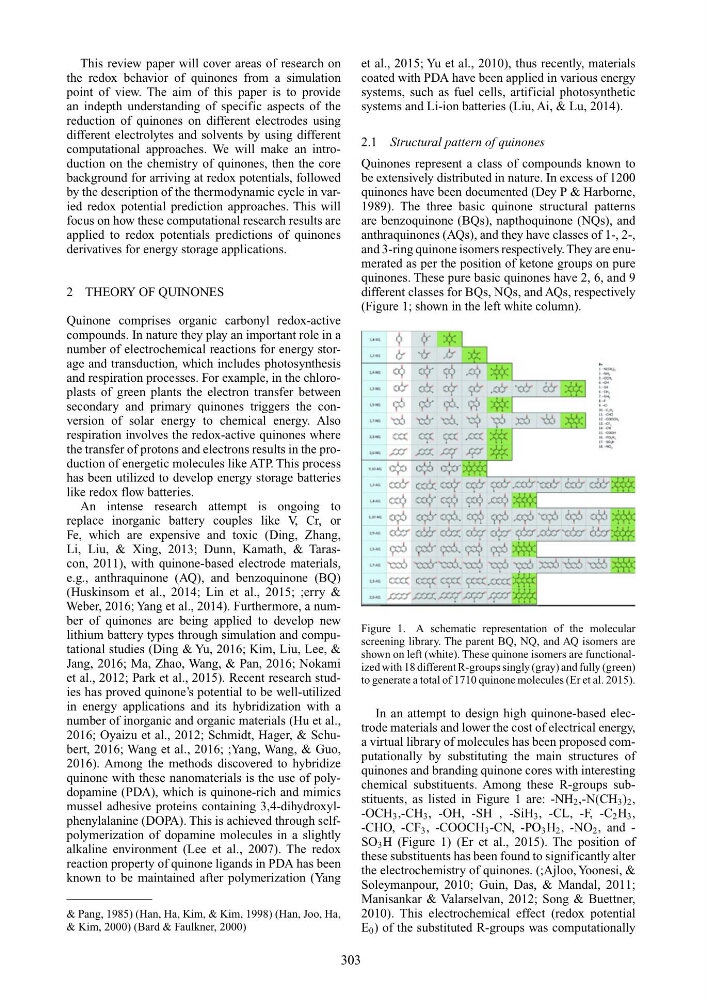
and 3-ring quinone isomers respectively. They are enumerated as per the position of ketone groups on pure
quinones. These pure basic quinones have 2, 6, and 9
different classes for BQs, NQs, and AQs, respectively
(Figure 1; shown in the left white column).
Figure 1. A schematic representation of the molecular
screening library. The parent BQ, NQ, and AQ isomers are
shown on left (white). These quinone isomers are functionalized with 18 different R-groups singly (gray) and fully (green)
to generate a total of 1710 quinone molecules (Er et al. 2015).
In an attempt to design high quinone-based electrode materials and lower the cost of electrical energy,
a virtual library of molecules has been proposed computationally by substituting the main structures of
quinones and branding quinone cores with interesting
chemical substituents. Among these R-groups substituents, as listed in Figure 1 are: -NH 2 ,-N(CH 3 ) 2 ,
-OCH 3 ,-CH 3 , -OH, -SH , -SiH 3 , -CL, -F, -C 2 H 3 ,
-CHO, -CF 3 , -COOCH 3 -CN, -PO 3 H 2 , -NO 2 , and -
SO 3 H (Figure 1) (Er et al., 2015). The position of
these substituents has been found to significantly alter
the electrochemistry of quinones. (;Ajloo, Yoonesi, &
Soleymanpour, 2010; Guin, Das, & Mandal, 2011;
Manisankar & Valarselvan, 2012; Song & Buettner,
2010). This electrochemical effect (redox potential
E 0 ) of the substituted R-groups was computationally
303
the redox behavior of quinones from a simulation
point of view. The aim of this paper is to provide
an indepth understanding of specific aspects of the
reduction of quinones on different electrodes using
different electrolytes and solvents by using different
computational approaches. We will make an introduction on the chemistry of quinones, then the core
background for arriving at redox potentials, followed
by the description of the thermodynamic cycle in varied redox potential prediction approaches. This will
focus on how these computational research results are
applied to redox potentials predictions of quinones
derivatives for energy storage applications.
2 THEORY OF QUINONES
Quinone comprises organic carbonyl redox-active
compounds. In nature they play an important role in a
number of electrochemical reactions for energy storage and transduction, which includes photosynthesis
and respiration processes. For example, in the chloroplasts of green plants the electron transfer between
secondary and primary quinones triggers the conversion of solar energy to chemical energy. Also
respiration involves the redox-active quinones where
the transfer of protons and electrons results in the production of energetic molecules like ATP. This process
has been utilized to develop energy storage batteries
like redox flow batteries.
An intense research attempt is ongoing to
replace inorganic battery couples like V, Cr, or
Fe, which are expensive and toxic (Ding, Zhang,
Li, Liu, & Xing, 2013; Dunn, Kamath, & Tarascon, 2011), with quinone-based electrode materials,
e.g., anthraquinone (AQ), and benzoquinone (BQ)
(Huskinsom et al., 2014; Lin et al., 2015; ;erry &
Weber, 2016; Yang et al., 2014). Furthermore, a number of quinones are being applied to develop new
lithium battery types through simulation and computational studies (Ding & Yu, 2016; Kim, Liu, Lee, &
Jang, 2016; Ma, Zhao, Wang, & Pan, 2016; Nokami
et al., 2012; Park et al., 2015). Recent research studies has proved quinone’s potential to be well-utilized
in energy applications and its hybridization with a
number of inorganic and organic materials (Hu et al.,
2016; Oyaizu et al., 2012; Schmidt, Hager, & Schubert, 2016; Wang et al., 2016; ;Yang, Wang, & Guo,
2016). Among the methods discovered to hybridize
quinone with these nanomaterials is the use of polydopamine (PDA), which is quinone-rich and mimics
mussel adhesive proteins containing 3,4-dihydroxylphenylalanine (DOPA). This is achieved through selfpolymerization of dopamine molecules in a slightly
alkaline environment (Lee et al., 2007). The redox
reaction property of quinone ligands in PDA has been
known to be maintained after polymerization (Yang
& Pang, 1985) (Han, Ha, Kim, & Kim, 1998) (Han, Joo, Ha,
& Kim, 2000) (Bard & Faulkner, 2000)
et al., 2015; Yu et al., 2010), thus recently, materials
coated with PDA have been applied in various energy
systems, such as fuel cells, artificial photosynthetic
systems and Li-ion batteries (Liu, Ai, & Lu, 2014).
2.1 Structural pattern of quinones
Quinones represent a class of compounds known to
be extensively distributed in nature. In excess of 1200
quinones have been documented (Dey P & Harborne,
1989). The three basic quinone structural patterns
are benzoquinone (BQs), napthoquinone (NQs), and
anthraquinones (AQs), and they have classes of 1-, 2-,
and 3-ring quinone isomers respectively. They are enumerated as per the position of ketone groups on pure
quinones. These pure basic quinones have 2, 6, and 9
different classes for BQs, NQs, and AQs, respectively
(Figure 1; shown in the left white column).
Figure 1. A schematic representation of the molecular
screening library. The parent BQ, NQ, and AQ isomers are
shown on left (white). These quinone isomers are functionalized with 18 different R-groups singly (gray) and fully (green)
to generate a total of 1710 quinone molecules (Er et al. 2015).
In an attempt to design high quinone-based electrode materials and lower the cost of electrical energy,
a virtual library of molecules has been proposed computationally by substituting the main structures of
quinones and branding quinone cores with interesting
chemical substituents. Among these R-groups substituents, as listed in Figure 1 are: -NH 2 ,-N(CH 3 ) 2 ,
-OCH 3 ,-CH 3 , -OH, -SH , -SiH 3 , -CL, -F, -C 2 H 3 ,
-CHO, -CF 3 , -COOCH 3 -CN, -PO 3 H 2 , -NO 2 , and -
SO 3 H (Figure 1) (Er et al., 2015). The position of
these substituents has been found to significantly alter
the electrochemistry of quinones. (;Ajloo, Yoonesi, &
Soleymanpour, 2010; Guin, Das, & Mandal, 2011;
Manisankar & Valarselvan, 2012; Song & Buettner,
2010). This electrochemical effect (redox potential
E 0 ) of the substituted R-groups was computationally
303