

3.3 Physical activation
Physical activation releases volatile matter from
biomass materials. The process depends on the nature
of feedstock and activation conditions such as temperature (Thomauske et al. 2007; Williams & Reed 2006).
The presence of volatile matter in activated carbon
reduces the pore volume and micropores. Therefore,
a substrate with high content of volatile matter needs
a high activation temperature. The high temperature
helps to develop the pore size and creates new pores.
Conversely, too high temperature may collapse the
pores, which reduces the quality of activated carbon
(T. Yang & Lua 2003).
Physical activation is done in two steps: carbonation and activation using steam and carbon dioxide.
Carbonation is the first step of physical activation. It
entails decomposition of organic matter without oxygen and removes non-carbon components. It converts
organic matter to char at temperatures of 600–800
◦ C
(Hernandez et al. 2007). Carbonization produces low
microporous carbon (Girgis et al. 2002). The second
step of the treatment is called activation, in which the
char from the carbonation process is activated using
steam and carbon dioxide as activating agents. A mixture of char and water is heated to a temperature range
of 800–1,000
◦ C (Dobele et al. 2012; Zabaniotou et
al. 2008). The steam pyrolysis creates porosity in the
range of mesopores. However, the process results in a
low surface area (El-hendawy et al. 2001; Girgis et al.
2002). Carbon dioxide activation enhances the microporosity of the product (Yang & Lua 2003). A summary
of the use of physically activated biomass materials to
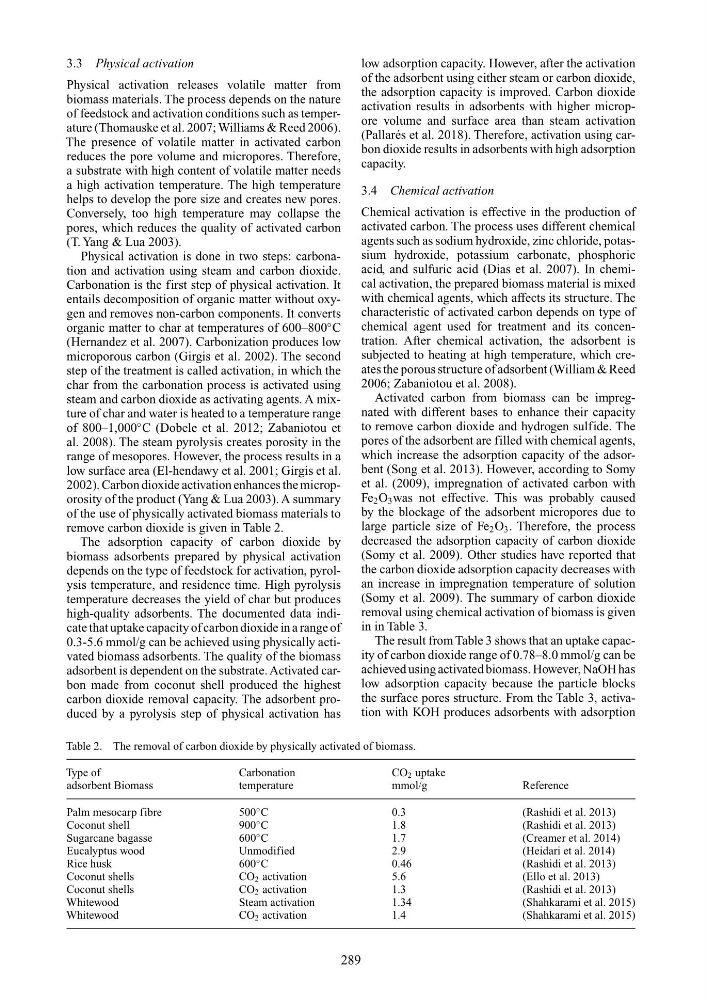
remove carbon dioxide is given in Table 2.
The adsorption capacity of carbon dioxide by
biomass adsorbents prepared by physical activation
depends on the type of feedstock for activation, pyrolysis temperature, and residence time. High pyrolysis
temperature decreases the yield of char but produces
high-quality adsorbents. The documented data indicate that uptake capacity of carbon dioxide in a range of
0.3-5.6 mmol/g can be achieved using physically activated biomass adsorbents. The quality of the biomass
adsorbent is dependent on the substrate. Activated carbon made from coconut shell produced the highest
carbon dioxide removal capacity. The adsorbent produced by a pyrolysis step of physical activation has
Table 2. The removal of carbon dioxide by physically activated of biomass.
Type of
Carbonation
CO 2 uptake
adsorbent Biomass
temperature
mmol/g
Reference
Palm mesocarp fibre
500
◦ C
0.3
(Rashidi et al. 2013)
Coconut shell
900
◦ C
1.8
(Rashidi et al. 2013)
Sugarcane bagasse
600
◦ C
1.7
(Creamer et al. 2014)
Eucalyptus wood
Unmodified
2.9
(Heidari et al. 2014)
Rice husk
600
◦ C
0.46
(Rashidi et al. 2013)
Coconut shells
CO 2 activation
5.6
(Ello et al. 2013)
Coconut shells
CO 2 activation
1.3
(Rashidi et al. 2013)
Whitewood
Steam activation
1.34
(Shahkarami et al. 2015)
Whitewood
CO 2 activation
1.4
(Shahkarami et al. 2015)
low adsorption capacity. However, after the activation
of the adsorbent using either steam or carbon dioxide,
the adsorption capacity is improved. Carbon dioxide
activation results in adsorbents with higher micropore volume and surface area than steam activation
(Pallarés et al. 2018). Therefore, activation using carbon dioxide results in adsorbents with high adsorption
capacity.
3.4 Chemical activation
Chemical activation is effective in the production of
activated carbon. The process uses different chemical
agents such as sodium hydroxide, zinc chloride, potassium hydroxide, potassium carbonate, phosphoric
acid, and sulfuric acid (Dias et al. 2007). In chemical activation, the prepared biomass material is mixed
with chemical agents, which affects its structure. The
characteristic of activated carbon depends on type of
chemical agent used for treatment and its concentration. After chemical activation, the adsorbent is
subjected to heating at high temperature, which creates the porous structure of adsorbent (William & Reed
2006; Zabaniotou et al. 2008).
Activated carbon from biomass can be impregnated with different bases to enhance their capacity
to remove carbon dioxide and hydrogen sulfide. The
pores of the adsorbent are filled with chemical agents,
which increase the adsorption capacity of the adsorbent (Song et al. 2013). However, according to Somy
et al. (2009), impregnation of activated carbon with
Fe 2 O 3 was not effective. This was probably caused
by the blockage of the adsorbent micropores due to
large particle size of Fe 2 O 3 . Therefore, the process
decreased the adsorption capacity of carbon dioxide
(Somy et al. 2009). Other studies have reported that
the carbon dioxide adsorption capacity decreases with
an increase in impregnation temperature of solution
(Somy et al. 2009). The summary of carbon dioxide
removal using chemical activation of biomass is given
in in Table 3.
The result from Table 3 shows that an uptake capacity of carbon dioxide range of 0.78–8.0 mmol/g can be
achieved using activated biomass. However, NaOH has
low adsorption capacity because the particle blocks
the surface pores structure. From the Table 3, activation with KOH produces adsorbents with adsorption
289
Physical activation releases volatile matter from
biomass materials. The process depends on the nature
of feedstock and activation conditions such as temperature (Thomauske et al. 2007; Williams & Reed 2006).
The presence of volatile matter in activated carbon
reduces the pore volume and micropores. Therefore,
a substrate with high content of volatile matter needs
a high activation temperature. The high temperature
helps to develop the pore size and creates new pores.
Conversely, too high temperature may collapse the
pores, which reduces the quality of activated carbon
(T. Yang & Lua 2003).
Physical activation is done in two steps: carbonation and activation using steam and carbon dioxide.
Carbonation is the first step of physical activation. It
entails decomposition of organic matter without oxygen and removes non-carbon components. It converts
organic matter to char at temperatures of 600–800
◦ C
(Hernandez et al. 2007). Carbonization produces low
microporous carbon (Girgis et al. 2002). The second
step of the treatment is called activation, in which the
char from the carbonation process is activated using
steam and carbon dioxide as activating agents. A mixture of char and water is heated to a temperature range
of 800–1,000
◦ C (Dobele et al. 2012; Zabaniotou et
al. 2008). The steam pyrolysis creates porosity in the
range of mesopores. However, the process results in a
low surface area (El-hendawy et al. 2001; Girgis et al.
2002). Carbon dioxide activation enhances the microporosity of the product (Yang & Lua 2003). A summary
of the use of physically activated biomass materials to
remove carbon dioxide is given in Table 2.
The adsorption capacity of carbon dioxide by
biomass adsorbents prepared by physical activation
depends on the type of feedstock for activation, pyrolysis temperature, and residence time. High pyrolysis
temperature decreases the yield of char but produces
high-quality adsorbents. The documented data indicate that uptake capacity of carbon dioxide in a range of
0.3-5.6 mmol/g can be achieved using physically activated biomass adsorbents. The quality of the biomass
adsorbent is dependent on the substrate. Activated carbon made from coconut shell produced the highest
carbon dioxide removal capacity. The adsorbent produced by a pyrolysis step of physical activation has
Table 2. The removal of carbon dioxide by physically activated of biomass.
Type of
Carbonation
CO 2 uptake
adsorbent Biomass
temperature
mmol/g
Reference
Palm mesocarp fibre
500
◦ C
0.3
(Rashidi et al. 2013)
Coconut shell
900
◦ C
1.8
(Rashidi et al. 2013)
Sugarcane bagasse
600
◦ C
1.7
(Creamer et al. 2014)
Eucalyptus wood
Unmodified
2.9
(Heidari et al. 2014)
Rice husk
600
◦ C
0.46
(Rashidi et al. 2013)
Coconut shells
CO 2 activation
5.6
(Ello et al. 2013)
Coconut shells
CO 2 activation
1.3
(Rashidi et al. 2013)
Whitewood
Steam activation
1.34
(Shahkarami et al. 2015)
Whitewood
CO 2 activation
1.4
(Shahkarami et al. 2015)
low adsorption capacity. However, after the activation
of the adsorbent using either steam or carbon dioxide,
the adsorption capacity is improved. Carbon dioxide
activation results in adsorbents with higher micropore volume and surface area than steam activation
(Pallarés et al. 2018). Therefore, activation using carbon dioxide results in adsorbents with high adsorption
capacity.
3.4 Chemical activation
Chemical activation is effective in the production of
activated carbon. The process uses different chemical
agents such as sodium hydroxide, zinc chloride, potassium hydroxide, potassium carbonate, phosphoric
acid, and sulfuric acid (Dias et al. 2007). In chemical activation, the prepared biomass material is mixed
with chemical agents, which affects its structure. The
characteristic of activated carbon depends on type of
chemical agent used for treatment and its concentration. After chemical activation, the adsorbent is
subjected to heating at high temperature, which creates the porous structure of adsorbent (William & Reed
2006; Zabaniotou et al. 2008).
Activated carbon from biomass can be impregnated with different bases to enhance their capacity
to remove carbon dioxide and hydrogen sulfide. The
pores of the adsorbent are filled with chemical agents,
which increase the adsorption capacity of the adsorbent (Song et al. 2013). However, according to Somy
et al. (2009), impregnation of activated carbon with
Fe 2 O 3 was not effective. This was probably caused
by the blockage of the adsorbent micropores due to
large particle size of Fe 2 O 3 . Therefore, the process
decreased the adsorption capacity of carbon dioxide
(Somy et al. 2009). Other studies have reported that
the carbon dioxide adsorption capacity decreases with
an increase in impregnation temperature of solution
(Somy et al. 2009). The summary of carbon dioxide
removal using chemical activation of biomass is given
in in Table 3.
The result from Table 3 shows that an uptake capacity of carbon dioxide range of 0.78–8.0 mmol/g can be
achieved using activated biomass. However, NaOH has
low adsorption capacity because the particle blocks
the surface pores structure. From the Table 3, activation with KOH produces adsorbents with adsorption
289