

Table 2. Kinetic model parameters at different temperatures
(Nanda et al., 2016).
Temperature (K)
K c
k (L mol
−1 min
−1 )
K w
298
2.66
0.11
2.65
303
1.82
0.16
1.50
308
1.51
0.24
1.09
313
1.30
0.33
0.73
323
0.98
0.63
0.34
K c : Equilibrium constant for the reaction; k: Kinetic constant;
K w : Equilibrium constant for water adsorption on the catalyst
surface.
then incorporated with the batch reactor model. There
were four parameters: the pre-exponential factor (A),
activation energy (Ea), acetone adsorption constant
(KA), and solketal desorption constant (KS). In addition, the equilibrium constant is presented as a function
of temperature, as shown in Equation 10. Parameters
A, Ea, KA, and KS in Equation 10 were estimated by
non-linear regression to minimize the SSE of glycerol conversion based on simulation and experimental
data. Parameter fitting and simulation were conducted
in MATLAB with gradient search methods (lsqnonlin)
and ODE solver. The initial concentrations of acetone
and glycerol used for the simulation were 11.25 and
2.25 M, respectively (Sulistyo et al., 2020).
It is well-known that the ketalization reaction has a
very low equilibrium constant. Therefore, to get high
conversions of glycerol it is necessary to shift the equilibrium towards the formation of solketal, which can be
achieved by either feeding an excess amount of acetone
or by removing the water generated during the reaction continuously. Removing the water by-product is
an effective way to break the resulting thermodynamic
barriers and several processes have used entrainers,
such as petroleum ethers and chloroform, successfully. Benzene is not a preferable entrainer as acetone
is removed by distillation before benzene. However,
the efficiency of the other mentioned entrainers is
not great either as their boiling points are still higher
than that of acetone. Acetone co-distillation creates the
problem of low efficiency in azeotropic water removal.
This phenomenon was evident from its very long reaction time when using petroleum ether as an entrainer.
The use of phosphorus pentoxide and sodium sulfate as
catalysts as well as desiccants for the removal of water
generated from the system has also been reported, but
high consumption of the catalysts in this case increased
the operation costs (Nanda et al., 2016).
More recently, molecular sieves have been used for
this purpose. All these processes are not economical on an industrial scale. These could be addressed
more effectively by using excess acetone, which not
only acts as a reactant but also as an entrainer for
the system. The excess acetone could be distilled off
and reused in the same or other processes. In the
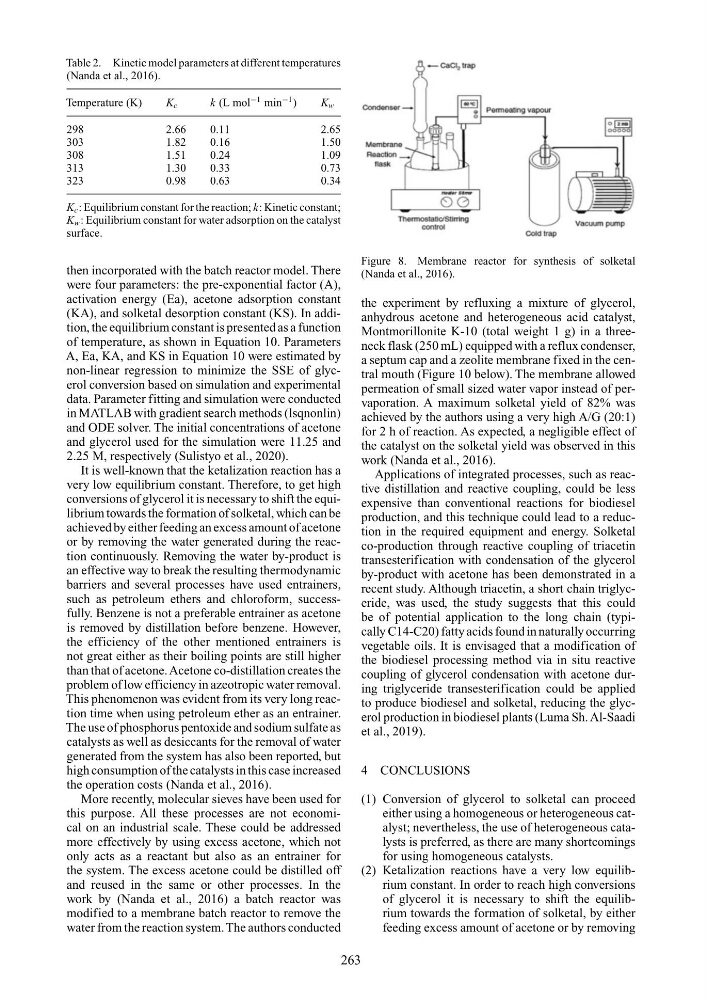
work by (Nanda et al., 2016) a batch reactor was
modified to a membrane batch reactor to remove the
water from the reaction system. The authors conducted
Figure 8. Membrane reactor for synthesis of solketal
(Nanda et al., 2016).
the experiment by refluxing a mixture of glycerol,
anhydrous acetone and heterogeneous acid catalyst,
Montmorillonite K-10 (total weight 1 g) in a threeneck flask (250 mL) equipped with a reflux condenser,
a septum cap and a zeolite membrane fixed in the central mouth (Figure 10 below). The membrane allowed
permeation of small sized water vapor instead of pervaporation. A maximum solketal yield of 82% was
achieved by the authors using a very high A/G (20:1)
for 2 h of reaction. As expected, a negligible effect of
the catalyst on the solketal yield was observed in this
work (Nanda et al., 2016).
Applications of integrated processes, such as reactive distillation and reactive coupling, could be less
expensive than conventional reactions for biodiesel
production, and this technique could lead to a reduction in the required equipment and energy. Solketal
co-production through reactive coupling of triacetin
transesterification with condensation of the glycerol
by-product with acetone has been demonstrated in a
recent study. Although triacetin, a short chain triglyceride, was used, the study suggests that this could
be of potential application to the long chain (typically C14-C20) fatty acids found in naturally occurring
vegetable oils. It is envisaged that a modification of
the biodiesel processing method via in situ reactive
coupling of glycerol condensation with acetone during triglyceride transesterification could be applied
to produce biodiesel and solketal, reducing the glycerol production in biodiesel plants (Luma Sh. Al-Saadi
et al., 2019).
4 CONCLUSIONS
(1) Conversion of glycerol to solketal can proceed
either using a homogeneous or heterogeneous catalyst; nevertheless, the use of heterogeneous catalysts is preferred, as there are many shortcomings
for using homogeneous catalysts.
(2) Ketalization reactions have a very low equilibrium constant. In order to reach high conversions
of glycerol it is necessary to shift the equilibrium towards the formation of solketal, by either
feeding excess amount of acetone or by removing
263
(Nanda et al., 2016).
Temperature (K)
K c
k (L mol
−1 min
−1 )
K w
298
2.66
0.11
2.65
303
1.82
0.16
1.50
308
1.51
0.24
1.09
313
1.30
0.33
0.73
323
0.98
0.63
0.34
K c : Equilibrium constant for the reaction; k: Kinetic constant;
K w : Equilibrium constant for water adsorption on the catalyst
surface.
then incorporated with the batch reactor model. There
were four parameters: the pre-exponential factor (A),
activation energy (Ea), acetone adsorption constant
(KA), and solketal desorption constant (KS). In addition, the equilibrium constant is presented as a function
of temperature, as shown in Equation 10. Parameters
A, Ea, KA, and KS in Equation 10 were estimated by
non-linear regression to minimize the SSE of glycerol conversion based on simulation and experimental
data. Parameter fitting and simulation were conducted
in MATLAB with gradient search methods (lsqnonlin)
and ODE solver. The initial concentrations of acetone
and glycerol used for the simulation were 11.25 and
2.25 M, respectively (Sulistyo et al., 2020).
It is well-known that the ketalization reaction has a
very low equilibrium constant. Therefore, to get high
conversions of glycerol it is necessary to shift the equilibrium towards the formation of solketal, which can be
achieved by either feeding an excess amount of acetone
or by removing the water generated during the reaction continuously. Removing the water by-product is
an effective way to break the resulting thermodynamic
barriers and several processes have used entrainers,
such as petroleum ethers and chloroform, successfully. Benzene is not a preferable entrainer as acetone
is removed by distillation before benzene. However,
the efficiency of the other mentioned entrainers is
not great either as their boiling points are still higher
than that of acetone. Acetone co-distillation creates the
problem of low efficiency in azeotropic water removal.
This phenomenon was evident from its very long reaction time when using petroleum ether as an entrainer.
The use of phosphorus pentoxide and sodium sulfate as
catalysts as well as desiccants for the removal of water
generated from the system has also been reported, but
high consumption of the catalysts in this case increased
the operation costs (Nanda et al., 2016).
More recently, molecular sieves have been used for
this purpose. All these processes are not economical on an industrial scale. These could be addressed
more effectively by using excess acetone, which not
only acts as a reactant but also as an entrainer for
the system. The excess acetone could be distilled off
and reused in the same or other processes. In the
work by (Nanda et al., 2016) a batch reactor was
modified to a membrane batch reactor to remove the
water from the reaction system. The authors conducted
Figure 8. Membrane reactor for synthesis of solketal
(Nanda et al., 2016).
the experiment by refluxing a mixture of glycerol,
anhydrous acetone and heterogeneous acid catalyst,
Montmorillonite K-10 (total weight 1 g) in a threeneck flask (250 mL) equipped with a reflux condenser,
a septum cap and a zeolite membrane fixed in the central mouth (Figure 10 below). The membrane allowed
permeation of small sized water vapor instead of pervaporation. A maximum solketal yield of 82% was
achieved by the authors using a very high A/G (20:1)
for 2 h of reaction. As expected, a negligible effect of
the catalyst on the solketal yield was observed in this
work (Nanda et al., 2016).
Applications of integrated processes, such as reactive distillation and reactive coupling, could be less
expensive than conventional reactions for biodiesel
production, and this technique could lead to a reduction in the required equipment and energy. Solketal
co-production through reactive coupling of triacetin
transesterification with condensation of the glycerol
by-product with acetone has been demonstrated in a
recent study. Although triacetin, a short chain triglyceride, was used, the study suggests that this could
be of potential application to the long chain (typically C14-C20) fatty acids found in naturally occurring
vegetable oils. It is envisaged that a modification of
the biodiesel processing method via in situ reactive
coupling of glycerol condensation with acetone during triglyceride transesterification could be applied
to produce biodiesel and solketal, reducing the glycerol production in biodiesel plants (Luma Sh. Al-Saadi
et al., 2019).
4 CONCLUSIONS
(1) Conversion of glycerol to solketal can proceed
either using a homogeneous or heterogeneous catalyst; nevertheless, the use of heterogeneous catalysts is preferred, as there are many shortcomings
for using homogeneous catalysts.
(2) Ketalization reactions have a very low equilibrium constant. In order to reach high conversions
of glycerol it is necessary to shift the equilibrium towards the formation of solketal, by either
feeding excess amount of acetone or by removing
263