

2.4 Energy input/fuel consumption
The amount of fuel expected from biomass fuel added
to the combustion chamber was calculated using
Equation 2.
FCR =
Q n
HV f × ε g
(2)
where FCR is the fuel consumption rate (kg/hr), HV f
is the heating value of fuel, is the heat energy needed
(kJ/hr), and ε g is the efficiency of the gasifier (%).
The predicted efficiency of the stove was 40%.
Thus, the calculated FCR by substitution in Equation
2 was found to be 0.13203 kg/hr.
2.5 Reactor diameter
This refers to the size of the reactor and is a function of the fuel consumed per unit time (FCR) to the
specific gasification rate (SGR) of biomass material
(Equation 3).
D =
1.27 × FCR
SGR
(3)
where D is the diameter of a reactor in meters. SGR of
the biomass fuel lies in the range of 50–210 kg/m
2 hr.
Using assumed FCR of 2 kg/hr and SGR of 100
kg/m
2 hr, the diameter (D) = 0.15937 m. This is equal
to 159.37 mm (≈160 mm). The diameter of the reactor
was taken as 180 mm, with an allowance of 20 mm in
order to accommodate the variation of cooking habits
throughout Ethiopia (Adem & Ambie, 2017).
2.6 Height of the reactor
The reactor height (H) is the overall height of the
reaction chamber and was the modified part from
previously improved cookstoves. This dimension indicates the loading capacity of the reactor. It is calculated assuming density of feedstock (ρ f ) = 100 kg/m
3
employing Equation 4 (Adem & Ambie, 2017).
H =
SGR × t
ρ f
(4)
By substitution, H = 200 mm (for SGR =
100 kg/m
2 hr and t = 20 minutes). To make the stove
manageable and compensate the increase in diameter
(Adem & Ambie, 2017), the developed stove height
was taken as 180 mm. This was also to reduce the time
taken by fire to reach the bottom part of the stove.
To increase the firepower, the height should be made
shorter.
2.7 Performance evaluation of the improved
cookstove
For this entire experiment, a revised version of the
Water Boiling Test Protocol (Adem & Ambie, 2017)
was used. This was conducted in a simulated kitchen
to find the specific fuel consumption and thermal efficiency of the desired improved cookstove.
The apparatus used included a thermometer with an
immersible probe, analytical balance, a standard 5liter cooking pot, and biomass feedstock (eucalyptus
wood).
The thermal efficiency (η th ) of the stove was calculated as the ratio of the amount of heat gained by the
water inside the pot and evaporated to the energy of
the fuel used for heating. The complete mathematical
relation is given in Equation 5 (Adem & Ambie, 2017).
η th =
m wi × C pw × (T b − T i ) + m e × L
m f × H vf
× 100 (5)
where m wi = the initial mass of water (kg), C p w =
specific heat capacity (kJ/kg/
◦ C), T i = initial temperature of the water (
◦ C), T b = final (boiling) temperature
of the water (
◦ C), m e = mass of water evaporated
(kg), L = latent heat of evaporation of water(kJ/kg),
mf = mass of fuel, and H vf = heating value of the fuel
(kJ/kg).
The performance of the stove was expressed in
terms of specific fuel consumption (SFC) which measured the amount of fuel required to cook the entire
food (Equation 6) (Adem & Ambie, 2017).
SFC =
Fuel used (Kg)
Food cooked (Kg)
(6)
2.8 Statistical analysis
The experiments were conducted in triplicate and
the values obtained were averaged. Quantitative data
were presented as means with errors as standard
deviations attached. All statistical analyses and mathematical computations were performed using Minitab
Statistical Software (Release 17, Minitab Inc., USA).
3 RESULTS AND DISCUSSION
3.1 Physical and thermal properties of biomass
used
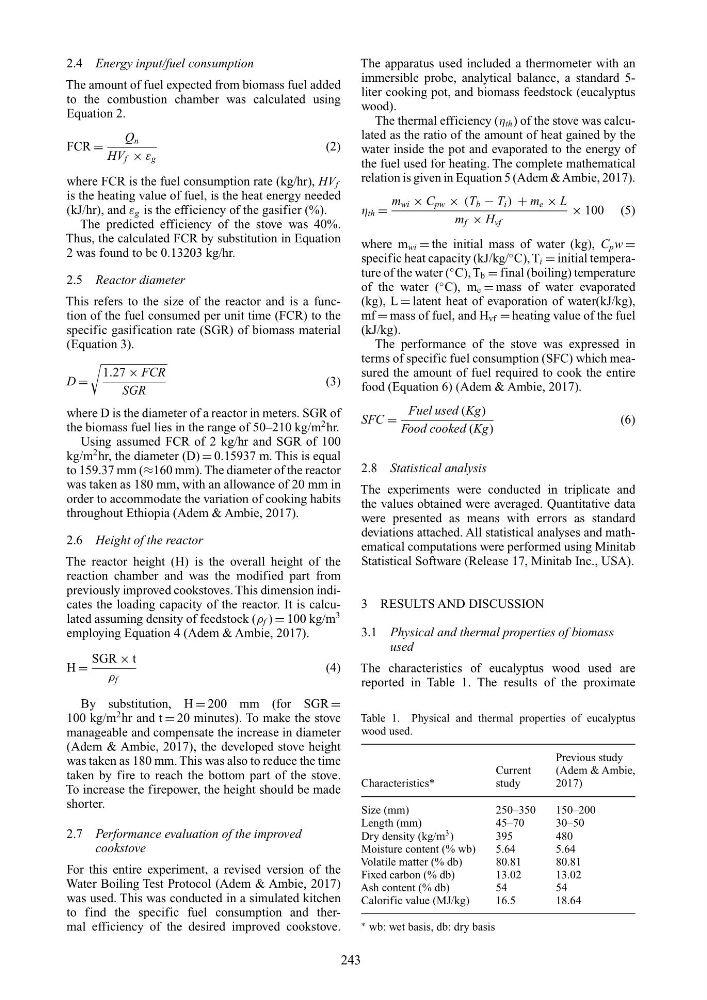
The characteristics of eucalyptus wood used are
reported in Table 1. The results of the proximate
Table 1. Physical and thermal properties of eucalyptus
wood used.
Previous study
Current
(Adem & Ambie,
Characteristics*
study
2017)
Size (mm)
250–350
150–200
Length (mm)
45–70
30–50
Dry density (kg/m
3 )
395
480
Moisture content (% wb)
5.64
5.64
Volatile matter (% db)
80.81
80.81
Fixed carbon (% db)
13.02
13.02
Ash content (% db)
54
54
Calorific value (MJ/kg)
16.5
18.64
∗ wb: wet basis, db: dry basis
243
The amount of fuel expected from biomass fuel added
to the combustion chamber was calculated using
Equation 2.
FCR =
Q n
HV f × ε g
(2)
where FCR is the fuel consumption rate (kg/hr), HV f
is the heating value of fuel, is the heat energy needed
(kJ/hr), and ε g is the efficiency of the gasifier (%).
The predicted efficiency of the stove was 40%.
Thus, the calculated FCR by substitution in Equation
2 was found to be 0.13203 kg/hr.
2.5 Reactor diameter
This refers to the size of the reactor and is a function of the fuel consumed per unit time (FCR) to the
specific gasification rate (SGR) of biomass material
(Equation 3).
D =
1.27 × FCR
SGR
(3)
where D is the diameter of a reactor in meters. SGR of
the biomass fuel lies in the range of 50–210 kg/m
2 hr.
Using assumed FCR of 2 kg/hr and SGR of 100
kg/m
2 hr, the diameter (D) = 0.15937 m. This is equal
to 159.37 mm (≈160 mm). The diameter of the reactor
was taken as 180 mm, with an allowance of 20 mm in
order to accommodate the variation of cooking habits
throughout Ethiopia (Adem & Ambie, 2017).
2.6 Height of the reactor
The reactor height (H) is the overall height of the
reaction chamber and was the modified part from
previously improved cookstoves. This dimension indicates the loading capacity of the reactor. It is calculated assuming density of feedstock (ρ f ) = 100 kg/m
3
employing Equation 4 (Adem & Ambie, 2017).
H =
SGR × t
ρ f
(4)
By substitution, H = 200 mm (for SGR =
100 kg/m
2 hr and t = 20 minutes). To make the stove
manageable and compensate the increase in diameter
(Adem & Ambie, 2017), the developed stove height
was taken as 180 mm. This was also to reduce the time
taken by fire to reach the bottom part of the stove.
To increase the firepower, the height should be made
shorter.
2.7 Performance evaluation of the improved
cookstove
For this entire experiment, a revised version of the
Water Boiling Test Protocol (Adem & Ambie, 2017)
was used. This was conducted in a simulated kitchen
to find the specific fuel consumption and thermal efficiency of the desired improved cookstove.
The apparatus used included a thermometer with an
immersible probe, analytical balance, a standard 5liter cooking pot, and biomass feedstock (eucalyptus
wood).
The thermal efficiency (η th ) of the stove was calculated as the ratio of the amount of heat gained by the
water inside the pot and evaporated to the energy of
the fuel used for heating. The complete mathematical
relation is given in Equation 5 (Adem & Ambie, 2017).
η th =
m wi × C pw × (T b − T i ) + m e × L
m f × H vf
× 100 (5)
where m wi = the initial mass of water (kg), C p w =
specific heat capacity (kJ/kg/
◦ C), T i = initial temperature of the water (
◦ C), T b = final (boiling) temperature
of the water (
◦ C), m e = mass of water evaporated
(kg), L = latent heat of evaporation of water(kJ/kg),
mf = mass of fuel, and H vf = heating value of the fuel
(kJ/kg).
The performance of the stove was expressed in
terms of specific fuel consumption (SFC) which measured the amount of fuel required to cook the entire
food (Equation 6) (Adem & Ambie, 2017).
SFC =
Fuel used (Kg)
Food cooked (Kg)
(6)
2.8 Statistical analysis
The experiments were conducted in triplicate and
the values obtained were averaged. Quantitative data
were presented as means with errors as standard
deviations attached. All statistical analyses and mathematical computations were performed using Minitab
Statistical Software (Release 17, Minitab Inc., USA).
3 RESULTS AND DISCUSSION
3.1 Physical and thermal properties of biomass
used
The characteristics of eucalyptus wood used are
reported in Table 1. The results of the proximate
Table 1. Physical and thermal properties of eucalyptus
wood used.
Previous study
Current
(Adem & Ambie,
Characteristics*
study
2017)
Size (mm)
250–350
150–200
Length (mm)
45–70
30–50
Dry density (kg/m
3 )
395
480
Moisture content (% wb)
5.64
5.64
Volatile matter (% db)
80.81
80.81
Fixed carbon (% db)
13.02
13.02
Ash content (% db)
54
54
Calorific value (MJ/kg)
16.5
18.64
∗ wb: wet basis, db: dry basis
243