

Improved cookstoves (ICS) can deliver “triple wins”
by improving household health, local environments,
and global climate (Pattanayak et al., 2019). Ethiopia
will be expected to rely on biomass for the coming
years as a primary source (Beyene & Koch, 2013;
Jewitt et al., 2020). So far, the focus of development has been on the improvement of parts of the
stove i.e., insulation, grate, and skirt. Current research
has focused on minimizing emissions and enhancing
energy efficiency (Adem et al., 2019; Manoj, Sachin,
& Tyagi, 2013; Ochieng, Vardoulakis, & Tonne, 2017;
Quansah et al., 2017). ICS are multipurpose with both
internal and external benefits. Internally, they reduce
the mortality rate due to air pollution, the concentration of smoke, reducing the demand for biomass
fuel, money, and time saved in acquiring fuel, reducing the use of animal dung as a fuel instead of as a
fertilizer. Externally improved biomass cookstoves are
beneficial in a way of reducing greenhouse gas (GHG)
emissions and deforestation (Barnes & Smith, 1993).
Therefore, the overall finding of the study underlined
the high importance of strengthening social groups to
enhance the adoption of improved cookstoves. This
paper was written to build the model of improved
cookstoves with high thermal efficiency, less fuel consumption, and less time of cooking for household
applications.
2 MATERIALS AND METHODS
The improved household cookstove was designed and
built with different modifications using easily and
locally available materials. Only clay soil and wood
ash were used to build the entire stove. The model is
based on the improvement of thermal efficiency using
low thermal conductive materials. The modification
includes insulating the cookstove by mixing clay soil
with wood ash. Increasing firepower, reducing fuel
consumption, and enhancing the combustion process
by reducing the height of the combustion zone, as
well as by adding secondary air through the developed
secondary air holes as shown in Figure 1.
Figure 1. Schematic diagram of the introduced cookstove.
2.1 Design of the desired cookstove
The model of the desired improved household cookstove employed a simple design while utilizing input
materials that are readily available for the rural community of Ethiopia.
The main part of the stove is clay soil and wood ash;
their selection to be used for developing the entire stove
was based on their low thermal conductivities (high
insulation capacities), high workability, and availability. The new improved cookstove was designed by
determining each design parameter. The construction
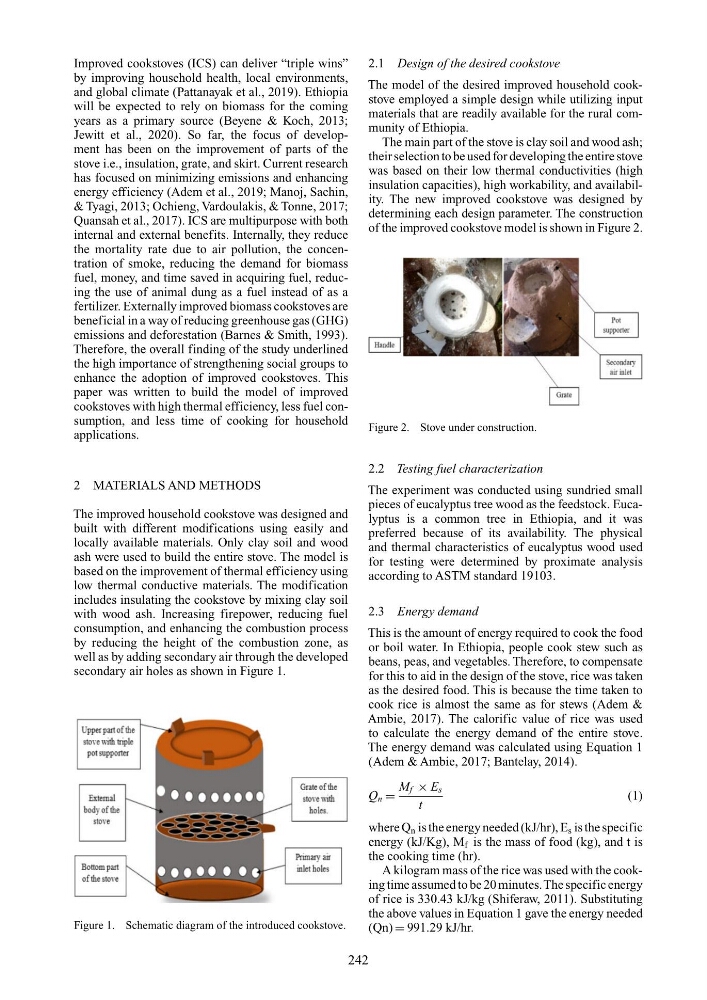
of the improved cookstove model is shown in Figure 2.
Figure 2. Stove under construction.
2.2 Testing fuel characterization
The experiment was conducted using sundried small
pieces of eucalyptus tree wood as the feedstock. Eucalyptus is a common tree in Ethiopia, and it was
preferred because of its availability. The physical
and thermal characteristics of eucalyptus wood used
for testing were determined by proximate analysis
according to ASTM standard 19103.
2.3 Energy demand
This is the amount of energy required to cook the food
or boil water. In Ethiopia, people cook stew such as
beans, peas, and vegetables. Therefore, to compensate
for this to aid in the design of the stove, rice was taken
as the desired food. This is because the time taken to
cook rice is almost the same as for stews (Adem &
Ambie, 2017). The calorific value of rice was used
to calculate the energy demand of the entire stove.
The energy demand was calculated using Equation 1
(Adem & Ambie, 2017; Bantelay, 2014).
Q n =
M f × E s
t
(1)
where Q n is the energy needed (kJ/hr), E s is the specific
energy (kJ/Kg), M f is the mass of food (kg), and t is
the cooking time (hr).
A kilogram mass of the rice was used with the cooking time assumed to be 20 minutes.The specific energy
of rice is 330.43 kJ/kg (Shiferaw, 2011). Substituting
the above values in Equation 1 gave the energy needed
(Qn) = 991.29 kJ/hr.
242
by improving household health, local environments,
and global climate (Pattanayak et al., 2019). Ethiopia
will be expected to rely on biomass for the coming
years as a primary source (Beyene & Koch, 2013;
Jewitt et al., 2020). So far, the focus of development has been on the improvement of parts of the
stove i.e., insulation, grate, and skirt. Current research
has focused on minimizing emissions and enhancing
energy efficiency (Adem et al., 2019; Manoj, Sachin,
& Tyagi, 2013; Ochieng, Vardoulakis, & Tonne, 2017;
Quansah et al., 2017). ICS are multipurpose with both
internal and external benefits. Internally, they reduce
the mortality rate due to air pollution, the concentration of smoke, reducing the demand for biomass
fuel, money, and time saved in acquiring fuel, reducing the use of animal dung as a fuel instead of as a
fertilizer. Externally improved biomass cookstoves are
beneficial in a way of reducing greenhouse gas (GHG)
emissions and deforestation (Barnes & Smith, 1993).
Therefore, the overall finding of the study underlined
the high importance of strengthening social groups to
enhance the adoption of improved cookstoves. This
paper was written to build the model of improved
cookstoves with high thermal efficiency, less fuel consumption, and less time of cooking for household
applications.
2 MATERIALS AND METHODS
The improved household cookstove was designed and
built with different modifications using easily and
locally available materials. Only clay soil and wood
ash were used to build the entire stove. The model is
based on the improvement of thermal efficiency using
low thermal conductive materials. The modification
includes insulating the cookstove by mixing clay soil
with wood ash. Increasing firepower, reducing fuel
consumption, and enhancing the combustion process
by reducing the height of the combustion zone, as
well as by adding secondary air through the developed
secondary air holes as shown in Figure 1.
Figure 1. Schematic diagram of the introduced cookstove.
2.1 Design of the desired cookstove
The model of the desired improved household cookstove employed a simple design while utilizing input
materials that are readily available for the rural community of Ethiopia.
The main part of the stove is clay soil and wood ash;
their selection to be used for developing the entire stove
was based on their low thermal conductivities (high
insulation capacities), high workability, and availability. The new improved cookstove was designed by
determining each design parameter. The construction
of the improved cookstove model is shown in Figure 2.
Figure 2. Stove under construction.
2.2 Testing fuel characterization
The experiment was conducted using sundried small
pieces of eucalyptus tree wood as the feedstock. Eucalyptus is a common tree in Ethiopia, and it was
preferred because of its availability. The physical
and thermal characteristics of eucalyptus wood used
for testing were determined by proximate analysis
according to ASTM standard 19103.
2.3 Energy demand
This is the amount of energy required to cook the food
or boil water. In Ethiopia, people cook stew such as
beans, peas, and vegetables. Therefore, to compensate
for this to aid in the design of the stove, rice was taken
as the desired food. This is because the time taken to
cook rice is almost the same as for stews (Adem &
Ambie, 2017). The calorific value of rice was used
to calculate the energy demand of the entire stove.
The energy demand was calculated using Equation 1
(Adem & Ambie, 2017; Bantelay, 2014).
Q n =
M f × E s
t
(1)
where Q n is the energy needed (kJ/hr), E s is the specific
energy (kJ/Kg), M f is the mass of food (kg), and t is
the cooking time (hr).
A kilogram mass of the rice was used with the cooking time assumed to be 20 minutes.The specific energy
of rice is 330.43 kJ/kg (Shiferaw, 2011). Substituting
the above values in Equation 1 gave the energy needed
(Qn) = 991.29 kJ/hr.
242