

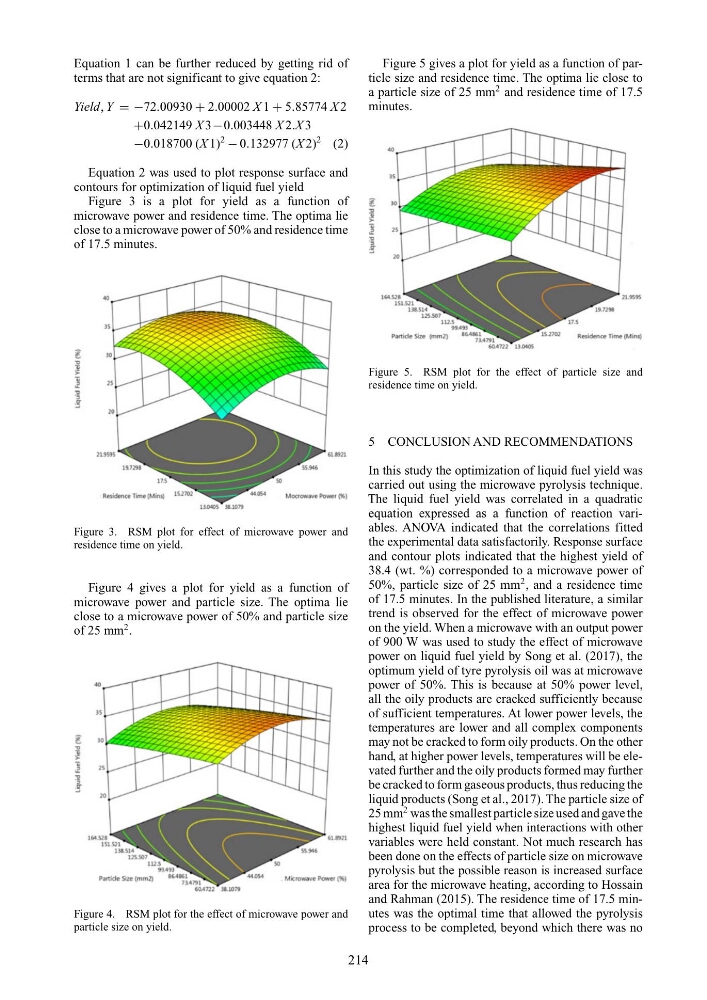
Equation 1 can be further reduced by getting rid of
terms that are not significant to give equation 2:
Yield, Y = −72.00930 + 2.00002 X 1 + 5.85774 X 2
+0.042149 X 3−0.003448 X 2.X 3
−0.018700 (X 1)
2 − 0.132977 (X 2)
2 (2)
Equation 2 was used to plot response surface and
contours for optimization of liquid fuel yield
Figure 3 is a plot for yield as a function of
microwave power and residence time. The optima lie
close to a microwave power of 50% and residence time
of 17.5 minutes.
Figure 3. RSM plot for effect of microwave power and
residence time on yield.
Figure 4 gives a plot for yield as a function of
microwave power and particle size. The optima lie
close to a microwave power of 50% and particle size
of 25 mm
2 .
Figure 4. RSM plot for the effect of microwave power and
particle size on yield.
Figure 5 gives a plot for yield as a function of particle size and residence time. The optima lie close to
a particle size of 25 mm
2 and residence time of 17.5
minutes.
Figure 5. RSM plot for the effect of particle size and
residence time on yield.
5 CONCLUSION AND RECOMMENDATIONS
In this study the optimization of liquid fuel yield was
carried out using the microwave pyrolysis technique.
The liquid fuel yield was correlated in a quadratic
equation expressed as a function of reaction variables. ANOVA indicated that the correlations fitted
the experimental data satisfactorily. Response surface
and contour plots indicated that the highest yield of
38.4 (wt. %) corresponded to a microwave power of
50%, particle size of 25 mm
2 , and a residence time
of 17.5 minutes. In the published literature, a similar
trend is observed for the effect of microwave power
on the yield. When a microwave with an output power
of 900 W was used to study the effect of microwave
power on liquid fuel yield by Song et al. (2017), the
optimum yield of tyre pyrolysis oil was at microwave
power of 50%. This is because at 50% power level,
all the oily products are cracked sufficiently because
of sufficient temperatures. At lower power levels, the
temperatures are lower and all complex components
may not be cracked to form oily products. On the other
hand, at higher power levels, temperatures will be elevated further and the oily products formed may further
be cracked to form gaseous products, thus reducing the
liquid products (Song et al., 2017). The particle size of
25 mm
2 was the smallest particle size used and gave the
highest liquid fuel yield when interactions with other
variables were held constant. Not much research has
been done on the effects of particle size on microwave
pyrolysis but the possible reason is increased surface
area for the microwave heating, according to Hossain
and Rahman (2015). The residence time of 17.5 minutes was the optimal time that allowed the pyrolysis
process to be completed, beyond which there was no
214
terms that are not significant to give equation 2:
Yield, Y = −72.00930 + 2.00002 X 1 + 5.85774 X 2
+0.042149 X 3−0.003448 X 2.X 3
−0.018700 (X 1)
2 − 0.132977 (X 2)
2 (2)
Equation 2 was used to plot response surface and
contours for optimization of liquid fuel yield
Figure 3 is a plot for yield as a function of
microwave power and residence time. The optima lie
close to a microwave power of 50% and residence time
of 17.5 minutes.
Figure 3. RSM plot for effect of microwave power and
residence time on yield.
Figure 4 gives a plot for yield as a function of
microwave power and particle size. The optima lie
close to a microwave power of 50% and particle size
of 25 mm
2 .
Figure 4. RSM plot for the effect of microwave power and
particle size on yield.
Figure 5 gives a plot for yield as a function of particle size and residence time. The optima lie close to
a particle size of 25 mm
2 and residence time of 17.5
minutes.
Figure 5. RSM plot for the effect of particle size and
residence time on yield.
5 CONCLUSION AND RECOMMENDATIONS
In this study the optimization of liquid fuel yield was
carried out using the microwave pyrolysis technique.
The liquid fuel yield was correlated in a quadratic
equation expressed as a function of reaction variables. ANOVA indicated that the correlations fitted
the experimental data satisfactorily. Response surface
and contour plots indicated that the highest yield of
38.4 (wt. %) corresponded to a microwave power of
50%, particle size of 25 mm
2 , and a residence time
of 17.5 minutes. In the published literature, a similar
trend is observed for the effect of microwave power
on the yield. When a microwave with an output power
of 900 W was used to study the effect of microwave
power on liquid fuel yield by Song et al. (2017), the
optimum yield of tyre pyrolysis oil was at microwave
power of 50%. This is because at 50% power level,
all the oily products are cracked sufficiently because
of sufficient temperatures. At lower power levels, the
temperatures are lower and all complex components
may not be cracked to form oily products. On the other
hand, at higher power levels, temperatures will be elevated further and the oily products formed may further
be cracked to form gaseous products, thus reducing the
liquid products (Song et al., 2017). The particle size of
25 mm
2 was the smallest particle size used and gave the
highest liquid fuel yield when interactions with other
variables were held constant. Not much research has
been done on the effects of particle size on microwave
pyrolysis but the possible reason is increased surface
area for the microwave heating, according to Hossain
and Rahman (2015). The residence time of 17.5 minutes was the optimal time that allowed the pyrolysis
process to be completed, beyond which there was no
214