

Table 2. Physicochemical characteristics of CYW and
inoculum before digestion.
Characteristic items
CYW
Inoculum
pH
7.1
6.4
%MC
6.82
92.67
%TS
93.18
7.33
%TVS (% of TS)
82.48
88.64
%AC (% of TS)
17.52
11.36
Total Carbon (% TC)
35.7
32.25
Total Nitrogen (% TN)
0.84
1.57
C/N ratio
42.5
20.5
25%, 22%, 20%, 18%, 14% and 10% in the batch reactors. This was done to investigate the effect of %TS on
biogas production. The experiment was run in triplicate. Each reactor was then filled with 200 g of fresh
cow dung as inoculum to get the constant quantity of
working volume.
3 RESULTS AND DISCUSSION
3.1 Physicochemical characteristics of CYW and
the inoculum
The characteristics of feedstock are important in
designing and operating anaerobic reactors. The initial
characteristics of feedstock strongly affect the quality and quantity of biogas produced and as well as
anaerobic stability (Phun et al., 2017).
The biodegradability of organic substrates is influenced by their physicochemical characteristics (Aslanzadeh, 2014). The characteristics of organic wastes
determine the success of the AD process (e.g. high
biogas production potential and degradability). The
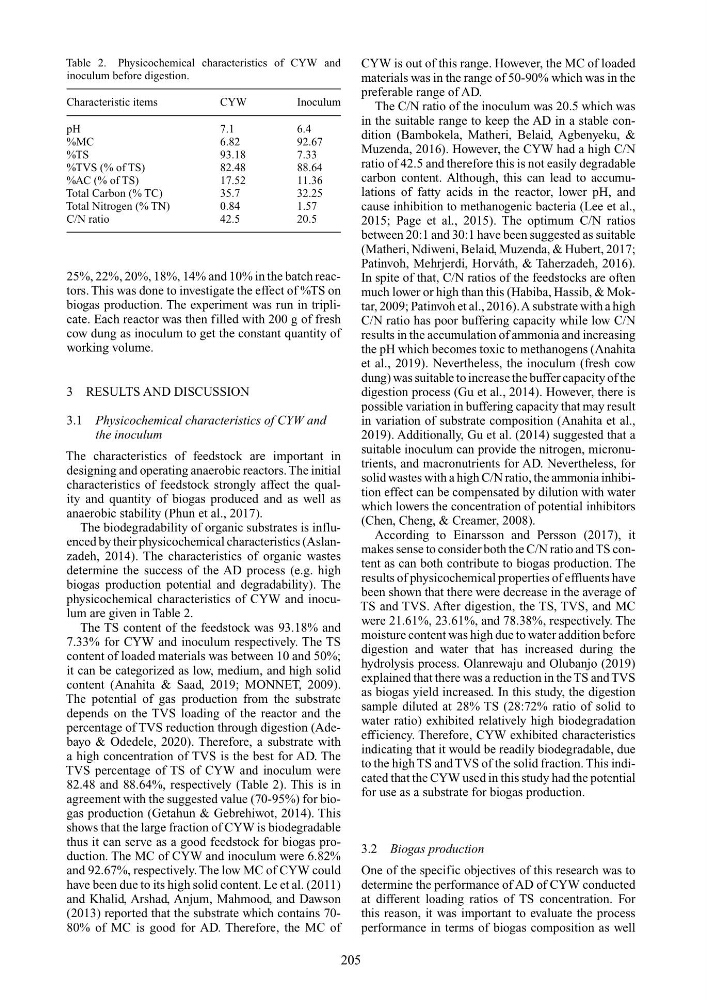
physicochemical characteristics of CYW and inoculum are given in Table 2.
The TS content of the feedstock was 93.18% and
7.33% for CYW and inoculum respectively. The TS
content of loaded materials was between 10 and 50%;
it can be categorized as low, medium, and high solid
content (Anahita & Saad, 2019; MONNET, 2009).
The potential of gas production from the substrate
depends on the TVS loading of the reactor and the
percentage of TVS reduction through digestion (Adebayo & Odedele, 2020). Therefore, a substrate with
a high concentration of TVS is the best for AD. The
TVS percentage of TS of CYW and inoculum were
82.48 and 88.64%, respectively (Table 2). This is in
agreement with the suggested value (70-95%) for biogas production (Getahun & Gebrehiwot, 2014). This
shows that the large fraction of CYW is biodegradable
thus it can serve as a good feedstock for biogas production. The MC of CYW and inoculum were 6.82%
and 92.67%, respectively. The low MC of CYW could
have been due to its high solid content. Le et al. (2011)
and Khalid, Arshad, Anjum, Mahmood, and Dawson
(2013) reported that the substrate which contains 7080% of MC is good for AD. Therefore, the MC of
CYW is out of this range. However, the MC of loaded
materials was in the range of 50-90% which was in the
preferable range of AD.
The C/N ratio of the inoculum was 20.5 which was
in the suitable range to keep the AD in a stable condition (Bambokela, Matheri, Belaid, Agbenyeku, &
Muzenda, 2016). However, the CYW had a high C/N
ratio of 42.5 and therefore this is not easily degradable
carbon content. Although, this can lead to accumulations of fatty acids in the reactor, lower pH, and
cause inhibition to methanogenic bacteria (Lee et al.,
2015; Page et al., 2015). The optimum C/N ratios
between 20:1 and 30:1 have been suggested as suitable
(Matheri, Ndiweni, Belaid, Muzenda, & Hubert, 2017;
Patinvoh, Mehrjerdi, Horváth, & Taherzadeh, 2016).
In spite of that, C/N ratios of the feedstocks are often
much lower or high than this (Habiba, Hassib, & Moktar, 2009; Patinvoh et al., 2016). A substrate with a high
C/N ratio has poor buffering capacity while low C/N
results in the accumulation of ammonia and increasing
the pH which becomes toxic to methanogens (Anahita
et al., 2019). Nevertheless, the inoculum (fresh cow
dung) was suitable to increase the buffer capacity of the
digestion process (Gu et al., 2014). However, there is
possible variation in buffering capacity that may result
in variation of substrate composition (Anahita et al.,
2019). Additionally, Gu et al. (2014) suggested that a
suitable inoculum can provide the nitrogen, micronutrients, and macronutrients for AD. Nevertheless, for
solid wastes with a high C/N ratio, the ammonia inhibition effect can be compensated by dilution with water
which lowers the concentration of potential inhibitors
(Chen, Cheng, & Creamer, 2008).
According to Einarsson and Persson (2017), it
makes sense to consider both the C/N ratio and TS content as can both contribute to biogas production. The
results of physicochemical properties of effluents have
been shown that there were decrease in the average of
TS and TVS. After digestion, the TS, TVS, and MC
were 21.61%, 23.61%, and 78.38%, respectively. The
moisture content was high due to water addition before
digestion and water that has increased during the
hydrolysis process. Olanrewaju and Olubanjo (2019)
explained that there was a reduction in the TS and TVS
as biogas yield increased. In this study, the digestion
sample diluted at 28% TS (28:72% ratio of solid to
water ratio) exhibited relatively high biodegradation
efficiency. Therefore, CYW exhibited characteristics
indicating that it would be readily biodegradable, due
to the high TS and TVS of the solid fraction. This indicated that the CYW used in this study had the potential
for use as a substrate for biogas production.
3.2 Biogas production
One of the specific objectives of this research was to
determine the performance of AD of CYW conducted
at different loading ratios of TS concentration. For
this reason, it was important to evaluate the process
performance in terms of biogas composition as well
205
inoculum before digestion.
Characteristic items
CYW
Inoculum
pH
7.1
6.4
%MC
6.82
92.67
%TS
93.18
7.33
%TVS (% of TS)
82.48
88.64
%AC (% of TS)
17.52
11.36
Total Carbon (% TC)
35.7
32.25
Total Nitrogen (% TN)
0.84
1.57
C/N ratio
42.5
20.5
25%, 22%, 20%, 18%, 14% and 10% in the batch reactors. This was done to investigate the effect of %TS on
biogas production. The experiment was run in triplicate. Each reactor was then filled with 200 g of fresh
cow dung as inoculum to get the constant quantity of
working volume.
3 RESULTS AND DISCUSSION
3.1 Physicochemical characteristics of CYW and
the inoculum
The characteristics of feedstock are important in
designing and operating anaerobic reactors. The initial
characteristics of feedstock strongly affect the quality and quantity of biogas produced and as well as
anaerobic stability (Phun et al., 2017).
The biodegradability of organic substrates is influenced by their physicochemical characteristics (Aslanzadeh, 2014). The characteristics of organic wastes
determine the success of the AD process (e.g. high
biogas production potential and degradability). The
physicochemical characteristics of CYW and inoculum are given in Table 2.
The TS content of the feedstock was 93.18% and
7.33% for CYW and inoculum respectively. The TS
content of loaded materials was between 10 and 50%;
it can be categorized as low, medium, and high solid
content (Anahita & Saad, 2019; MONNET, 2009).
The potential of gas production from the substrate
depends on the TVS loading of the reactor and the
percentage of TVS reduction through digestion (Adebayo & Odedele, 2020). Therefore, a substrate with
a high concentration of TVS is the best for AD. The
TVS percentage of TS of CYW and inoculum were
82.48 and 88.64%, respectively (Table 2). This is in
agreement with the suggested value (70-95%) for biogas production (Getahun & Gebrehiwot, 2014). This
shows that the large fraction of CYW is biodegradable
thus it can serve as a good feedstock for biogas production. The MC of CYW and inoculum were 6.82%
and 92.67%, respectively. The low MC of CYW could
have been due to its high solid content. Le et al. (2011)
and Khalid, Arshad, Anjum, Mahmood, and Dawson
(2013) reported that the substrate which contains 7080% of MC is good for AD. Therefore, the MC of
CYW is out of this range. However, the MC of loaded
materials was in the range of 50-90% which was in the
preferable range of AD.
The C/N ratio of the inoculum was 20.5 which was
in the suitable range to keep the AD in a stable condition (Bambokela, Matheri, Belaid, Agbenyeku, &
Muzenda, 2016). However, the CYW had a high C/N
ratio of 42.5 and therefore this is not easily degradable
carbon content. Although, this can lead to accumulations of fatty acids in the reactor, lower pH, and
cause inhibition to methanogenic bacteria (Lee et al.,
2015; Page et al., 2015). The optimum C/N ratios
between 20:1 and 30:1 have been suggested as suitable
(Matheri, Ndiweni, Belaid, Muzenda, & Hubert, 2017;
Patinvoh, Mehrjerdi, Horváth, & Taherzadeh, 2016).
In spite of that, C/N ratios of the feedstocks are often
much lower or high than this (Habiba, Hassib, & Moktar, 2009; Patinvoh et al., 2016). A substrate with a high
C/N ratio has poor buffering capacity while low C/N
results in the accumulation of ammonia and increasing
the pH which becomes toxic to methanogens (Anahita
et al., 2019). Nevertheless, the inoculum (fresh cow
dung) was suitable to increase the buffer capacity of the
digestion process (Gu et al., 2014). However, there is
possible variation in buffering capacity that may result
in variation of substrate composition (Anahita et al.,
2019). Additionally, Gu et al. (2014) suggested that a
suitable inoculum can provide the nitrogen, micronutrients, and macronutrients for AD. Nevertheless, for
solid wastes with a high C/N ratio, the ammonia inhibition effect can be compensated by dilution with water
which lowers the concentration of potential inhibitors
(Chen, Cheng, & Creamer, 2008).
According to Einarsson and Persson (2017), it
makes sense to consider both the C/N ratio and TS content as can both contribute to biogas production. The
results of physicochemical properties of effluents have
been shown that there were decrease in the average of
TS and TVS. After digestion, the TS, TVS, and MC
were 21.61%, 23.61%, and 78.38%, respectively. The
moisture content was high due to water addition before
digestion and water that has increased during the
hydrolysis process. Olanrewaju and Olubanjo (2019)
explained that there was a reduction in the TS and TVS
as biogas yield increased. In this study, the digestion
sample diluted at 28% TS (28:72% ratio of solid to
water ratio) exhibited relatively high biodegradation
efficiency. Therefore, CYW exhibited characteristics
indicating that it would be readily biodegradable, due
to the high TS and TVS of the solid fraction. This indicated that the CYW used in this study had the potential
for use as a substrate for biogas production.
3.2 Biogas production
One of the specific objectives of this research was to
determine the performance of AD of CYW conducted
at different loading ratios of TS concentration. For
this reason, it was important to evaluate the process
performance in terms of biogas composition as well
205