

3.6 Colour fastness properties tests
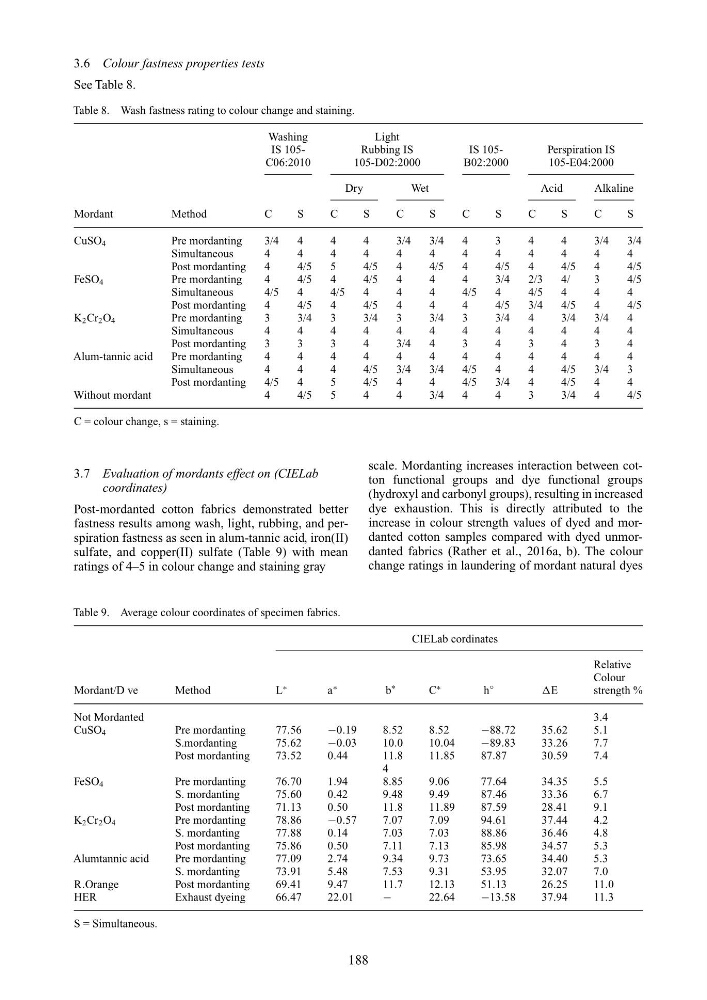
See Table 8.
Table 8. Wash fastness rating to colour change and staining.
Washing
Light
IS 105Rubbing IS
IS 105Perspiration IS
C06:2010
105-D02:2000
B02:2000
105-E04:2000
Dry
Wet
Acid
Alkaline
Mordant
Method
C
S
C
S
C
S
C
S
C
S
C
S
CuSO 4
Pre mordanting
3/4
4
4
4
3/4
3/4
4
3
4
4
3/4
3/4
Simultaneous
4
4
4
4
4
4
4
4
4
4
4
4
Post mordanting
4
4/5
5
4/5
4
4/5
4
4/5
4
4/5
4
4/5
FeSO 4
Pre mordanting
4
4/5
4
4/5
4
4
4
3/4
2/3
4/
3
4/5
Simultaneous
4/5
4
4/5
4
4
4
4/5
4
4/5
4
4
4
Post mordanting
4
4/5
4
4/5
4
4
4
4/5
3/4
4/5
4
4/5
K 2 Cr 2 O 4
Pre mordanting
3
3/4
3
3/4
3
3/4
3
3/4
4
3/4
3/4
4
Simultaneous
4
4
4
4
4
4
4
4
4
4
4
4
Post mordanting
3
3
3
4
3/4
4
3
4
3
4
3
4
Alum-tannic acid
Pre mordanting
4
4
4
4
4
4
4
4
4
4
4
4
Simultaneous
4
4
4
4/5
3/4
3/4
4/5
4
4
4/5
3/4
3
Post mordanting
4/5
4
5
4/5
4
4
4/5
3/4
4
4/5
4
4
Without mordant
4
4/5
5
4
4
3/4
4
4
3
3/4
4
4/5
C = colour change, s = staining.
3.7 Evaluation of mordants effect on (CIELab
coordinates)
Post-mordanted cotton fabrics demonstrated better
fastness results among wash, light, rubbing, and perspiration fastness as seen in alum-tannic acid, iron(II)
sulfate, and copper(II) sulfate (Table 9) with mean
ratings of 4–5 in colour change and staining gray
Table 9. Average colour coordinates of specimen fabrics.
CIELab cordinates
Relative
Colour
Mordant/D ve
Method
L
∗
a
∗
b
∗
C
∗
h
◦
E
strength %
Not Mordanted
3.4
CuSO 4
Pre mordanting
77.56
−0.19
8.52
8.52
−88.72
35.62
5.1
S.mordanting
75.62
−0.03
10.0
10.04
−89.83
33.26
7.7
Post mordanting
73.52
0.44
11.8
11.85
87.87
30.59
7.4
4
FeSO 4
Pre mordanting
76.70
1.94
8.85
9.06
77.64
34.35
5.5
S. mordanting
75.60
0.42
9.48
9.49
87.46
33.36
6.7
Post mordanting
71.13
0.50
11.8
11.89
87.59
28.41
9.1
K 2 Cr 2 O 4
Pre mordanting
78.86
−0.57
7.07
7.09
94.61
37.44
4.2
S. mordanting
77.88
0.14
7.03
7.03
88.86
36.46
4.8
Post mordanting
75.86
0.50
7.11
7.13
85.98
34.57
5.3
Alumtannic acid
Pre mordanting
77.09
2.74
9.34
9.73
73.65
34.40
5.3
S. mordanting
73.91
5.48
7.53
9.31
53.95
32.07
7.0
R.Orange
Post mordanting
69.41
9.47
11.7
12.13
51.13
26.25
11.0
HER
Exhaust dyeing
66.47
22.01
−
22.64
−13.58
37.94
11.3
S = Simultaneous.
scale. Mordanting increases interaction between cotton functional groups and dye functional groups
(hydroxyl and carbonyl groups), resulting in increased
dye exhaustion. This is directly attributed to the
increase in colour strength values of dyed and mordanted cotton samples compared with dyed unmordanted fabrics (Rather et al., 2016a, b). The colour
change ratings in laundering of mordant natural dyes
188
See Table 8.
Table 8. Wash fastness rating to colour change and staining.
Washing
Light
IS 105Rubbing IS
IS 105Perspiration IS
C06:2010
105-D02:2000
B02:2000
105-E04:2000
Dry
Wet
Acid
Alkaline
Mordant
Method
C
S
C
S
C
S
C
S
C
S
C
S
CuSO 4
Pre mordanting
3/4
4
4
4
3/4
3/4
4
3
4
4
3/4
3/4
Simultaneous
4
4
4
4
4
4
4
4
4
4
4
4
Post mordanting
4
4/5
5
4/5
4
4/5
4
4/5
4
4/5
4
4/5
FeSO 4
Pre mordanting
4
4/5
4
4/5
4
4
4
3/4
2/3
4/
3
4/5
Simultaneous
4/5
4
4/5
4
4
4
4/5
4
4/5
4
4
4
Post mordanting
4
4/5
4
4/5
4
4
4
4/5
3/4
4/5
4
4/5
K 2 Cr 2 O 4
Pre mordanting
3
3/4
3
3/4
3
3/4
3
3/4
4
3/4
3/4
4
Simultaneous
4
4
4
4
4
4
4
4
4
4
4
4
Post mordanting
3
3
3
4
3/4
4
3
4
3
4
3
4
Alum-tannic acid
Pre mordanting
4
4
4
4
4
4
4
4
4
4
4
4
Simultaneous
4
4
4
4/5
3/4
3/4
4/5
4
4
4/5
3/4
3
Post mordanting
4/5
4
5
4/5
4
4
4/5
3/4
4
4/5
4
4
Without mordant
4
4/5
5
4
4
3/4
4
4
3
3/4
4
4/5
C = colour change, s = staining.
3.7 Evaluation of mordants effect on (CIELab
coordinates)
Post-mordanted cotton fabrics demonstrated better
fastness results among wash, light, rubbing, and perspiration fastness as seen in alum-tannic acid, iron(II)
sulfate, and copper(II) sulfate (Table 9) with mean
ratings of 4–5 in colour change and staining gray
Table 9. Average colour coordinates of specimen fabrics.
CIELab cordinates
Relative
Colour
Mordant/D ve
Method
L
∗
a
∗
b
∗
C
∗
h
◦
E
strength %
Not Mordanted
3.4
CuSO 4
Pre mordanting
77.56
−0.19
8.52
8.52
−88.72
35.62
5.1
S.mordanting
75.62
−0.03
10.0
10.04
−89.83
33.26
7.7
Post mordanting
73.52
0.44
11.8
11.85
87.87
30.59
7.4
4
FeSO 4
Pre mordanting
76.70
1.94
8.85
9.06
77.64
34.35
5.5
S. mordanting
75.60
0.42
9.48
9.49
87.46
33.36
6.7
Post mordanting
71.13
0.50
11.8
11.89
87.59
28.41
9.1
K 2 Cr 2 O 4
Pre mordanting
78.86
−0.57
7.07
7.09
94.61
37.44
4.2
S. mordanting
77.88
0.14
7.03
7.03
88.86
36.46
4.8
Post mordanting
75.86
0.50
7.11
7.13
85.98
34.57
5.3
Alumtannic acid
Pre mordanting
77.09
2.74
9.34
9.73
73.65
34.40
5.3
S. mordanting
73.91
5.48
7.53
9.31
53.95
32.07
7.0
R.Orange
Post mordanting
69.41
9.47
11.7
12.13
51.13
26.25
11.0
HER
Exhaust dyeing
66.47
22.01
−
22.64
−13.58
37.94
11.3
S = Simultaneous.
scale. Mordanting increases interaction between cotton functional groups and dye functional groups
(hydroxyl and carbonyl groups), resulting in increased
dye exhaustion. This is directly attributed to the
increase in colour strength values of dyed and mordanted cotton samples compared with dyed unmordanted fabrics (Rather et al., 2016a, b). The colour
change ratings in laundering of mordant natural dyes
188