

The regressed variables (temp, X 1 ; time, X 2 ; and
pH, X 3 ) are demonstrated in Table 5. The p-values of
the variables were greater than the common p-level of
0.05, which indicated that they were not statistically
significant. There are other factors which also affected
dyeing and colour strength such as dye concentration
and mordanting. Therefore, the use of mordants to fix
colour onto fabrics and modify colour was required
according to Kulkarni, Gokhale, Bodake, and Pathade
(2011) and Samantha et al. (2011). The adjusted R
2
values were well within the acceptable limits indicating a good fit model. The response surface plot
represented in Figure 5 reveals a non-linear (zig-zag)
relation between the response and the variables. The
investigated variables have some effect on dyeing in
terms of linear, quadratic, and cross terms leading to
optimized dyeing conditions in Table 6. Increase in
dye bath concentration leads to more dye transfer to
the fabric, hence a higher apparent depth of colour
(Rather et al., 2016).
Figure 5. Response surface plot for dyeing process.
3.5 Effect of mordants on relative colour strength
and absorption
Natural dyes need metal ions for adsorption of the dye
by forming an insoluble composition precipitate on the
surface of the fibres, and this gives the fabric a range
of bright colours (Uddin, 2015). Mordants fix and
modify colour onto fabrics as well as enhancing the
colour fastness of dyed fabrics (Kulkarni et al., 2011;
Table 6. ANOVA for dyeing process.
Properties
df
SS
MS
F
Significance F
p-value
Intercept
3
5.74209
1.9140
0.4833
0.69962
0.01026
Temp.,
0 C
13
51.4885
3.9607
0.60370
Time, hrs
16
57.2306
0.29970
pH
0.99684
Regression Statistics
Multiple R
0.316753
R
2
0.100333
Adjusted R
2
−0.10728
Standard Error
1.990139
Samantha et al., 2011). B. vulgaris dye is water soluble
and contains carbonyl and hydroxyl groups, hence it
can interact with cotton fabric via hydrogen bonding
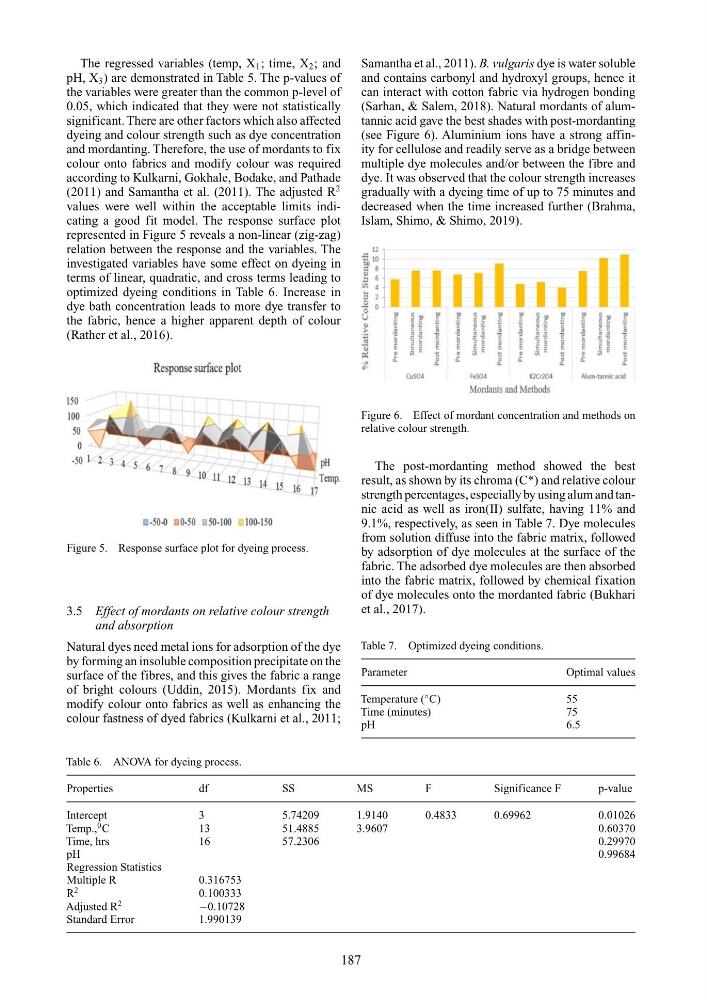
(Sarhan, & Salem, 2018). Natural mordants of alumtannic acid gave the best shades with post-mordanting
(see Figure 6). Aluminium ions have a strong affinity for cellulose and readily serve as a bridge between
multiple dye molecules and/or between the fibre and
dye. It was observed that the colour strength increases
gradually with a dyeing time of up to 75 minutes and
decreased when the time increased further (Brahma,
Islam, Shimo, & Shimo, 2019).
Figure 6. Effect of mordant concentration and methods on
relative colour strength.
The post-mordanting method showed the best
result, as shown by its chroma (C*) and relative colour
strength percentages, especially by using alum and tannic acid as well as iron(II) sulfate, having 11% and
9.1%, respectively, as seen in Table 7. Dye molecules
from solution diffuse into the fabric matrix, followed
by adsorption of dye molecules at the surface of the
fabric. The adsorbed dye molecules are then absorbed
into the fabric matrix, followed by chemical fixation
of dye molecules onto the mordanted fabric (Bukhari
et al., 2017).
Table 7. Optimized dyeing conditions.
Parameter
Optimal values
Temperature (
◦ C)
55
Time (minutes)
75
pH
6.5
187
pH, X 3 ) are demonstrated in Table 5. The p-values of
the variables were greater than the common p-level of
0.05, which indicated that they were not statistically
significant. There are other factors which also affected
dyeing and colour strength such as dye concentration
and mordanting. Therefore, the use of mordants to fix
colour onto fabrics and modify colour was required
according to Kulkarni, Gokhale, Bodake, and Pathade
(2011) and Samantha et al. (2011). The adjusted R
2
values were well within the acceptable limits indicating a good fit model. The response surface plot
represented in Figure 5 reveals a non-linear (zig-zag)
relation between the response and the variables. The
investigated variables have some effect on dyeing in
terms of linear, quadratic, and cross terms leading to
optimized dyeing conditions in Table 6. Increase in
dye bath concentration leads to more dye transfer to
the fabric, hence a higher apparent depth of colour
(Rather et al., 2016).
Figure 5. Response surface plot for dyeing process.
3.5 Effect of mordants on relative colour strength
and absorption
Natural dyes need metal ions for adsorption of the dye
by forming an insoluble composition precipitate on the
surface of the fibres, and this gives the fabric a range
of bright colours (Uddin, 2015). Mordants fix and
modify colour onto fabrics as well as enhancing the
colour fastness of dyed fabrics (Kulkarni et al., 2011;
Table 6. ANOVA for dyeing process.
Properties
df
SS
MS
F
Significance F
p-value
Intercept
3
5.74209
1.9140
0.4833
0.69962
0.01026
Temp.,
0 C
13
51.4885
3.9607
0.60370
Time, hrs
16
57.2306
0.29970
pH
0.99684
Regression Statistics
Multiple R
0.316753
R
2
0.100333
Adjusted R
2
−0.10728
Standard Error
1.990139
Samantha et al., 2011). B. vulgaris dye is water soluble
and contains carbonyl and hydroxyl groups, hence it
can interact with cotton fabric via hydrogen bonding
(Sarhan, & Salem, 2018). Natural mordants of alumtannic acid gave the best shades with post-mordanting
(see Figure 6). Aluminium ions have a strong affinity for cellulose and readily serve as a bridge between
multiple dye molecules and/or between the fibre and
dye. It was observed that the colour strength increases
gradually with a dyeing time of up to 75 minutes and
decreased when the time increased further (Brahma,
Islam, Shimo, & Shimo, 2019).
Figure 6. Effect of mordant concentration and methods on
relative colour strength.
The post-mordanting method showed the best
result, as shown by its chroma (C*) and relative colour
strength percentages, especially by using alum and tannic acid as well as iron(II) sulfate, having 11% and
9.1%, respectively, as seen in Table 7. Dye molecules
from solution diffuse into the fabric matrix, followed
by adsorption of dye molecules at the surface of the
fabric. The adsorbed dye molecules are then absorbed
into the fabric matrix, followed by chemical fixation
of dye molecules onto the mordanted fabric (Bukhari
et al., 2017).
Table 7. Optimized dyeing conditions.
Parameter
Optimal values
Temperature (
◦ C)
55
Time (minutes)
75
pH
6.5
187