

Table 1. Phytochemicals identified in essential oils of P.
caribaea fresh needles from Uganda.
Peak
Constituent
RI
a
Area (%)
1
α− Pinene
1032
27.6 ± 0.17
2
α− Thujene
1035
0.7 ± 0.00
3
Camphene
1076
1.6 ± 0.20
4
Hexanal
1093
Trace
5
β− Pinene
1118
0.6 ± 0.10
6
Sabinene
1132
0.9 ± 0.00
7
Myrcene
1174
3.5 ± 0.20
8
α− Phellandrene
1176
2.1 ± 0.17
9
α− Terpinene
1188
0.6 ± 0.10
10
Limonene
1203
38.6 ± 0.10
11
1,8-Cineole
1213
0.2 ± 0.00
12
β− phellandrene
1218
1.0 ± 0.10
13
γ− Terpinene
1255
Trace
14
Trans-linalool oxide
1450
0.5 ± 0.10
15
α− Copaene
1497
0.3 ± 0.00
16
Camphor
1532
0.3 ± 0.10
17
β− Cubebene
1547
Trace
18
Linalool
1553
1.1 ± 0.17
19
Aristolene
1589
0.9 ± 0.17
20
Bornyl acetate
1590
1.1 ± 0.00
21
β− Caryophyllene
1612
1.2 ± 0.10
22
Citronellyl acetate
1668
0.4 ± 0.00
23
α− Humulene
1687
0.2 ± 0.10
24
γ− Muurolene
1704
0.3 ± 0.00
25
α− Terpinyl acetate
1709
Trace
26
Borneol
1719
6.7 ± 0.00
27
Germacrene D
1726
0.8 ± 0.10
28
α− Muurolene
1740
0.3 ± 0.00
29
β− Selinene
1742
0.3 ± 0.00
30
Carvone
1751
0.2 ± 0.00
31
δ− Cadinene
1773
0.4 ± 0.10
32
Trans-Carveol
1845
0.5 ± 0.00
33
p-cymen-8-ol
1864
0.1 ± 0.00
34
Cis-Carveol
1882
0.5 ± 0.17
35
Geranyl butyrate
1901
0.2 ± 0.10
36
Caryophyllene oxide
2008
0.2 ± 0.00
37
Ledol
2057
0.7 ± 0.00
38
Globulol
2098
0.8 ± 0.10
39
Guaiol
2103
0.2 ± 0.10
Monoterpene hydrocarbons
77.2%
Sesquiterpene hydrocarbons
4.7%
Oxygenated monoterpenes
12.0%
Oxygenated sesquiterpenes
1.7%
Total
95.6%
Trace = <0.01%.
∗ RI = Retention index as determined on
an Innowax FSC column. Peak area presented as mean ±
standard deviation of triplicates.
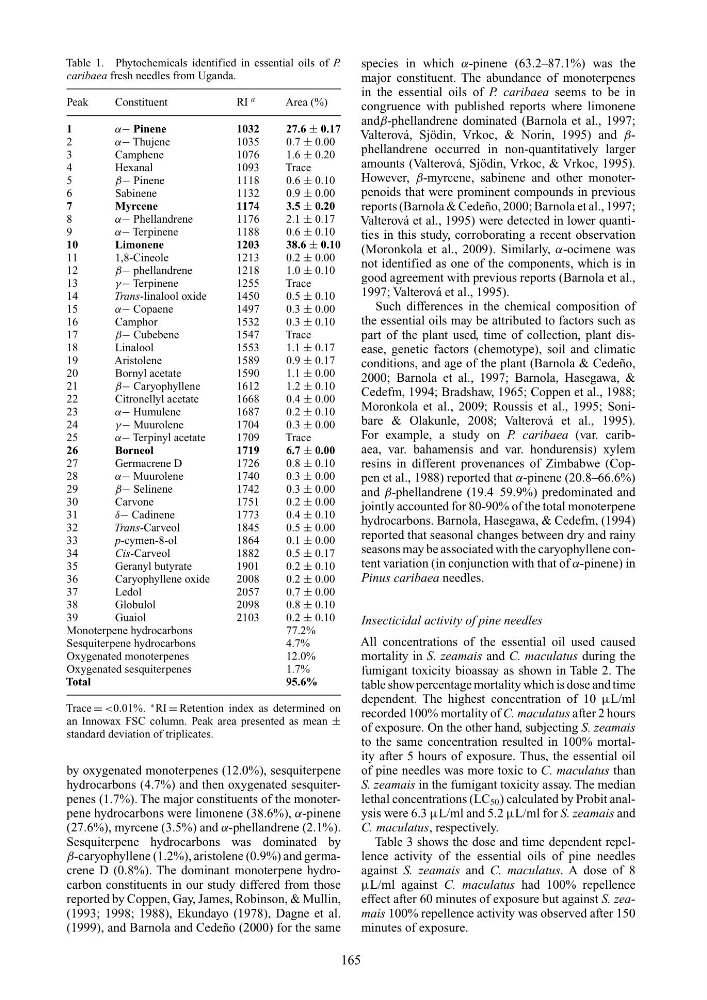
by oxygenated monoterpenes (12.0%), sesquiterpene
hydrocarbons (4.7%) and then oxygenated sesquiterpenes (1.7%). The major constituents of the monoterpene hydrocarbons were limonene (38.6%), α-pinene
(27.6%), myrcene (3.5%) and α-phellandrene (2.1%).
Sesquiterpene hydrocarbons was dominated by
β-caryophyllene (1.2%), aristolene (0.9%) and germacrene D (0.8%). The dominant monoterpene hydrocarbon constituents in our study differed from those
reported by Coppen, Gay, James, Robinson, & Mullin,
(1993; 1998; 1988), Ekundayo (1978), Dagne et al.
(1999), and Barnola and Cedeño (2000) for the same
species in which α-pinene (63.2–87.1%) was the
major constituent. The abundance of monoterpenes
in the essential oils of P. caribaea seems to be in
congruence with published reports where limonene
andβ-phellandrene dominated (Barnola et al., 1997;
Valterová, Sjödin, Vrkoc, & Norin, 1995) and βphellandrene occurred in non-quantitatively larger
amounts (Valterová, Sjödin, Vrkoc, & Vrkoc, 1995).
However, β-myrcene, sabinene and other monoterpenoids that were prominent compounds in previous
reports (Barnola & Cedeño, 2000; Barnola et al., 1997;
Valterová et al., 1995) were detected in lower quantities in this study, corroborating a recent observation
(Moronkola et al., 2009). Similarly, α-ocimene was
not identified as one of the components, which is in
good agreement with previous reports (Barnola et al.,
1997; Valterová et al., 1995).
Such differences in the chemical composition of
the essential oils may be attributed to factors such as
part of the plant used, time of collection, plant disease, genetic factors (chemotype), soil and climatic
conditions, and age of the plant (Barnola & Cedeño,
2000; Barnola et al., 1997; Barnola, Hasegawa, &
Cedefm, 1994; Bradshaw, 1965; Coppen et al., 1988;
Moronkola et al., 2009; Roussis et al., 1995; Sonibare & Olakunle, 2008; Valterová et al., 1995).
For example, a study on P. caribaea (var. caribaea, var. bahamensis and var. hondurensis) xylem
resins in different provenances of Zimbabwe (Coppen et al., 1988) reported that α-pinene (20.8–66.6%)
and β-phellandrene (19.4–59.9%) predominated and
jointly accounted for 80-90% of the total monoterpene
hydrocarbons. Barnola, Hasegawa, & Cedefm, (1994)
reported that seasonal changes between dry and rainy
seasons may be associated with the caryophyllene content variation (in conjunction with that of α-pinene) in
Pinus caribaea needles.
Insecticidal activity of pine needles
All concentrations of the essential oil used caused
mortality in S. zeamais and C. maculatus during the
fumigant toxicity bioassay as shown in Table 2. The
table show percentage mortality which is dose and time
dependent. The highest concentration of 10 µL/ml
recorded 100% mortality of C. maculatus after 2 hours
of exposure. On the other hand, subjecting S. zeamais
to the same concentration resulted in 100% mortality after 5 hours of exposure. Thus, the essential oil
of pine needles was more toxic to C. maculatus than
S. zeamais in the fumigant toxicity assay. The median
lethal concentrations (LC 50 ) calculated by Probit analysis were 6.3 µL/ml and 5.2 µL/ml for S. zeamais and
C. maculatus, respectively.
Table 3 shows the dose and time dependent repellence activity of the essential oils of pine needles
against S. zeamais and C. maculatus. A dose of 8
µL/ml against C. maculatus had 100% repellence
effect after 60 minutes of exposure but against S. zeamais 100% repellence activity was observed after 150
minutes of exposure.
165
caribaea fresh needles from Uganda.
Peak
Constituent
RI
a
Area (%)
1
α− Pinene
1032
27.6 ± 0.17
2
α− Thujene
1035
0.7 ± 0.00
3
Camphene
1076
1.6 ± 0.20
4
Hexanal
1093
Trace
5
β− Pinene
1118
0.6 ± 0.10
6
Sabinene
1132
0.9 ± 0.00
7
Myrcene
1174
3.5 ± 0.20
8
α− Phellandrene
1176
2.1 ± 0.17
9
α− Terpinene
1188
0.6 ± 0.10
10
Limonene
1203
38.6 ± 0.10
11
1,8-Cineole
1213
0.2 ± 0.00
12
β− phellandrene
1218
1.0 ± 0.10
13
γ− Terpinene
1255
Trace
14
Trans-linalool oxide
1450
0.5 ± 0.10
15
α− Copaene
1497
0.3 ± 0.00
16
Camphor
1532
0.3 ± 0.10
17
β− Cubebene
1547
Trace
18
Linalool
1553
1.1 ± 0.17
19
Aristolene
1589
0.9 ± 0.17
20
Bornyl acetate
1590
1.1 ± 0.00
21
β− Caryophyllene
1612
1.2 ± 0.10
22
Citronellyl acetate
1668
0.4 ± 0.00
23
α− Humulene
1687
0.2 ± 0.10
24
γ− Muurolene
1704
0.3 ± 0.00
25
α− Terpinyl acetate
1709
Trace
26
Borneol
1719
6.7 ± 0.00
27
Germacrene D
1726
0.8 ± 0.10
28
α− Muurolene
1740
0.3 ± 0.00
29
β− Selinene
1742
0.3 ± 0.00
30
Carvone
1751
0.2 ± 0.00
31
δ− Cadinene
1773
0.4 ± 0.10
32
Trans-Carveol
1845
0.5 ± 0.00
33
p-cymen-8-ol
1864
0.1 ± 0.00
34
Cis-Carveol
1882
0.5 ± 0.17
35
Geranyl butyrate
1901
0.2 ± 0.10
36
Caryophyllene oxide
2008
0.2 ± 0.00
37
Ledol
2057
0.7 ± 0.00
38
Globulol
2098
0.8 ± 0.10
39
Guaiol
2103
0.2 ± 0.10
Monoterpene hydrocarbons
77.2%
Sesquiterpene hydrocarbons
4.7%
Oxygenated monoterpenes
12.0%
Oxygenated sesquiterpenes
1.7%
Total
95.6%
Trace = <0.01%.
∗ RI = Retention index as determined on
an Innowax FSC column. Peak area presented as mean ±
standard deviation of triplicates.
by oxygenated monoterpenes (12.0%), sesquiterpene
hydrocarbons (4.7%) and then oxygenated sesquiterpenes (1.7%). The major constituents of the monoterpene hydrocarbons were limonene (38.6%), α-pinene
(27.6%), myrcene (3.5%) and α-phellandrene (2.1%).
Sesquiterpene hydrocarbons was dominated by
β-caryophyllene (1.2%), aristolene (0.9%) and germacrene D (0.8%). The dominant monoterpene hydrocarbon constituents in our study differed from those
reported by Coppen, Gay, James, Robinson, & Mullin,
(1993; 1998; 1988), Ekundayo (1978), Dagne et al.
(1999), and Barnola and Cedeño (2000) for the same
species in which α-pinene (63.2–87.1%) was the
major constituent. The abundance of monoterpenes
in the essential oils of P. caribaea seems to be in
congruence with published reports where limonene
andβ-phellandrene dominated (Barnola et al., 1997;
Valterová, Sjödin, Vrkoc, & Norin, 1995) and βphellandrene occurred in non-quantitatively larger
amounts (Valterová, Sjödin, Vrkoc, & Vrkoc, 1995).
However, β-myrcene, sabinene and other monoterpenoids that were prominent compounds in previous
reports (Barnola & Cedeño, 2000; Barnola et al., 1997;
Valterová et al., 1995) were detected in lower quantities in this study, corroborating a recent observation
(Moronkola et al., 2009). Similarly, α-ocimene was
not identified as one of the components, which is in
good agreement with previous reports (Barnola et al.,
1997; Valterová et al., 1995).
Such differences in the chemical composition of
the essential oils may be attributed to factors such as
part of the plant used, time of collection, plant disease, genetic factors (chemotype), soil and climatic
conditions, and age of the plant (Barnola & Cedeño,
2000; Barnola et al., 1997; Barnola, Hasegawa, &
Cedefm, 1994; Bradshaw, 1965; Coppen et al., 1988;
Moronkola et al., 2009; Roussis et al., 1995; Sonibare & Olakunle, 2008; Valterová et al., 1995).
For example, a study on P. caribaea (var. caribaea, var. bahamensis and var. hondurensis) xylem
resins in different provenances of Zimbabwe (Coppen et al., 1988) reported that α-pinene (20.8–66.6%)
and β-phellandrene (19.4–59.9%) predominated and
jointly accounted for 80-90% of the total monoterpene
hydrocarbons. Barnola, Hasegawa, & Cedefm, (1994)
reported that seasonal changes between dry and rainy
seasons may be associated with the caryophyllene content variation (in conjunction with that of α-pinene) in
Pinus caribaea needles.
Insecticidal activity of pine needles
All concentrations of the essential oil used caused
mortality in S. zeamais and C. maculatus during the
fumigant toxicity bioassay as shown in Table 2. The
table show percentage mortality which is dose and time
dependent. The highest concentration of 10 µL/ml
recorded 100% mortality of C. maculatus after 2 hours
of exposure. On the other hand, subjecting S. zeamais
to the same concentration resulted in 100% mortality after 5 hours of exposure. Thus, the essential oil
of pine needles was more toxic to C. maculatus than
S. zeamais in the fumigant toxicity assay. The median
lethal concentrations (LC 50 ) calculated by Probit analysis were 6.3 µL/ml and 5.2 µL/ml for S. zeamais and
C. maculatus, respectively.
Table 3 shows the dose and time dependent repellence activity of the essential oils of pine needles
against S. zeamais and C. maculatus. A dose of 8
µL/ml against C. maculatus had 100% repellence
effect after 60 minutes of exposure but against S. zeamais 100% repellence activity was observed after 150
minutes of exposure.
165