

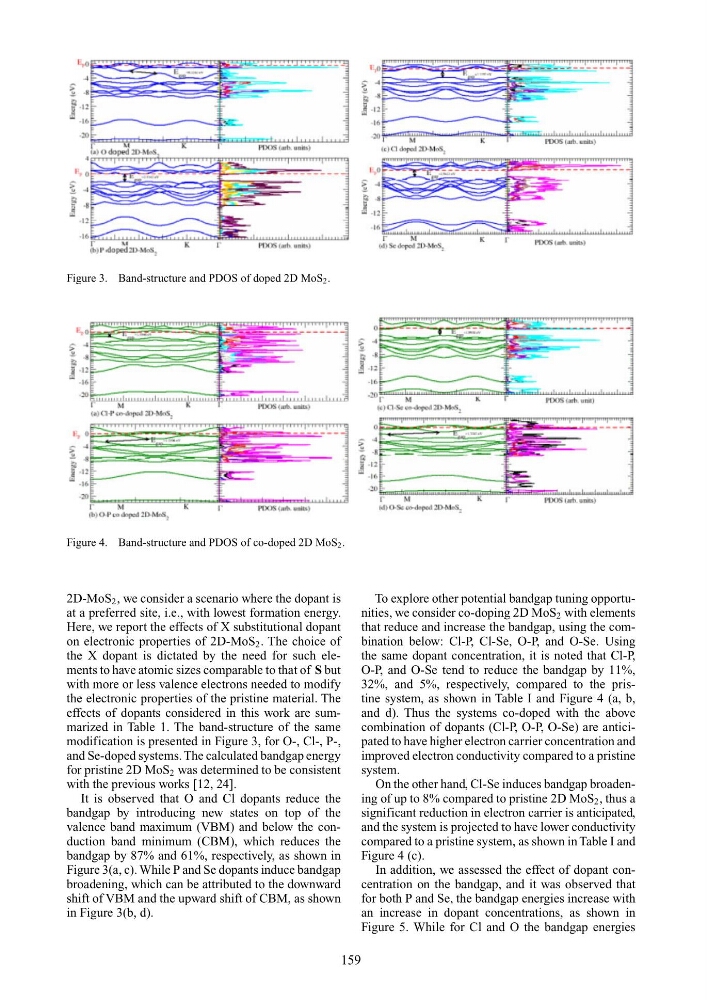
Figure 3. Band-structure and PDOS of doped 2D MoS 2 .
Figure 4. Band-structure and PDOS of co-doped 2D MoS 2 .
2D-MoS 2 , we consider a scenario where the dopant is
at a preferred site, i.e., with lowest formation energy.
Here, we report the effects of X substitutional dopant
on electronic properties of 2D-MoS 2 . The choice of
the X dopant is dictated by the need for such elements to have atomic sizes comparable to that of S but
with more or less valence electrons needed to modify
the electronic properties of the pristine material. The
effects of dopants considered in this work are summarized in Table 1. The band-structure of the same
modification is presented in Figure 3, for O-, Cl-, P-,
and Se-doped systems. The calculated bandgap energy
for pristine 2D MoS 2 was determined to be consistent
with the previous works [12, 24].
It is observed that O and Cl dopants reduce the
bandgap by introducing new states on top of the
valence band maximum (VBM) and below the conduction band minimum (CBM), which reduces the
bandgap by 87% and 61%, respectively, as shown in
Figure 3(a, c). While P and Se dopants induce bandgap
broadening, which can be attributed to the downward
shift of VBM and the upward shift of CBM, as shown
in Figure 3(b, d).
To explore other potential bandgap tuning opportunities, we consider co-doping 2D MoS 2 with elements
that reduce and increase the bandgap, using the combination below: Cl-P, Cl-Se, O-P, and O-Se. Using
the same dopant concentration, it is noted that Cl-P,
O-P, and O-Se tend to reduce the bandgap by 11%,
32%, and 5%, respectively, compared to the pristine system, as shown in Table I and Figure 4 (a, b,
and d). Thus the systems co-doped with the above
combination of dopants (Cl-P, O-P, O-Se) are anticipated to have higher electron carrier concentration and
improved electron conductivity compared to a pristine
system.
On the other hand, Cl-Se induces bandgap broadening of up to 8% compared to pristine 2D MoS 2 , thus a
significant reduction in electron carrier is anticipated,
and the system is projected to have lower conductivity
compared to a pristine system, as shown in Table I and
Figure 4 (c).
In addition, we assessed the effect of dopant concentration on the bandgap, and it was observed that
for both P and Se, the bandgap energies increase with
an increase in dopant concentrations, as shown in
Figure 5. While for Cl and O the bandgap energies
159
Figure 4. Band-structure and PDOS of co-doped 2D MoS 2 .
2D-MoS 2 , we consider a scenario where the dopant is
at a preferred site, i.e., with lowest formation energy.
Here, we report the effects of X substitutional dopant
on electronic properties of 2D-MoS 2 . The choice of
the X dopant is dictated by the need for such elements to have atomic sizes comparable to that of S but
with more or less valence electrons needed to modify
the electronic properties of the pristine material. The
effects of dopants considered in this work are summarized in Table 1. The band-structure of the same
modification is presented in Figure 3, for O-, Cl-, P-,
and Se-doped systems. The calculated bandgap energy
for pristine 2D MoS 2 was determined to be consistent
with the previous works [12, 24].
It is observed that O and Cl dopants reduce the
bandgap by introducing new states on top of the
valence band maximum (VBM) and below the conduction band minimum (CBM), which reduces the
bandgap by 87% and 61%, respectively, as shown in
Figure 3(a, c). While P and Se dopants induce bandgap
broadening, which can be attributed to the downward
shift of VBM and the upward shift of CBM, as shown
in Figure 3(b, d).
To explore other potential bandgap tuning opportunities, we consider co-doping 2D MoS 2 with elements
that reduce and increase the bandgap, using the combination below: Cl-P, Cl-Se, O-P, and O-Se. Using
the same dopant concentration, it is noted that Cl-P,
O-P, and O-Se tend to reduce the bandgap by 11%,
32%, and 5%, respectively, compared to the pristine system, as shown in Table I and Figure 4 (a, b,
and d). Thus the systems co-doped with the above
combination of dopants (Cl-P, O-P, O-Se) are anticipated to have higher electron carrier concentration and
improved electron conductivity compared to a pristine
system.
On the other hand, Cl-Se induces bandgap broadening of up to 8% compared to pristine 2D MoS 2 , thus a
significant reduction in electron carrier is anticipated,
and the system is projected to have lower conductivity
compared to a pristine system, as shown in Table I and
Figure 4 (c).
In addition, we assessed the effect of dopant concentration on the bandgap, and it was observed that
for both P and Se, the bandgap energies increase with
an increase in dopant concentrations, as shown in
Figure 5. While for Cl and O the bandgap energies
159