

materials via such approaches [17]. However, comprehensive studies that consider substitutional doping
of 2D MoS 2 with non-metallic elements as a potential route towards realization of superior properties are
limited, yet such studies may provide critical insights
that may enable further optimization.
In this work, we perform ab initio density functional theory (DFT) calculations for selected sulfur
substitutional dopants denoted by X (where X=Cl,
O, Se, and P). To ensure negligible structural distortion of 2D MoS 2 , the selected dopants should
have an atomic radius comparable to that of the sulfur atom but with more/less valence electrons that
can modify the electronic properties of the host
material. Thereafter, the preferred doping site was
determined and then the effects of dopants concentration on structural and electronic properties explored.
Whereas the ab initio DFT calculations have previously focused on transition metal substitutional doping
in 2D MoS 2 [18], studies that evaluate non-metallic
dopants for tuning the electronic properties are lacking. A comprehensive understanding of atomic scale
doping structure and corresponding change in properties can provide pathways for the synthesis of doped
2D MoS 2 for various applications. Moreover, these
findings can be extended to other semiconductors,
whose pure electronic structures are similar to those
of 2D-MoS 2 .
2 COMPUTATIONAL DETAILS
All calculations reported in this work were performed
within the framework of DFT [19], as implemented in
Quantum espresso suite [20]. The generalized gradient
approximation (GGA) to the exchange and correlation
was employed in the form proposed by Perdew–
Burke–Ernzerhof (PBE) [21]. The core electrons were
replaced with ultra-soft pseudo-potential as per Vanderbilt’s formalism [22] and the charge density in the
system was expanded on a plane wave basis set with
energy cutoff of 70 Ry (700 Ry).
A well converged Monkhorst-Pack grid of 4×4×1
was used for the integration of the Brillouin zone [23].
In all cases the geometrical optimizations were performed using the conjugate gradient algorithm until
all forces were lower than 0.01 eV/Å, and the total
energy for ionic minimization was considered converged when the total energy changes were lower
than 10
−8 eV between consecutive self-consistent
steps.
The simulation of X-doped systems for the different dopant concentrations considered in this work used
similar convergent parameters to those utilized in pristine 2D MoS 2 . Super-cell calculations were performed
using an optimized cell with a vacuum of 16 Å along
the perpendicular direction, which ensured no interaction between the periodic images of the monolayer.
Grimme-term was incorporated in all the calculations
to ensure that theVan der Waals interaction is described
correctly [24].
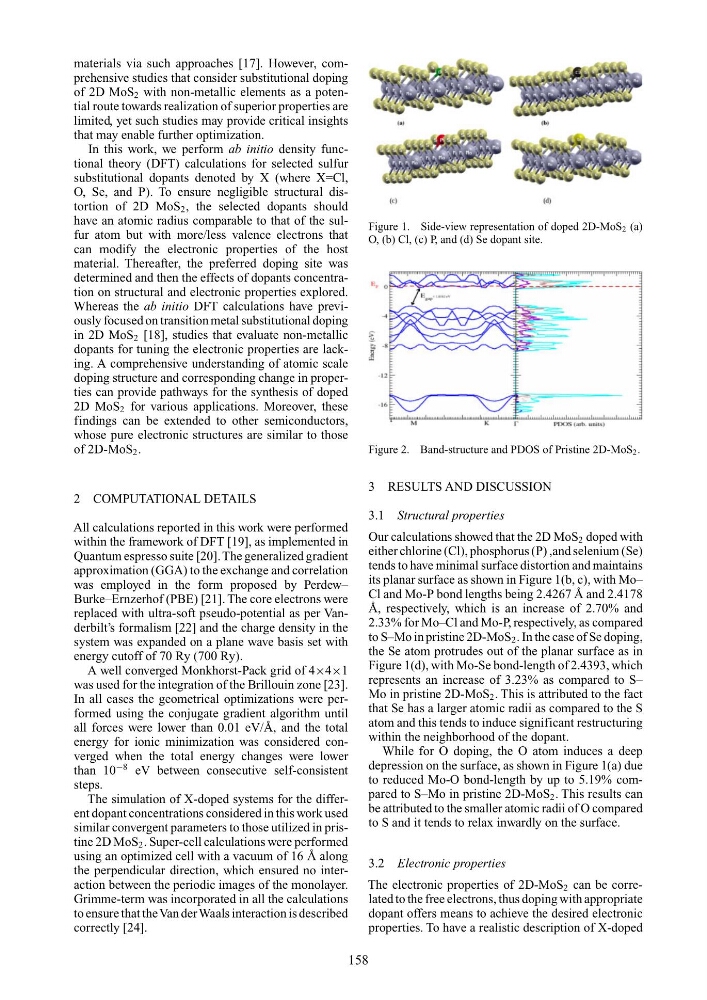
Figure 1. Side-view representation of doped 2D-MoS 2 (a)
O, (b) Cl, (c) P, and (d) Se dopant site.
Figure 2. Band-structure and PDOS of Pristine 2D-MoS 2 .
3 RESULTS AND DISCUSSION
3.1 Structural properties
Our calculations showed that the 2D MoS 2 doped with
either chlorine (Cl), phosphorus (P) ,and selenium (Se)
tends to have minimal surface distortion and maintains
its planar surface as shown in Figure 1(b, c), with Mo–
Cl and Mo-P bond lengths being 2.4267 Å and 2.4178
Å, respectively, which is an increase of 2.70% and
2.33% for Mo–Cl and Mo-P, respectively, as compared
to S–Mo in pristine 2D-MoS 2 . In the case of Se doping,
the Se atom protrudes out of the planar surface as in
Figure 1(d), with Mo-Se bond-length of 2.4393, which
represents an increase of 3.23% as compared to S–
Mo in pristine 2D-MoS 2 . This is attributed to the fact
that Se has a larger atomic radii as compared to the S
atom and this tends to induce significant restructuring
within the neighborhood of the dopant.
While for O doping, the O atom induces a deep
depression on the surface, as shown in Figure 1(a) due
to reduced Mo-O bond-length by up to 5.19% compared to S–Mo in pristine 2D-MoS 2 . This results can
be attributed to the smaller atomic radii of O compared
to S and it tends to relax inwardly on the surface.
3.2 Electronic properties
The electronic properties of 2D-MoS 2 can be correlated to the free electrons, thus doping with appropriate
dopant offers means to achieve the desired electronic
properties. To have a realistic description of X-doped
158
of 2D MoS 2 with non-metallic elements as a potential route towards realization of superior properties are
limited, yet such studies may provide critical insights
that may enable further optimization.
In this work, we perform ab initio density functional theory (DFT) calculations for selected sulfur
substitutional dopants denoted by X (where X=Cl,
O, Se, and P). To ensure negligible structural distortion of 2D MoS 2 , the selected dopants should
have an atomic radius comparable to that of the sulfur atom but with more/less valence electrons that
can modify the electronic properties of the host
material. Thereafter, the preferred doping site was
determined and then the effects of dopants concentration on structural and electronic properties explored.
Whereas the ab initio DFT calculations have previously focused on transition metal substitutional doping
in 2D MoS 2 [18], studies that evaluate non-metallic
dopants for tuning the electronic properties are lacking. A comprehensive understanding of atomic scale
doping structure and corresponding change in properties can provide pathways for the synthesis of doped
2D MoS 2 for various applications. Moreover, these
findings can be extended to other semiconductors,
whose pure electronic structures are similar to those
of 2D-MoS 2 .
2 COMPUTATIONAL DETAILS
All calculations reported in this work were performed
within the framework of DFT [19], as implemented in
Quantum espresso suite [20]. The generalized gradient
approximation (GGA) to the exchange and correlation
was employed in the form proposed by Perdew–
Burke–Ernzerhof (PBE) [21]. The core electrons were
replaced with ultra-soft pseudo-potential as per Vanderbilt’s formalism [22] and the charge density in the
system was expanded on a plane wave basis set with
energy cutoff of 70 Ry (700 Ry).
A well converged Monkhorst-Pack grid of 4×4×1
was used for the integration of the Brillouin zone [23].
In all cases the geometrical optimizations were performed using the conjugate gradient algorithm until
all forces were lower than 0.01 eV/Å, and the total
energy for ionic minimization was considered converged when the total energy changes were lower
than 10
−8 eV between consecutive self-consistent
steps.
The simulation of X-doped systems for the different dopant concentrations considered in this work used
similar convergent parameters to those utilized in pristine 2D MoS 2 . Super-cell calculations were performed
using an optimized cell with a vacuum of 16 Å along
the perpendicular direction, which ensured no interaction between the periodic images of the monolayer.
Grimme-term was incorporated in all the calculations
to ensure that theVan der Waals interaction is described
correctly [24].
Figure 1. Side-view representation of doped 2D-MoS 2 (a)
O, (b) Cl, (c) P, and (d) Se dopant site.
Figure 2. Band-structure and PDOS of Pristine 2D-MoS 2 .
3 RESULTS AND DISCUSSION
3.1 Structural properties
Our calculations showed that the 2D MoS 2 doped with
either chlorine (Cl), phosphorus (P) ,and selenium (Se)
tends to have minimal surface distortion and maintains
its planar surface as shown in Figure 1(b, c), with Mo–
Cl and Mo-P bond lengths being 2.4267 Å and 2.4178
Å, respectively, which is an increase of 2.70% and
2.33% for Mo–Cl and Mo-P, respectively, as compared
to S–Mo in pristine 2D-MoS 2 . In the case of Se doping,
the Se atom protrudes out of the planar surface as in
Figure 1(d), with Mo-Se bond-length of 2.4393, which
represents an increase of 3.23% as compared to S–
Mo in pristine 2D-MoS 2 . This is attributed to the fact
that Se has a larger atomic radii as compared to the S
atom and this tends to induce significant restructuring
within the neighborhood of the dopant.
While for O doping, the O atom induces a deep
depression on the surface, as shown in Figure 1(a) due
to reduced Mo-O bond-length by up to 5.19% compared to S–Mo in pristine 2D-MoS 2 . This results can
be attributed to the smaller atomic radii of O compared
to S and it tends to relax inwardly on the surface.
3.2 Electronic properties
The electronic properties of 2D-MoS 2 can be correlated to the free electrons, thus doping with appropriate
dopant offers means to achieve the desired electronic
properties. To have a realistic description of X-doped
158