

Table 1. Effects of dopants on the bandgap of 2D MoS 2 at
4.17% dopant concentration.
Dopant atom(s)
Bandgap energy (eV)
O
0.2282
Cl
1.1192
P
2.5242
Se
2.9412
Cl+P
1.5946
Cl+Se
1.9958
O+P
1.2396
O+Se
1.7287
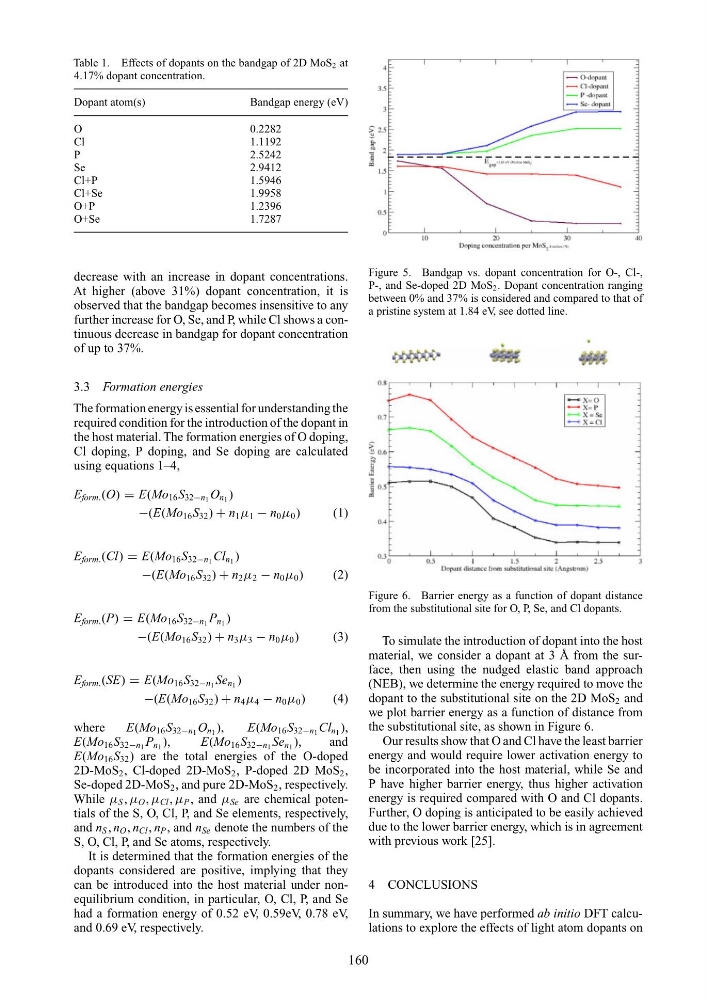
decrease with an increase in dopant concentrations.
At higher (above 31%) dopant concentration, it is
observed that the bandgap becomes insensitive to any
further increase for O, Se, and P, while Cl shows a continuous decrease in bandgap for dopant concentration
of up to 37%.
3.3 Formation energies
The formation energy is essential for understanding the
required condition for the introduction of the dopant in
the host material. The formation energies of O doping,
Cl doping, P doping, and Se doping are calculated
using equations 1–4,
E form. (O) = E(Mo 16 S 32−n1 O n1 )
−(E(Mo 16 S 32 ) + n 1 µ 1 − n 0 µ 0 )
(1)
E form. (Cl) = E(Mo 16 S 32−n1 Cl n1 )
−(E(Mo 16 S 32 ) + n 2 µ 2 − n 0 µ 0 )
(2)
E form. (P) = E(Mo 16 S 32−n1 P n1 )
−(E(Mo 16 S 32 ) + n 3 µ 3 − n 0 µ 0 )
(3)
E form. (SE) = E(Mo 16 S 32−n1 Se n1 )
−(E(Mo 16 S 32 ) + n 4 µ 4 − n 0 µ 0 )
(4)
where
E(Mo 16 S 32−n1 O n1 ),
E(Mo 16 S 32−n1 Cl n1 ),
E(Mo 16 S 32−n1 P n1 ),
E(Mo 16 S 32−n1 Se n1 ),
and
E(Mo 16 S 32 ) are the total energies of the O-doped
2D-MoS 2 , Cl-doped 2D-MoS 2 , P-doped 2D MoS 2 ,
Se-doped 2D-MoS 2 , and pure 2D-MoS 2 , respectively.
While µ S , µ O , µ Cl , µ P , and µ Se are chemical potentials of the S, O, Cl, P, and Se elements, respectively,
and n S , n O , n Cl , n P , and n Se denote the numbers of the
S, O, Cl, P, and Se atoms, respectively.
It is determined that the formation energies of the
dopants considered are positive, implying that they
can be introduced into the host material under nonequilibrium condition, in particular, O, Cl, P, and Se
had a formation energy of 0.52 eV, 0.59eV, 0.78 eV,
and 0.69 eV, respectively.
Figure 5. Bandgap vs. dopant concentration for O-, Cl-,
P-, and Se-doped 2D MoS 2 . Dopant concentration ranging
between 0% and 37% is considered and compared to that of
a pristine system at 1.84 eV, see dotted line.
Figure 6. Barrier energy as a function of dopant distance
from the substitutional site for O, P, Se, and Cl dopants.
To simulate the introduction of dopant into the host
material, we consider a dopant at 3 Å from the surface, then using the nudged elastic band approach
(NEB), we determine the energy required to move the
dopant to the substitutional site on the 2D MoS 2 and
we plot barrier energy as a function of distance from
the substitutional site, as shown in Figure 6.
Our results show that O and Cl have the least barrier
energy and would require lower activation energy to
be incorporated into the host material, while Se and
P have higher barrier energy, thus higher activation
energy is required compared with O and Cl dopants.
Further, O doping is anticipated to be easily achieved
due to the lower barrier energy, which is in agreement
with previous work [25].
4 CONCLUSIONS
In summary, we have performed ab initio DFT calculations to explore the effects of light atom dopants on
160
4.17% dopant concentration.
Dopant atom(s)
Bandgap energy (eV)
O
0.2282
Cl
1.1192
P
2.5242
Se
2.9412
Cl+P
1.5946
Cl+Se
1.9958
O+P
1.2396
O+Se
1.7287
decrease with an increase in dopant concentrations.
At higher (above 31%) dopant concentration, it is
observed that the bandgap becomes insensitive to any
further increase for O, Se, and P, while Cl shows a continuous decrease in bandgap for dopant concentration
of up to 37%.
3.3 Formation energies
The formation energy is essential for understanding the
required condition for the introduction of the dopant in
the host material. The formation energies of O doping,
Cl doping, P doping, and Se doping are calculated
using equations 1–4,
E form. (O) = E(Mo 16 S 32−n1 O n1 )
−(E(Mo 16 S 32 ) + n 1 µ 1 − n 0 µ 0 )
(1)
E form. (Cl) = E(Mo 16 S 32−n1 Cl n1 )
−(E(Mo 16 S 32 ) + n 2 µ 2 − n 0 µ 0 )
(2)
E form. (P) = E(Mo 16 S 32−n1 P n1 )
−(E(Mo 16 S 32 ) + n 3 µ 3 − n 0 µ 0 )
(3)
E form. (SE) = E(Mo 16 S 32−n1 Se n1 )
−(E(Mo 16 S 32 ) + n 4 µ 4 − n 0 µ 0 )
(4)
where
E(Mo 16 S 32−n1 O n1 ),
E(Mo 16 S 32−n1 Cl n1 ),
E(Mo 16 S 32−n1 P n1 ),
E(Mo 16 S 32−n1 Se n1 ),
and
E(Mo 16 S 32 ) are the total energies of the O-doped
2D-MoS 2 , Cl-doped 2D-MoS 2 , P-doped 2D MoS 2 ,
Se-doped 2D-MoS 2 , and pure 2D-MoS 2 , respectively.
While µ S , µ O , µ Cl , µ P , and µ Se are chemical potentials of the S, O, Cl, P, and Se elements, respectively,
and n S , n O , n Cl , n P , and n Se denote the numbers of the
S, O, Cl, P, and Se atoms, respectively.
It is determined that the formation energies of the
dopants considered are positive, implying that they
can be introduced into the host material under nonequilibrium condition, in particular, O, Cl, P, and Se
had a formation energy of 0.52 eV, 0.59eV, 0.78 eV,
and 0.69 eV, respectively.
Figure 5. Bandgap vs. dopant concentration for O-, Cl-,
P-, and Se-doped 2D MoS 2 . Dopant concentration ranging
between 0% and 37% is considered and compared to that of
a pristine system at 1.84 eV, see dotted line.
Figure 6. Barrier energy as a function of dopant distance
from the substitutional site for O, P, Se, and Cl dopants.
To simulate the introduction of dopant into the host
material, we consider a dopant at 3 Å from the surface, then using the nudged elastic band approach
(NEB), we determine the energy required to move the
dopant to the substitutional site on the 2D MoS 2 and
we plot barrier energy as a function of distance from
the substitutional site, as shown in Figure 6.
Our results show that O and Cl have the least barrier
energy and would require lower activation energy to
be incorporated into the host material, while Se and
P have higher barrier energy, thus higher activation
energy is required compared with O and Cl dopants.
Further, O doping is anticipated to be easily achieved
due to the lower barrier energy, which is in agreement
with previous work [25].
4 CONCLUSIONS
In summary, we have performed ab initio DFT calculations to explore the effects of light atom dopants on
160