

powdered plant material with 25 mL of methanol solvent (HPLC) and kept for 48 hrs with slight shaking.
All the extraction was performed at room temperature. All the extracts were filtered through Whatman
No.1 paper to get filtrate as extracts which was dried
to concentrate the samples (Prabhavathi, Prasad, &
Jayaramu 2016). 50 mL of Cissus quadrangualis leaf
extract was measured into a conical flask, which was
then boiled at 60–80
◦ C by a stirrer heater. 5g of zinc
nitrate was added to the solution when the temperature reached 60
◦ C. The mixture was heated until the
suspension turned deep yellow in color. The paste was
then collected in a ceramic crucible where it was transferred into an air furnace followed by heating at 400
◦ C
for 2 hrs. A light white colored solid of zinc oxide
was collected and then powdered to form zinc oxide
nanoparticles (Fazlzadeh et al. 2017).
2.4 Characterization of zinc oxide nanoparticles
The UV–Vis reflectance spectra (U–Vis DRS) measurements were carried out with UV140404B in the
wavelength range of 200–850 nm in reflectance mode.
The crystalline structure of the samples was analyzed
by using PANalytical X’PERT PRO model X-Ray
diffractometer, with the instrument operating at a
voltage of 50 kV and a current of 30 mA.
3 RESULTS AND DISCUSSION
The following were the data from the zinc oxide
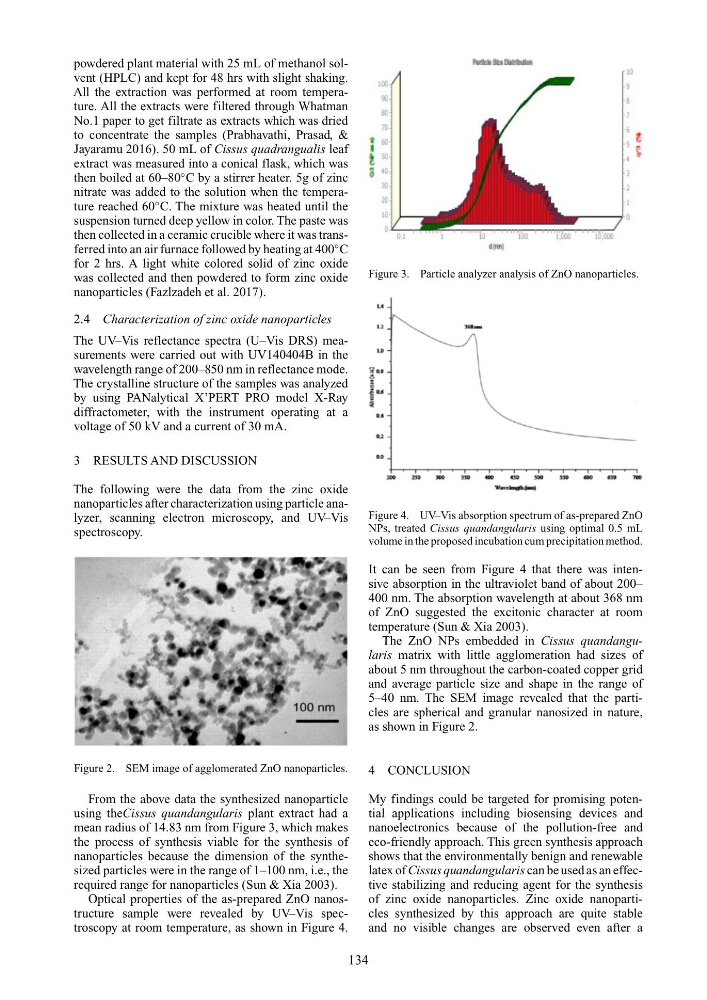
nanoparticles after characterization using particle analyzer, scanning electron microscopy, and UV–Vis
spectroscopy.
Figure 2. SEM image of agglomerated ZnO nanoparticles.
From the above data the synthesized nanoparticle
using theCissus quandangularis plant extract had a
mean radius of 14.83 nm from Figure 3, which makes
the process of synthesis viable for the synthesis of
nanoparticles because the dimension of the synthesized particles were in the range of 1–100 nm, i.e., the
required range for nanoparticles (Sun & Xia 2003).
Optical properties of the as-prepared ZnO nanostructure sample were revealed by UV–Vis spectroscopy at room temperature, as shown in Figure 4.
Figure 3. Particle analyzer analysis of ZnO nanoparticles.
Figure 4. UV–Vis absorption spectrum of as-prepared ZnO
NPs, treated Cissus quandangularis using optimal 0.5 mL
volume in the proposed incubation cum precipitation method.
It can be seen from Figure 4 that there was intensive absorption in the ultraviolet band of about 200–
400 nm. The absorption wavelength at about 368 nm
of ZnO suggested the excitonic character at room
temperature (Sun & Xia 2003).
The ZnO NPs embedded in Cissus quandangularis matrix with little agglomeration had sizes of
about 5 nm throughout the carbon-coated copper grid
and average particle size and shape in the range of
5–40 nm. The SEM image revealed that the particles are spherical and granular nanosized in nature,
as shown in Figure 2.
4 CONCLUSION
My findings could be targeted for promising potential applications including biosensing devices and
nanoelectronics because of the pollution-free and
eco-friendly approach. This green synthesis approach
shows that the environmentally benign and renewable
latex of Cissus quandangularis can be used as an effective stabilizing and reducing agent for the synthesis
of zinc oxide nanoparticles. Zinc oxide nanoparticles synthesized by this approach are quite stable
and no visible changes are observed even after a
134
All the extraction was performed at room temperature. All the extracts were filtered through Whatman
No.1 paper to get filtrate as extracts which was dried
to concentrate the samples (Prabhavathi, Prasad, &
Jayaramu 2016). 50 mL of Cissus quadrangualis leaf
extract was measured into a conical flask, which was
then boiled at 60–80
◦ C by a stirrer heater. 5g of zinc
nitrate was added to the solution when the temperature reached 60
◦ C. The mixture was heated until the
suspension turned deep yellow in color. The paste was
then collected in a ceramic crucible where it was transferred into an air furnace followed by heating at 400
◦ C
for 2 hrs. A light white colored solid of zinc oxide
was collected and then powdered to form zinc oxide
nanoparticles (Fazlzadeh et al. 2017).
2.4 Characterization of zinc oxide nanoparticles
The UV–Vis reflectance spectra (U–Vis DRS) measurements were carried out with UV140404B in the
wavelength range of 200–850 nm in reflectance mode.
The crystalline structure of the samples was analyzed
by using PANalytical X’PERT PRO model X-Ray
diffractometer, with the instrument operating at a
voltage of 50 kV and a current of 30 mA.
3 RESULTS AND DISCUSSION
The following were the data from the zinc oxide
nanoparticles after characterization using particle analyzer, scanning electron microscopy, and UV–Vis
spectroscopy.
Figure 2. SEM image of agglomerated ZnO nanoparticles.
From the above data the synthesized nanoparticle
using theCissus quandangularis plant extract had a
mean radius of 14.83 nm from Figure 3, which makes
the process of synthesis viable for the synthesis of
nanoparticles because the dimension of the synthesized particles were in the range of 1–100 nm, i.e., the
required range for nanoparticles (Sun & Xia 2003).
Optical properties of the as-prepared ZnO nanostructure sample were revealed by UV–Vis spectroscopy at room temperature, as shown in Figure 4.
Figure 3. Particle analyzer analysis of ZnO nanoparticles.
Figure 4. UV–Vis absorption spectrum of as-prepared ZnO
NPs, treated Cissus quandangularis using optimal 0.5 mL
volume in the proposed incubation cum precipitation method.
It can be seen from Figure 4 that there was intensive absorption in the ultraviolet band of about 200–
400 nm. The absorption wavelength at about 368 nm
of ZnO suggested the excitonic character at room
temperature (Sun & Xia 2003).
The ZnO NPs embedded in Cissus quandangularis matrix with little agglomeration had sizes of
about 5 nm throughout the carbon-coated copper grid
and average particle size and shape in the range of
5–40 nm. The SEM image revealed that the particles are spherical and granular nanosized in nature,
as shown in Figure 2.
4 CONCLUSION
My findings could be targeted for promising potential applications including biosensing devices and
nanoelectronics because of the pollution-free and
eco-friendly approach. This green synthesis approach
shows that the environmentally benign and renewable
latex of Cissus quandangularis can be used as an effective stabilizing and reducing agent for the synthesis
of zinc oxide nanoparticles. Zinc oxide nanoparticles synthesized by this approach are quite stable
and no visible changes are observed even after a
134