

Green routes are used for the synthesis of zinc
oxide nanoparticles because of the small number of
chemicals that are used, which then produces the least
amount of pollutants, and they are energy efficient and
cost-effective. A number of natural products such as
plants, fungi, algae, bacteria, and viruses can be used
to synthesize the zinc oxide nanoparticles (Naveed Ul
Haq et al. 2017).
In the past zinc oxide nanoparticles have been in
gas sensors, biosensors, cosmetics, storage, optical
devices, window materials for display, solar cells, and
drug delivery, due to their unique properties (Pascariu
& Homocianu 2019). Zinc oxide nanoparticles have
diameters of less than 100 nanometers. Their large surface area relative to their size results in higher catalytic
activity (Siripireddy & Mandal 2017).
Nanomaterials can function in the phytoremediation system through directly removing pollutants, promoting plant growth and increasing pollutant bioavailability to ease the remediation process. This means the
development of nanotechnology can provide an effective way of cleaning the environment with less cost
and harmful end products.
Zinc oxide (ZnO) nanoparticles have a wide
bandgap semiconductor with an energy gap of 3.37
eV at room temperature which then allows the transfer of electrons in the presence of light to initiate the
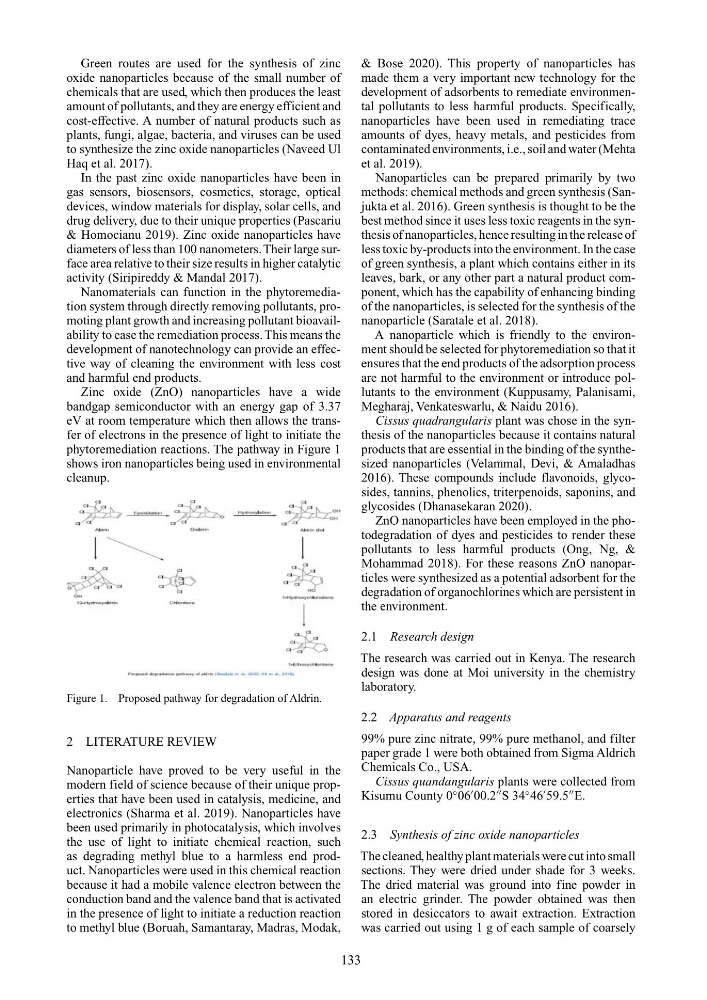
phytoremediation reactions. The pathway in Figure 1
shows iron nanoparticles being used in environmental
cleanup.
Figure 1. Proposed pathway for degradation of Aldrin.
2 LITERATURE REVIEW
Nanoparticle have proved to be very useful in the
modern field of science because of their unique properties that have been used in catalysis, medicine, and
electronics (Sharma et al. 2019). Nanoparticles have
been used primarily in photocatalysis, which involves
the use of light to initiate chemical reaction, such
as degrading methyl blue to a harmless end product. Nanoparticles were used in this chemical reaction
because it had a mobile valence electron between the
conduction band and the valence band that is activated
in the presence of light to initiate a reduction reaction
to methyl blue (Boruah, Samantaray, Madras, Modak,
& Bose 2020). This property of nanoparticles has
made them a very important new technology for the
development of adsorbents to remediate environmental pollutants to less harmful products. Specifically,
nanoparticles have been used in remediating trace
amounts of dyes, heavy metals, and pesticides from
contaminated environments, i.e., soil and water (Mehta
et al. 2019).
Nanoparticles can be prepared primarily by two
methods: chemical methods and green synthesis (Sanjukta et al. 2016). Green synthesis is thought to be the
best method since it uses less toxic reagents in the synthesis of nanoparticles, hence resulting in the release of
less toxic by-products into the environment. In the case
of green synthesis, a plant which contains either in its
leaves, bark, or any other part a natural product component, which has the capability of enhancing binding
of the nanoparticles, is selected for the synthesis of the
nanoparticle (Saratale et al. 2018).
A nanoparticle which is friendly to the environment should be selected for phytoremediation so that it
ensures that the end products of the adsorption process
are not harmful to the environment or introduce pollutants to the environment (Kuppusamy, Palanisami,
Megharaj, Venkateswarlu, & Naidu 2016).
Cissus quadrangularis plant was chose in the synthesis of the nanoparticles because it contains natural
products that are essential in the binding of the synthesized nanoparticles (Velammal, Devi, & Amaladhas
2016). These compounds include flavonoids, glycosides, tannins, phenolics, triterpenoids, saponins, and
glycosides (Dhanasekaran 2020).
ZnO nanoparticles have been employed in the photodegradation of dyes and pesticides to render these
pollutants to less harmful products (Ong, Ng, &
Mohammad 2018). For these reasons ZnO nanoparticles were synthesized as a potential adsorbent for the
degradation of organochlorines which are persistent in
the environment.
2.1 Research design
The research was carried out in Kenya. The research
design was done at Moi university in the chemistry
laboratory.
2.2 Apparatus and reagents
99% pure zinc nitrate, 99% pure methanol, and filter
paper grade 1 were both obtained from Sigma Aldrich
Chemicals Co., USA.
Cissus quandangularis plants were collected from
Kisumu County 0
◦ 06
00.2
S 34
◦ 46
59.5
E.
2.3 Synthesis of zinc oxide nanoparticles
The cleaned, healthy plant materials were cut into small
sections. They were dried under shade for 3 weeks.
The dried material was ground into fine powder in
an electric grinder. The powder obtained was then
stored in desiccators to await extraction. Extraction
was carried out using 1 g of each sample of coarsely
133
oxide nanoparticles because of the small number of
chemicals that are used, which then produces the least
amount of pollutants, and they are energy efficient and
cost-effective. A number of natural products such as
plants, fungi, algae, bacteria, and viruses can be used
to synthesize the zinc oxide nanoparticles (Naveed Ul
Haq et al. 2017).
In the past zinc oxide nanoparticles have been in
gas sensors, biosensors, cosmetics, storage, optical
devices, window materials for display, solar cells, and
drug delivery, due to their unique properties (Pascariu
& Homocianu 2019). Zinc oxide nanoparticles have
diameters of less than 100 nanometers. Their large surface area relative to their size results in higher catalytic
activity (Siripireddy & Mandal 2017).
Nanomaterials can function in the phytoremediation system through directly removing pollutants, promoting plant growth and increasing pollutant bioavailability to ease the remediation process. This means the
development of nanotechnology can provide an effective way of cleaning the environment with less cost
and harmful end products.
Zinc oxide (ZnO) nanoparticles have a wide
bandgap semiconductor with an energy gap of 3.37
eV at room temperature which then allows the transfer of electrons in the presence of light to initiate the
phytoremediation reactions. The pathway in Figure 1
shows iron nanoparticles being used in environmental
cleanup.
Figure 1. Proposed pathway for degradation of Aldrin.
2 LITERATURE REVIEW
Nanoparticle have proved to be very useful in the
modern field of science because of their unique properties that have been used in catalysis, medicine, and
electronics (Sharma et al. 2019). Nanoparticles have
been used primarily in photocatalysis, which involves
the use of light to initiate chemical reaction, such
as degrading methyl blue to a harmless end product. Nanoparticles were used in this chemical reaction
because it had a mobile valence electron between the
conduction band and the valence band that is activated
in the presence of light to initiate a reduction reaction
to methyl blue (Boruah, Samantaray, Madras, Modak,
& Bose 2020). This property of nanoparticles has
made them a very important new technology for the
development of adsorbents to remediate environmental pollutants to less harmful products. Specifically,
nanoparticles have been used in remediating trace
amounts of dyes, heavy metals, and pesticides from
contaminated environments, i.e., soil and water (Mehta
et al. 2019).
Nanoparticles can be prepared primarily by two
methods: chemical methods and green synthesis (Sanjukta et al. 2016). Green synthesis is thought to be the
best method since it uses less toxic reagents in the synthesis of nanoparticles, hence resulting in the release of
less toxic by-products into the environment. In the case
of green synthesis, a plant which contains either in its
leaves, bark, or any other part a natural product component, which has the capability of enhancing binding
of the nanoparticles, is selected for the synthesis of the
nanoparticle (Saratale et al. 2018).
A nanoparticle which is friendly to the environment should be selected for phytoremediation so that it
ensures that the end products of the adsorption process
are not harmful to the environment or introduce pollutants to the environment (Kuppusamy, Palanisami,
Megharaj, Venkateswarlu, & Naidu 2016).
Cissus quadrangularis plant was chose in the synthesis of the nanoparticles because it contains natural
products that are essential in the binding of the synthesized nanoparticles (Velammal, Devi, & Amaladhas
2016). These compounds include flavonoids, glycosides, tannins, phenolics, triterpenoids, saponins, and
glycosides (Dhanasekaran 2020).
ZnO nanoparticles have been employed in the photodegradation of dyes and pesticides to render these
pollutants to less harmful products (Ong, Ng, &
Mohammad 2018). For these reasons ZnO nanoparticles were synthesized as a potential adsorbent for the
degradation of organochlorines which are persistent in
the environment.
2.1 Research design
The research was carried out in Kenya. The research
design was done at Moi university in the chemistry
laboratory.
2.2 Apparatus and reagents
99% pure zinc nitrate, 99% pure methanol, and filter
paper grade 1 were both obtained from Sigma Aldrich
Chemicals Co., USA.
Cissus quandangularis plants were collected from
Kisumu County 0
◦ 06
00.2
S 34
◦ 46
59.5
E.
2.3 Synthesis of zinc oxide nanoparticles
The cleaned, healthy plant materials were cut into small
sections. They were dried under shade for 3 weeks.
The dried material was ground into fine powder in
an electric grinder. The powder obtained was then
stored in desiccators to await extraction. Extraction
was carried out using 1 g of each sample of coarsely
133