

3 RESULTS AND DISCUSSION
3.1 Phytochemical analysis of the Lichen extract
Phytochemical analysis was carried out for various
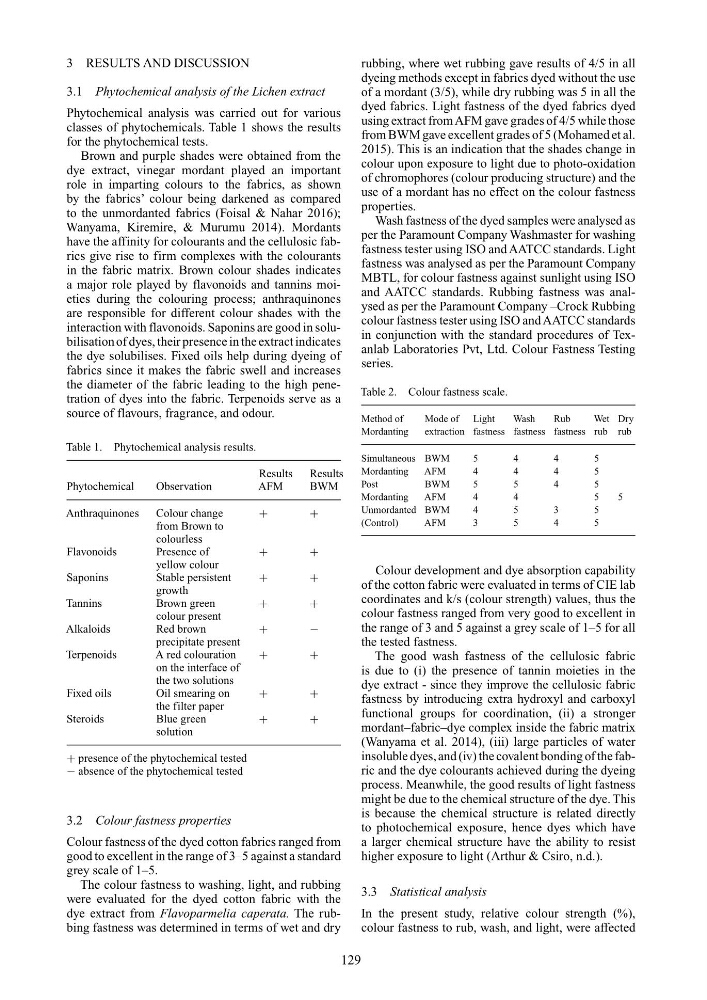
classes of phytochemicals. Table 1 shows the results
for the phytochemical tests.
Brown and purple shades were obtained from the
dye extract, vinegar mordant played an important
role in imparting colours to the fabrics, as shown
by the fabrics’ colour being darkened as compared
to the unmordanted fabrics (Foisal & Nahar 2016);
Wanyama, Kiremire, & Murumu 2014). Mordants
have the affinity for colourants and the cellulosic fabrics give rise to firm complexes with the colourants
in the fabric matrix. Brown colour shades indicates
a major role played by flavonoids and tannins moieties during the colouring process; anthraquinones
are responsible for different colour shades with the
interaction with flavonoids. Saponins are good in solubilisation of dyes, their presence in the extract indicates
the dye solubilises. Fixed oils help during dyeing of
fabrics since it makes the fabric swell and increases
the diameter of the fabric leading to the high penetration of dyes into the fabric. Terpenoids serve as a
source of flavours, fragrance, and odour.
Table 1. Phytochemical analysis results.
Results
Results
Phytochemical
Observation
AFM
BWM
Anthraquinones
Colour change
from Brown to
colourless
+
+
Flavonoids
Presence of
yellow colour
+
+
Saponins
Stable persistent
growth
+
+
Tannins
Brown green
colour present
+
+
Alkaloids
Red brown
precipitate present
+
−
Terpenoids
A red colouration
on the interface of
the two solutions
+
+
Fixed oils
Oil smearing on
the filter paper
+
+
Steroids
Blue green
solution
+
+
+ presence of the phytochemical tested
− absence of the phytochemical tested
3.2 Colour fastness properties
Colour fastness of the dyed cotton fabrics ranged from
good to excellent in the range of 3–5 against a standard
grey scale of 1–5.
The colour fastness to washing, light, and rubbing
were evaluated for the dyed cotton fabric with the
dye extract from Flavoparmelia caperata. The rubbing fastness was determined in terms of wet and dry
rubbing, where wet rubbing gave results of 4/5 in all
dyeing methods except in fabrics dyed without the use
of a mordant (3/5), while dry rubbing was 5 in all the
dyed fabrics. Light fastness of the dyed fabrics dyed
using extract from AFM gave grades of 4/5 while those
from BWM gave excellent grades of 5 (Mohamed et al.
2015). This is an indication that the shades change in
colour upon exposure to light due to photo-oxidation
of chromophores (colour producing structure) and the
use of a mordant has no effect on the colour fastness
properties.
Wash fastness of the dyed samples were analysed as
per the Paramount Company Washmaster for washing
fastness tester using ISO and AATCC standards. Light
fastness was analysed as per the Paramount Company
MBTL, for colour fastness against sunlight using ISO
and AATCC standards. Rubbing fastness was analysed as per the Paramount Company –Crock Rubbing
colour fastness tester using ISO and AATCC standards
in conjunction with the standard procedures of Texanlab Laboratories Pvt, Ltd. Colour Fastness Testing
series.
Table 2. Colour fastness scale.
Method of
Mode of Light
Wash
Rub
Wet Dry
Mordanting
extraction fastness fastness fastness rub rub
Simultaneous BWM
5
4
4
5
Mordanting
AFM
4
4
4
5
P o s t
B W M
5
5
4
5
Mordanting
AFM
4
4
5
5
Unmordanted BWM
4
5
3
5
(Control)
AFM
3
5
4
5
Colour development and dye absorption capability
of the cotton fabric were evaluated in terms of CIE lab
coordinates and k/s (colour strength) values, thus the
colour fastness ranged from very good to excellent in
the range of 3 and 5 against a grey scale of 1–5 for all
the tested fastness.
The good wash fastness of the cellulosic fabric
is due to (i) the presence of tannin moieties in the
dye extract - since they improve the cellulosic fabric
fastness by introducing extra hydroxyl and carboxyl
functional groups for coordination, (ii) a stronger
mordant–fabric–dye complex inside the fabric matrix
(Wanyama et al. 2014), (iii) large particles of water
insoluble dyes, and (iv) the covalent bonding of the fabric and the dye colourants achieved during the dyeing
process. Meanwhile, the good results of light fastness
might be due to the chemical structure of the dye. This
is because the chemical structure is related directly
to photochemical exposure, hence dyes which have
a larger chemical structure have the ability to resist
higher exposure to light (Arthur & Csiro, n.d.).
3.3 Statistical analysis
In the present study, relative colour strength (%),
colour fastness to rub, wash, and light, were affected
129
3.1 Phytochemical analysis of the Lichen extract
Phytochemical analysis was carried out for various
classes of phytochemicals. Table 1 shows the results
for the phytochemical tests.
Brown and purple shades were obtained from the
dye extract, vinegar mordant played an important
role in imparting colours to the fabrics, as shown
by the fabrics’ colour being darkened as compared
to the unmordanted fabrics (Foisal & Nahar 2016);
Wanyama, Kiremire, & Murumu 2014). Mordants
have the affinity for colourants and the cellulosic fabrics give rise to firm complexes with the colourants
in the fabric matrix. Brown colour shades indicates
a major role played by flavonoids and tannins moieties during the colouring process; anthraquinones
are responsible for different colour shades with the
interaction with flavonoids. Saponins are good in solubilisation of dyes, their presence in the extract indicates
the dye solubilises. Fixed oils help during dyeing of
fabrics since it makes the fabric swell and increases
the diameter of the fabric leading to the high penetration of dyes into the fabric. Terpenoids serve as a
source of flavours, fragrance, and odour.
Table 1. Phytochemical analysis results.
Results
Results
Phytochemical
Observation
AFM
BWM
Anthraquinones
Colour change
from Brown to
colourless
+
+
Flavonoids
Presence of
yellow colour
+
+
Saponins
Stable persistent
growth
+
+
Tannins
Brown green
colour present
+
+
Alkaloids
Red brown
precipitate present
+
−
Terpenoids
A red colouration
on the interface of
the two solutions
+
+
Fixed oils
Oil smearing on
the filter paper
+
+
Steroids
Blue green
solution
+
+
+ presence of the phytochemical tested
− absence of the phytochemical tested
3.2 Colour fastness properties
Colour fastness of the dyed cotton fabrics ranged from
good to excellent in the range of 3–5 against a standard
grey scale of 1–5.
The colour fastness to washing, light, and rubbing
were evaluated for the dyed cotton fabric with the
dye extract from Flavoparmelia caperata. The rubbing fastness was determined in terms of wet and dry
rubbing, where wet rubbing gave results of 4/5 in all
dyeing methods except in fabrics dyed without the use
of a mordant (3/5), while dry rubbing was 5 in all the
dyed fabrics. Light fastness of the dyed fabrics dyed
using extract from AFM gave grades of 4/5 while those
from BWM gave excellent grades of 5 (Mohamed et al.
2015). This is an indication that the shades change in
colour upon exposure to light due to photo-oxidation
of chromophores (colour producing structure) and the
use of a mordant has no effect on the colour fastness
properties.
Wash fastness of the dyed samples were analysed as
per the Paramount Company Washmaster for washing
fastness tester using ISO and AATCC standards. Light
fastness was analysed as per the Paramount Company
MBTL, for colour fastness against sunlight using ISO
and AATCC standards. Rubbing fastness was analysed as per the Paramount Company –Crock Rubbing
colour fastness tester using ISO and AATCC standards
in conjunction with the standard procedures of Texanlab Laboratories Pvt, Ltd. Colour Fastness Testing
series.
Table 2. Colour fastness scale.
Method of
Mode of Light
Wash
Rub
Wet Dry
Mordanting
extraction fastness fastness fastness rub rub
Simultaneous BWM
5
4
4
5
Mordanting
AFM
4
4
4
5
P o s t
B W M
5
5
4
5
Mordanting
AFM
4
4
5
5
Unmordanted BWM
4
5
3
5
(Control)
AFM
3
5
4
5
Colour development and dye absorption capability
of the cotton fabric were evaluated in terms of CIE lab
coordinates and k/s (colour strength) values, thus the
colour fastness ranged from very good to excellent in
the range of 3 and 5 against a grey scale of 1–5 for all
the tested fastness.
The good wash fastness of the cellulosic fabric
is due to (i) the presence of tannin moieties in the
dye extract - since they improve the cellulosic fabric
fastness by introducing extra hydroxyl and carboxyl
functional groups for coordination, (ii) a stronger
mordant–fabric–dye complex inside the fabric matrix
(Wanyama et al. 2014), (iii) large particles of water
insoluble dyes, and (iv) the covalent bonding of the fabric and the dye colourants achieved during the dyeing
process. Meanwhile, the good results of light fastness
might be due to the chemical structure of the dye. This
is because the chemical structure is related directly
to photochemical exposure, hence dyes which have
a larger chemical structure have the ability to resist
higher exposure to light (Arthur & Csiro, n.d.).
3.3 Statistical analysis
In the present study, relative colour strength (%),
colour fastness to rub, wash, and light, were affected
129