

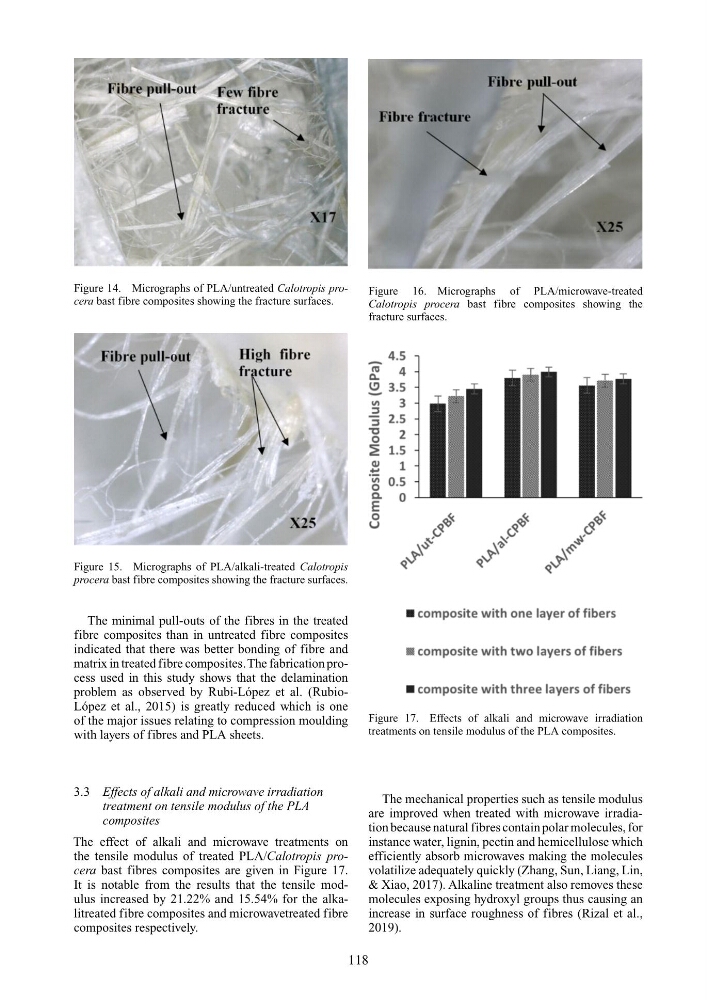
Figure 14. Micrographs of PLA/untreated Calotropis procera bast fibre composites showing the fracture surfaces.
Figure 15. Micrographs of PLA/alkali-treated Calotropis
procera bast fibre composites showing the fracture surfaces.
The minimal pull-outs of the fibres in the treated
fibre composites than in untreated fibre composites
indicated that there was better bonding of fibre and
matrix in treated fibre composites.The fabrication process used in this study shows that the delamination
problem as observed by Rubi-López et al. (RubioLópez et al., 2015) is greatly reduced which is one
of the major issues relating to compression moulding
with layers of fibres and PLA sheets.
3.3 Effects of alkali and microwave irradiation
treatment on tensile modulus of the PLA
composites
The effect of alkali and microwave treatments on
the tensile modulus of treated PLA/Calotropis procera bast fibres composites are given in Figure 17.
It is notable from the results that the tensile modulus increased by 21.22% and 15.54% for the alkalitreated fibre composites and microwavetreated fibre
composites respectively.
Figure 16. Micrographs of PLA/microwave-treated
Calotropis procera bast fibre composites showing the
fracture surfaces.
Figure 17. Effects of alkali and microwave irradiation
treatments on tensile modulus of the PLA composites.
The mechanical properties such as tensile modulus
are improved when treated with microwave irradiation because natural fibres contain polar molecules, for
instance water, lignin, pectin and hemicellulose which
efficiently absorb microwaves making the molecules
volatilize adequately quickly (Zhang, Sun, Liang, Lin,
& Xiao, 2017). Alkaline treatment also removes these
molecules exposing hydroxyl groups thus causing an
increase in surface roughness of fibres (Rizal et al.,
2019).
118
Figure 15. Micrographs of PLA/alkali-treated Calotropis
procera bast fibre composites showing the fracture surfaces.
The minimal pull-outs of the fibres in the treated
fibre composites than in untreated fibre composites
indicated that there was better bonding of fibre and
matrix in treated fibre composites.The fabrication process used in this study shows that the delamination
problem as observed by Rubi-López et al. (RubioLópez et al., 2015) is greatly reduced which is one
of the major issues relating to compression moulding
with layers of fibres and PLA sheets.
3.3 Effects of alkali and microwave irradiation
treatment on tensile modulus of the PLA
composites
The effect of alkali and microwave treatments on
the tensile modulus of treated PLA/Calotropis procera bast fibres composites are given in Figure 17.
It is notable from the results that the tensile modulus increased by 21.22% and 15.54% for the alkalitreated fibre composites and microwavetreated fibre
composites respectively.
Figure 16. Micrographs of PLA/microwave-treated
Calotropis procera bast fibre composites showing the
fracture surfaces.
Figure 17. Effects of alkali and microwave irradiation
treatments on tensile modulus of the PLA composites.
The mechanical properties such as tensile modulus
are improved when treated with microwave irradiation because natural fibres contain polar molecules, for
instance water, lignin, pectin and hemicellulose which
efficiently absorb microwaves making the molecules
volatilize adequately quickly (Zhang, Sun, Liang, Lin,
& Xiao, 2017). Alkaline treatment also removes these
molecules exposing hydroxyl groups thus causing an
increase in surface roughness of fibres (Rizal et al.,
2019).
118