

determining their linear density and tensile properties. Linear density for both treated and untreated
Calotropis fibres was determined as per ASTM
D1577-2001 which is a standard test method for linear density of fibres. Four bundles of fibres from
treated and four bundles from untreated Calotropis
fibres were picked randomly and then cut to a specific length. Each of the four samples of treated
and four samples of untreated Calotropis fibres were
weighed. From the number of fibres in each bundle
and the weights of the bundles, the weight of each
fibre was determined. The linear density in Tex was
determined by dividing the fibre weights in grams by
its length in kilometres. The tensile strength of both
treated and untreated Calotropis fibres were determined as per ASTM D3822M-2001, done at ambient
conditions using a universal tensile testing machine
(UTM-TH2730, Rycobel, Belgium). At a gauge length
of 25 mm and speed of 5 mm/min, Tensile strength
was determined for the four test specimen bundles
of treated and the four untreated Calotropis fibres.
An average of 30 test replicates for each were conducted. The tensile strength of treated and untreated
fibres were determined in terms of breaking tenacity
(cN/Tex) using the breaking force (cN) and the linear
density (Tex) of the respective fibres. The optimum
conditions obtained in this experiment were used to
treat fibres used for the composite fabrication.
2.5 Fabrication of polylactic acid/Calotropis bast
fibres (PLA/CBF) composite structure
The polylactic acid/Calotropis procera bast fibres
(PLA/CPBF) composites were fabricated by using
Calotropis bast fibres as reinforcement of PLA matrix
by applying a compression moulding method as
described by Wu et al. (2012) with slight modification. A mould measuring 310 × 310 × 30 mm with a
lid die was fabricated using a polished iron metal sheet.
Aluminium foil was used to cover the inner surfaces to
avoid the composites sticking onto the mould surface.
The Calotropis bast fibres were cut into approximately
1.5cmlong lengths before being used for the fabrication of composite panels with dimensions 300 mm
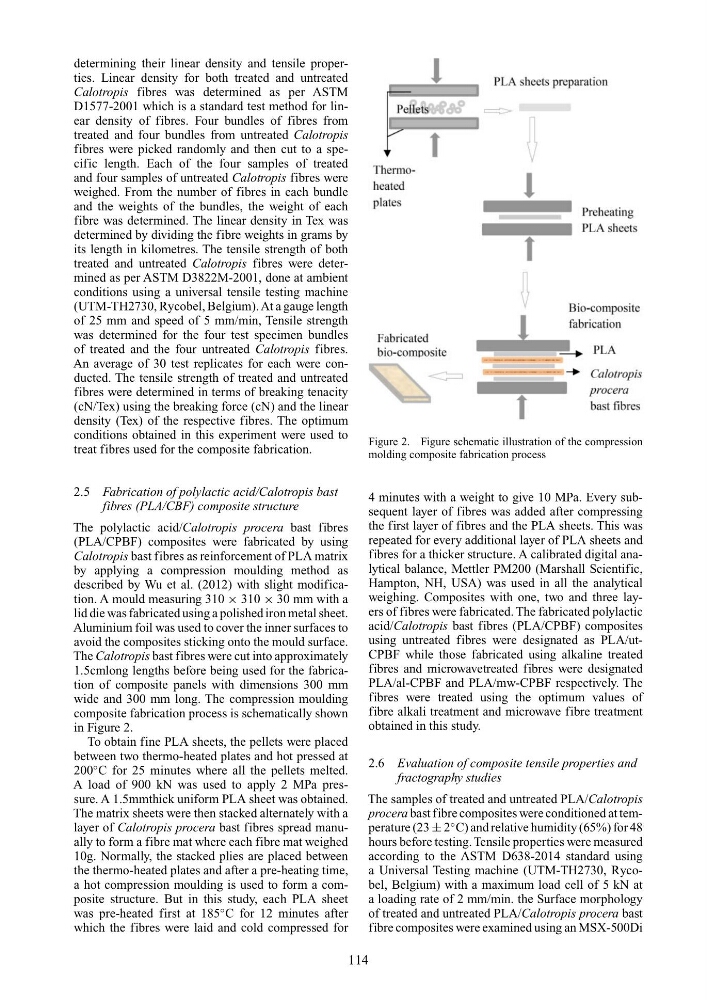
wide and 300 mm long. The compression moulding
composite fabrication process is schematically shown
in Figure 2.
To obtain fine PLA sheets, the pellets were placed
between two thermo-heated plates and hot pressed at
200
◦ C for 25 minutes where all the pellets melted.
A load of 900 kN was used to apply 2 MPa pressure. A 1.5mmthick uniform PLA sheet was obtained.
The matrix sheets were then stacked alternately with a
layer of Calotropis procera bast fibres spread manually to form a fibre mat where each fibre mat weighed
10g. Normally, the stacked plies are placed between
the thermo-heated plates and after a pre-heating time,
a hot compression moulding is used to form a composite structure. But in this study, each PLA sheet
was pre-heated first at 185
◦ C for 12 minutes after
which the fibres were laid and cold compressed for
Figure 2. Figure schematic illustration of the compression
molding composite fabrication process
4 minutes with a weight to give 10 MPa. Every subsequent layer of fibres was added after compressing
the first layer of fibres and the PLA sheets. This was
repeated for every additional layer of PLA sheets and
fibres for a thicker structure. A calibrated digital analytical balance, Mettler PM200 (Marshall Scientific,
Hampton, NH, USA) was used in all the analytical
weighing. Composites with one, two and three layers of fibres were fabricated. The fabricated polylactic
acid/Calotropis bast fibres (PLA/CPBF) composites
using untreated fibres were designated as PLA/utCPBF while those fabricated using alkaline treated
fibres and microwavetreated fibres were designated
PLA/al-CPBF and PLA/mw-CPBF respectively. The
fibres were treated using the optimum values of
fibre alkali treatment and microwave fibre treatment
obtained in this study.
2.6 Evaluation of composite tensile properties and
fractography studies
The samples of treated and untreated PLA/Calotropis
procera bast fibre composites were conditioned at temperature (23 ± 2
◦ C) and relative humidity (65%) for 48
hours before testing. Tensile properties were measured
according to the ASTM D638-2014 standard using
a Universal Testing machine (UTM-TH2730, Rycobel, Belgium) with a maximum load cell of 5 kN at
a loading rate of 2 mm/min. the Surface morphology
of treated and untreated PLA/Calotropis procera bast
fibre composites were examined using an MSX-500Di
114
Calotropis fibres was determined as per ASTM
D1577-2001 which is a standard test method for linear density of fibres. Four bundles of fibres from
treated and four bundles from untreated Calotropis
fibres were picked randomly and then cut to a specific length. Each of the four samples of treated
and four samples of untreated Calotropis fibres were
weighed. From the number of fibres in each bundle
and the weights of the bundles, the weight of each
fibre was determined. The linear density in Tex was
determined by dividing the fibre weights in grams by
its length in kilometres. The tensile strength of both
treated and untreated Calotropis fibres were determined as per ASTM D3822M-2001, done at ambient
conditions using a universal tensile testing machine
(UTM-TH2730, Rycobel, Belgium). At a gauge length
of 25 mm and speed of 5 mm/min, Tensile strength
was determined for the four test specimen bundles
of treated and the four untreated Calotropis fibres.
An average of 30 test replicates for each were conducted. The tensile strength of treated and untreated
fibres were determined in terms of breaking tenacity
(cN/Tex) using the breaking force (cN) and the linear
density (Tex) of the respective fibres. The optimum
conditions obtained in this experiment were used to
treat fibres used for the composite fabrication.
2.5 Fabrication of polylactic acid/Calotropis bast
fibres (PLA/CBF) composite structure
The polylactic acid/Calotropis procera bast fibres
(PLA/CPBF) composites were fabricated by using
Calotropis bast fibres as reinforcement of PLA matrix
by applying a compression moulding method as
described by Wu et al. (2012) with slight modification. A mould measuring 310 × 310 × 30 mm with a
lid die was fabricated using a polished iron metal sheet.
Aluminium foil was used to cover the inner surfaces to
avoid the composites sticking onto the mould surface.
The Calotropis bast fibres were cut into approximately
1.5cmlong lengths before being used for the fabrication of composite panels with dimensions 300 mm
wide and 300 mm long. The compression moulding
composite fabrication process is schematically shown
in Figure 2.
To obtain fine PLA sheets, the pellets were placed
between two thermo-heated plates and hot pressed at
200
◦ C for 25 minutes where all the pellets melted.
A load of 900 kN was used to apply 2 MPa pressure. A 1.5mmthick uniform PLA sheet was obtained.
The matrix sheets were then stacked alternately with a
layer of Calotropis procera bast fibres spread manually to form a fibre mat where each fibre mat weighed
10g. Normally, the stacked plies are placed between
the thermo-heated plates and after a pre-heating time,
a hot compression moulding is used to form a composite structure. But in this study, each PLA sheet
was pre-heated first at 185
◦ C for 12 minutes after
which the fibres were laid and cold compressed for
Figure 2. Figure schematic illustration of the compression
molding composite fabrication process
4 minutes with a weight to give 10 MPa. Every subsequent layer of fibres was added after compressing
the first layer of fibres and the PLA sheets. This was
repeated for every additional layer of PLA sheets and
fibres for a thicker structure. A calibrated digital analytical balance, Mettler PM200 (Marshall Scientific,
Hampton, NH, USA) was used in all the analytical
weighing. Composites with one, two and three layers of fibres were fabricated. The fabricated polylactic
acid/Calotropis bast fibres (PLA/CPBF) composites
using untreated fibres were designated as PLA/utCPBF while those fabricated using alkaline treated
fibres and microwavetreated fibres were designated
PLA/al-CPBF and PLA/mw-CPBF respectively. The
fibres were treated using the optimum values of
fibre alkali treatment and microwave fibre treatment
obtained in this study.
2.6 Evaluation of composite tensile properties and
fractography studies
The samples of treated and untreated PLA/Calotropis
procera bast fibre composites were conditioned at temperature (23 ± 2
◦ C) and relative humidity (65%) for 48
hours before testing. Tensile properties were measured
according to the ASTM D638-2014 standard using
a Universal Testing machine (UTM-TH2730, Rycobel, Belgium) with a maximum load cell of 5 kN at
a loading rate of 2 mm/min. the Surface morphology
of treated and untreated PLA/Calotropis procera bast
fibre composites were examined using an MSX-500Di
114