

They must be kept dry or they may lose all their
insulating qualities. Since the air that is flowing
into the system contains moisture, the insulator
should have a desiccant to absorb the moisture
(Alghoul, 2005).
The benefits of using solar dryers include the following: dried grains are tasty, nutritious (high in
carbohydrates and low in fat), the nutritional value and
flavour in food is only minimally affected by drying,
dried grains are easy to store (minimizing space of storage) and easy to prepare (processing), and the grains
remain clean since the grains are protected from rain
and pollution from dust
Some of the limitations of the solar dryer are
inadequate infrastructure in Kenya, growing market
difficulties by intensifying competition in the worldwide agricultural market, as well as the need for an
improvement in the population income and supply situation. The major limitation for the automated solar
powered dryer is the use of a fan. The fan should be
inexpensive, durable, and produce high flow rates at
a high pressure while having a low power consumption, in order to keep the price of the solar crop dryer
down and at them same time ensure an efficient drying
process.
2 MATERIAL AND METHODS
The solar system consisted of seven pieces of 0.74 m
long open-ended evacuated glass tubes to heat the air,
seven 0.5 m length aluminium to allow flow of air
within the system, and wooden bed frames to hold
the evacuated tubes in position. A blower was used to
blow air into the solar evacuated tubes, as shown in
Figure 2.
Figure 2. Arrangement of solar evacuated tubes.
The design and arrangement of the solar evacuated
tube system consist of the following parts:
• Solar evacuated tubes
• Manifold chamber
2.1 Solar evacuated tube
The solar evacuated tubes are arranged parallel to each
other in this system, as shown in Figure 2. Each evacuated tube consists of two concentric glass tubes made
of extremely strong borosilicate glass. It consists of
two glass tubes, and in-between the glass tubes there
is a vacuum. The outer tube is transparent which allows
rays of light to pass through with minimal reflection.
The inner tube is coated with a special selective coating
(Al-N/Al) which absorbs the solar radiation superbly
with negligible reflection properties. The length of the
evacuated tube is 1.8 m and the outer and inner tube
diameters are 0.057 m and 0.047 m, respectively.
2.2 Manifold chamber
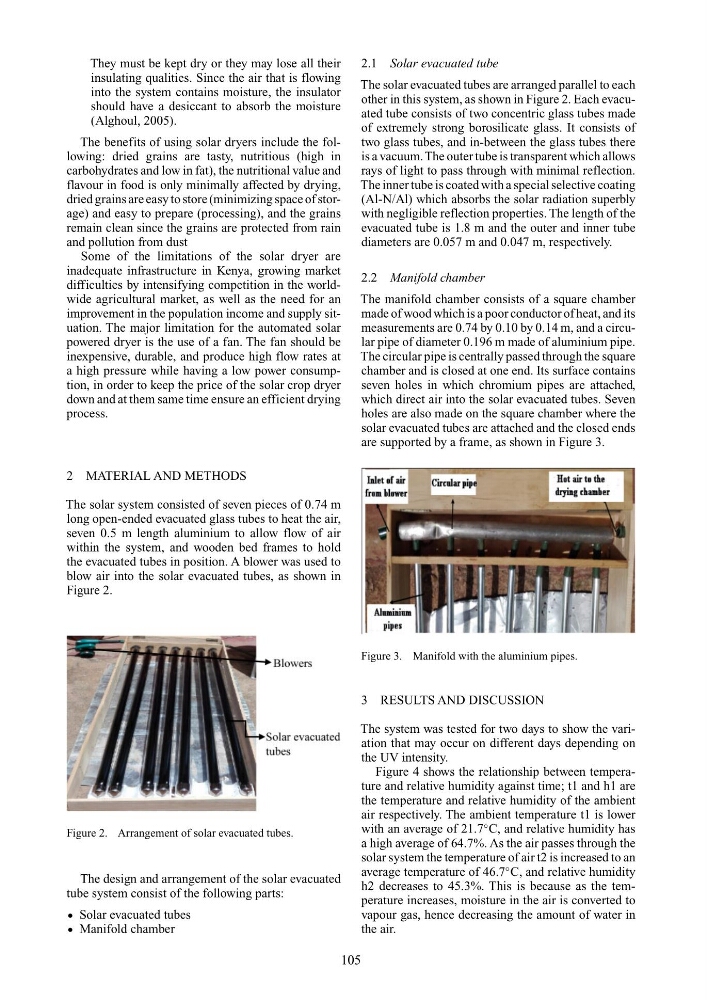
The manifold chamber consists of a square chamber
made of wood which is a poor conductor of heat, and its
measurements are 0.74 by 0.10 by 0.14 m, and a circular pipe of diameter 0.196 m made of aluminium pipe.
The circular pipe is centrally passed through the square
chamber and is closed at one end. Its surface contains
seven holes in which chromium pipes are attached,
which direct air into the solar evacuated tubes. Seven
holes are also made on the square chamber where the
solar evacuated tubes are attached and the closed ends
are supported by a frame, as shown in Figure 3.
Figure 3. Manifold with the aluminium pipes.
3 RESULTS AND DISCUSSION
The system was tested for two days to show the variation that may occur on different days depending on
the UV intensity.
Figure 4 shows the relationship between temperature and relative humidity against time; t1 and h1 are
the temperature and relative humidity of the ambient
air respectively. The ambient temperature t1 is lower
with an average of 21.7
◦ C, and relative humidity has
a high average of 64.7%. As the air passes through the
solar system the temperature of air t2 is increased to an
average temperature of 46.7
◦ C, and relative humidity
h2 decreases to 45.3%. This is because as the temperature increases, moisture in the air is converted to
vapour gas, hence decreasing the amount of water in
the air.
105
insulating qualities. Since the air that is flowing
into the system contains moisture, the insulator
should have a desiccant to absorb the moisture
(Alghoul, 2005).
The benefits of using solar dryers include the following: dried grains are tasty, nutritious (high in
carbohydrates and low in fat), the nutritional value and
flavour in food is only minimally affected by drying,
dried grains are easy to store (minimizing space of storage) and easy to prepare (processing), and the grains
remain clean since the grains are protected from rain
and pollution from dust
Some of the limitations of the solar dryer are
inadequate infrastructure in Kenya, growing market
difficulties by intensifying competition in the worldwide agricultural market, as well as the need for an
improvement in the population income and supply situation. The major limitation for the automated solar
powered dryer is the use of a fan. The fan should be
inexpensive, durable, and produce high flow rates at
a high pressure while having a low power consumption, in order to keep the price of the solar crop dryer
down and at them same time ensure an efficient drying
process.
2 MATERIAL AND METHODS
The solar system consisted of seven pieces of 0.74 m
long open-ended evacuated glass tubes to heat the air,
seven 0.5 m length aluminium to allow flow of air
within the system, and wooden bed frames to hold
the evacuated tubes in position. A blower was used to
blow air into the solar evacuated tubes, as shown in
Figure 2.
Figure 2. Arrangement of solar evacuated tubes.
The design and arrangement of the solar evacuated
tube system consist of the following parts:
• Solar evacuated tubes
• Manifold chamber
2.1 Solar evacuated tube
The solar evacuated tubes are arranged parallel to each
other in this system, as shown in Figure 2. Each evacuated tube consists of two concentric glass tubes made
of extremely strong borosilicate glass. It consists of
two glass tubes, and in-between the glass tubes there
is a vacuum. The outer tube is transparent which allows
rays of light to pass through with minimal reflection.
The inner tube is coated with a special selective coating
(Al-N/Al) which absorbs the solar radiation superbly
with negligible reflection properties. The length of the
evacuated tube is 1.8 m and the outer and inner tube
diameters are 0.057 m and 0.047 m, respectively.
2.2 Manifold chamber
The manifold chamber consists of a square chamber
made of wood which is a poor conductor of heat, and its
measurements are 0.74 by 0.10 by 0.14 m, and a circular pipe of diameter 0.196 m made of aluminium pipe.
The circular pipe is centrally passed through the square
chamber and is closed at one end. Its surface contains
seven holes in which chromium pipes are attached,
which direct air into the solar evacuated tubes. Seven
holes are also made on the square chamber where the
solar evacuated tubes are attached and the closed ends
are supported by a frame, as shown in Figure 3.
Figure 3. Manifold with the aluminium pipes.
3 RESULTS AND DISCUSSION
The system was tested for two days to show the variation that may occur on different days depending on
the UV intensity.
Figure 4 shows the relationship between temperature and relative humidity against time; t1 and h1 are
the temperature and relative humidity of the ambient
air respectively. The ambient temperature t1 is lower
with an average of 21.7
◦ C, and relative humidity has
a high average of 64.7%. As the air passes through the
solar system the temperature of air t2 is increased to an
average temperature of 46.7
◦ C, and relative humidity
h2 decreases to 45.3%. This is because as the temperature increases, moisture in the air is converted to
vapour gas, hence decreasing the amount of water in
the air.
105