

as shallow layer dryers (John, 2017), continuous flow
dryers (Kasiviswanathan., 2016), and fluidized dryers
(Mujumdar., 2000). The mechanized drying method
is advantageous in the sense that it speeds up the time
required for drying, less labour is required, and a better
quality of the product is produced. Its major challenges are the higher operation costs due to the use
of electricity and the substantial amount of fuel (Ajay,
2009).
Solar dryers are specialized devices that control the
process of drying and prevent the products from the
damage caused by insects, rain, and dust (Bala., 2002),
(Senadeera., 2007). Solar energy is absorbed and is
converted into heat energy which then heats the air
and dries the product. They have been beneficial in the
sense that they generate high temperatures, lower relative humidity, lower product moisture content, reduce
the spoilage of product during drying processes, use
less space, take less time, and are relatively inexpensive compared to other artificial drying methods
(Mohanraj, 2008).
1.2 Components of the solar dryer
a) Drying chamber: The drying chamber is the section where the drying process will take place, it is
the section where the product to be dried is placed.
(Folaranmi, 2008).
b) Air flow system: The flow of air into the drying
system can be either be natural or forced (convection). For a natural system, the air is blown
into the system by wind or hot air moves up and
cold air moves down into the drying chamber. For
forced convection, the air is blown in with the help
of a fan. The fan can be powered by a generator
or the utility electricity. When using the fan, the
drying time is reduced and the product quality is
maintained, hence optimizing the drying process
(Mathew, 2001). The fan works either to create a
negative pressure in the system which will prevent
hot air leakage during drying to positive pressure
which prevents cold air and dust entering into the
system.
c) Solar collector: The solar collector is used to
absorb the solar energy and converts it into heat,
hence it is used for thermal application. It is used
to absorb shorter wavelengths of sunlight of 0.3–
2 mm and prevents heating wavelengths of 2–10
mm from being lost into the atmosphere using a
greenhouse effect. Some of the types of solar collector are flat plate, heated pipes, and solar evacuated tubes (Norton, 2006), (Kalogirou., 2004).
The flat plate collectors have commonly been used
for several solar experiments. Their operation parameters are mass flow rate of the fluid, inlet, outlet and
ambient temperature, solar radiation, air speed, glass
cover, and environment condition (Akpinar, 2010).
Their performance depends on the design parameters which include type and thickness of the glazing,
number and type of coating on the collectors plate,
evacuated space between the collector and the inner
glass, insulation type, and convection movement of
the air in the system (Alghoul, 2005).
Solar evacuated tubes have been used for many
years in Germany, Canada, China, and the UK. There
are various types of evacuated tube but the most commonly used have a double glass tube, because of their
reliability, excellent performance, and ease to manufacture (Zulovich, 2013). An evacuated tube has two
glass tubes, i.e., the outer tube and the inner tube. The
outer tube is made of very strong transparent borosilicate glass that can resist impact from hail and is 38
mm in diameter. The inner tube is made of borosilicate glass but is coated with a special selective coating
that is excellent in absorbing solar energy and has a
minimal reflection property (Kalogirou., 2004). The
air is evacuated from the space between the two layers
of glass to form a vacuum that will eliminate loss of
heat through conduction and convection. At the bottom
is a layer of barium that is used to absorb CO, CO 2 ,
N 2 , O 2 , H 2 O, and H 2 during operation and storage to
ensure that the vacuum is maintained; also the barium
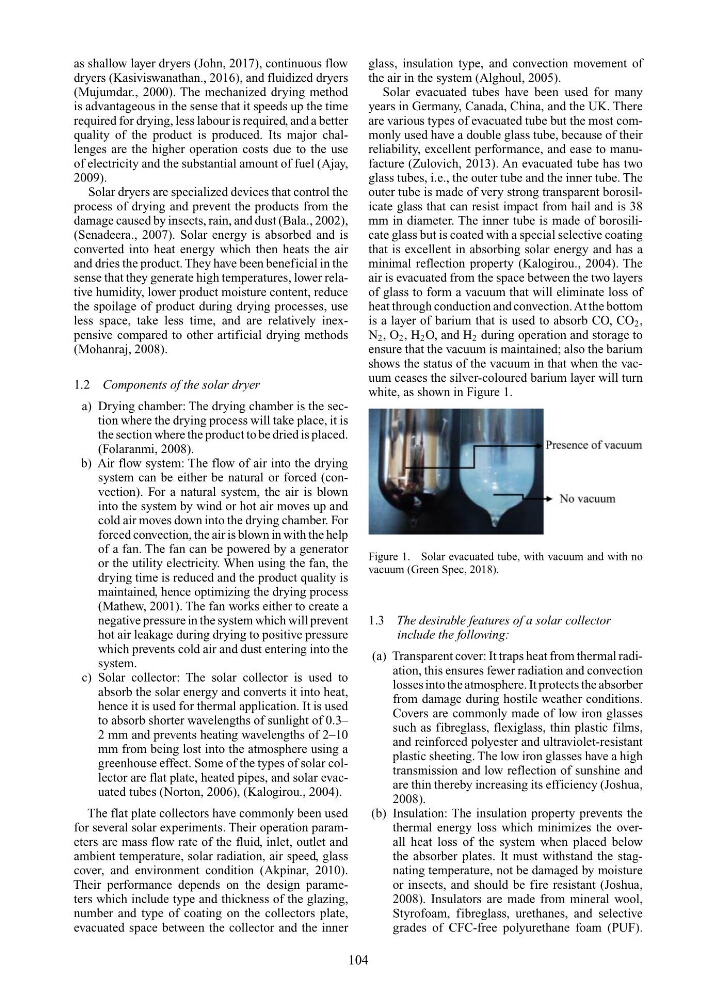
shows the status of the vacuum in that when the vacuum ceases the silver-coloured barium layer will turn
white, as shown in Figure 1.
Figure 1. Solar evacuated tube, with vacuum and with no
vacuum (Green Spec, 2018).
1.3 The desirable features of a solar collector
include the following:
(a) Transparent cover: It traps heat from thermal radiation, this ensures fewer radiation and convection
losses into the atmosphere. It protects the absorber
from damage during hostile weather conditions.
Covers are commonly made of low iron glasses
such as fibreglass, flexiglass, thin plastic films,
and reinforced polyester and ultraviolet-resistant
plastic sheeting. The low iron glasses have a high
transmission and low reflection of sunshine and
are thin thereby increasing its efficiency (Joshua,
2008).
(b) Insulation: The insulation property prevents the
thermal energy loss which minimizes the overall heat loss of the system when placed below
the absorber plates. It must withstand the stagnating temperature, not be damaged by moisture
or insects, and should be fire resistant (Joshua,
2008). Insulators are made from mineral wool,
Styrofoam, fibreglass, urethanes, and selective
grades of CFC-free polyurethane foam (PUF).
104
dryers (Kasiviswanathan., 2016), and fluidized dryers
(Mujumdar., 2000). The mechanized drying method
is advantageous in the sense that it speeds up the time
required for drying, less labour is required, and a better
quality of the product is produced. Its major challenges are the higher operation costs due to the use
of electricity and the substantial amount of fuel (Ajay,
2009).
Solar dryers are specialized devices that control the
process of drying and prevent the products from the
damage caused by insects, rain, and dust (Bala., 2002),
(Senadeera., 2007). Solar energy is absorbed and is
converted into heat energy which then heats the air
and dries the product. They have been beneficial in the
sense that they generate high temperatures, lower relative humidity, lower product moisture content, reduce
the spoilage of product during drying processes, use
less space, take less time, and are relatively inexpensive compared to other artificial drying methods
(Mohanraj, 2008).
1.2 Components of the solar dryer
a) Drying chamber: The drying chamber is the section where the drying process will take place, it is
the section where the product to be dried is placed.
(Folaranmi, 2008).
b) Air flow system: The flow of air into the drying
system can be either be natural or forced (convection). For a natural system, the air is blown
into the system by wind or hot air moves up and
cold air moves down into the drying chamber. For
forced convection, the air is blown in with the help
of a fan. The fan can be powered by a generator
or the utility electricity. When using the fan, the
drying time is reduced and the product quality is
maintained, hence optimizing the drying process
(Mathew, 2001). The fan works either to create a
negative pressure in the system which will prevent
hot air leakage during drying to positive pressure
which prevents cold air and dust entering into the
system.
c) Solar collector: The solar collector is used to
absorb the solar energy and converts it into heat,
hence it is used for thermal application. It is used
to absorb shorter wavelengths of sunlight of 0.3–
2 mm and prevents heating wavelengths of 2–10
mm from being lost into the atmosphere using a
greenhouse effect. Some of the types of solar collector are flat plate, heated pipes, and solar evacuated tubes (Norton, 2006), (Kalogirou., 2004).
The flat plate collectors have commonly been used
for several solar experiments. Their operation parameters are mass flow rate of the fluid, inlet, outlet and
ambient temperature, solar radiation, air speed, glass
cover, and environment condition (Akpinar, 2010).
Their performance depends on the design parameters which include type and thickness of the glazing,
number and type of coating on the collectors plate,
evacuated space between the collector and the inner
glass, insulation type, and convection movement of
the air in the system (Alghoul, 2005).
Solar evacuated tubes have been used for many
years in Germany, Canada, China, and the UK. There
are various types of evacuated tube but the most commonly used have a double glass tube, because of their
reliability, excellent performance, and ease to manufacture (Zulovich, 2013). An evacuated tube has two
glass tubes, i.e., the outer tube and the inner tube. The
outer tube is made of very strong transparent borosilicate glass that can resist impact from hail and is 38
mm in diameter. The inner tube is made of borosilicate glass but is coated with a special selective coating
that is excellent in absorbing solar energy and has a
minimal reflection property (Kalogirou., 2004). The
air is evacuated from the space between the two layers
of glass to form a vacuum that will eliminate loss of
heat through conduction and convection. At the bottom
is a layer of barium that is used to absorb CO, CO 2 ,
N 2 , O 2 , H 2 O, and H 2 during operation and storage to
ensure that the vacuum is maintained; also the barium
shows the status of the vacuum in that when the vacuum ceases the silver-coloured barium layer will turn
white, as shown in Figure 1.
Figure 1. Solar evacuated tube, with vacuum and with no
vacuum (Green Spec, 2018).
1.3 The desirable features of a solar collector
include the following:
(a) Transparent cover: It traps heat from thermal radiation, this ensures fewer radiation and convection
losses into the atmosphere. It protects the absorber
from damage during hostile weather conditions.
Covers are commonly made of low iron glasses
such as fibreglass, flexiglass, thin plastic films,
and reinforced polyester and ultraviolet-resistant
plastic sheeting. The low iron glasses have a high
transmission and low reflection of sunshine and
are thin thereby increasing its efficiency (Joshua,
2008).
(b) Insulation: The insulation property prevents the
thermal energy loss which minimizes the overall heat loss of the system when placed below
the absorber plates. It must withstand the stagnating temperature, not be damaged by moisture
or insects, and should be fire resistant (Joshua,
2008). Insulators are made from mineral wool,
Styrofoam, fibreglass, urethanes, and selective
grades of CFC-free polyurethane foam (PUF).
104