

27
Properties of Pesticides and Contaminants
3.2.1 Volatilization of Pure Liquids and Solids
The term “pure” not only includes single compounds that are liquids or solids,
depending on their properties, but it also encompasses liquids and solids composed of a mixture of like compounds. Examples of “pure” mixtures include
hydrocarbon oils/fuels and paraffn. In other words, they are not dissolved in
or blended with unlike materials. The main driving force for the volatilization
of a pure substance is vapor pressure, which is a function of temperature. It
is assumed, in this case, that the substance is volatilizing from a noninteractive (i.e., “inert”) surface. This was observed in several feld and laboratory
studies with hydrocarbon mixtures and pure compounds (Mackay and Van
Wesenbeeck, 2014; Seiber et al., 1986; Woodrow et al., 1997). The ideal gas law
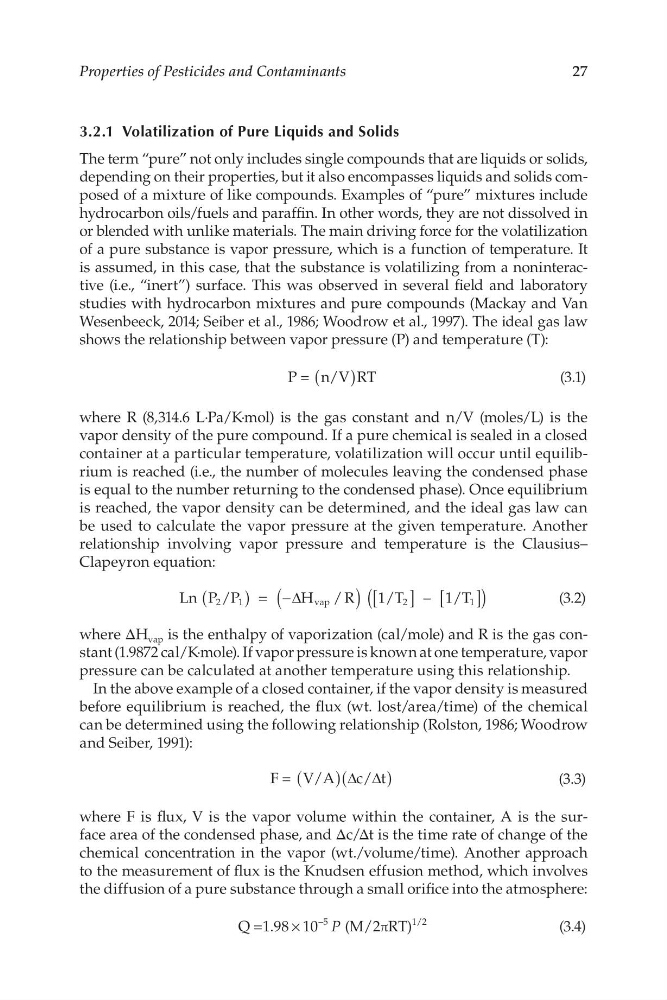
shows the relationship between vapor pressure (P) and temperature (T):
P = (n/V RT
)
(3.1)
where R (8,314.6 L·Pa/K·mol) is the gas constant and n/V (moles/L) is the
vapor density of the pure compound. If a pure chemical is sealed in a closed
container at a particular temperature, volatilization will occur until equilibrium is reached (i.e., the number of molecules leaving the condensed phase
is equal to the number returning to the condensed phase). Once equilibrium
is reached, the vapor density can be determined, and the ideal gas law can
be used to calculate the vapor pressure at the given temperature. Another
relationship involving vapor pressure and temperature is the Clausius–
Clapeyron equation:
Ln (P /P = −
( H / R ) 1/T – 1/T )
2
1 )
ˇ vap
([ ] [ ]
2
1
(3.2)
where ΔH vap is the enthalpy of vaporization (cal/mole) and R is the gas constant (1.9872 cal/K·mole). If vapor pressure is known at one temperature, vapor
pressure can be calculated at another temperature using this relationship.
In the above example of a closed container, if the vapor density is measured
before equilibrium is reached, the fux (wt. lost/area/time) of the chemical
can be determined using the following relationship (Rolston, 1986; Woodrow
and Seiber, 1991):
c/ t
F = (V/A)(˛ ˛ )
(3.3)
where F is fux, V is the vapor volume within the container, A is the surface area of the condensed phase, and Δc/Δt is the time rate of change of the
chemical concentration in the vapor (wt./volume/time). Another approach
to the measurement of fux is the Knudsen effusion method, which involves
the diffusion of a pure substance through a small orifce into the atmosphere:
−5
1 /2
Q =1.98 × 10 P (M/2πRT)
(3.4)
Properties of Pesticides and Contaminants
3.2.1 Volatilization of Pure Liquids and Solids
The term “pure” not only includes single compounds that are liquids or solids,
depending on their properties, but it also encompasses liquids and solids composed of a mixture of like compounds. Examples of “pure” mixtures include
hydrocarbon oils/fuels and paraffn. In other words, they are not dissolved in
or blended with unlike materials. The main driving force for the volatilization
of a pure substance is vapor pressure, which is a function of temperature. It
is assumed, in this case, that the substance is volatilizing from a noninteractive (i.e., “inert”) surface. This was observed in several feld and laboratory
studies with hydrocarbon mixtures and pure compounds (Mackay and Van
Wesenbeeck, 2014; Seiber et al., 1986; Woodrow et al., 1997). The ideal gas law
shows the relationship between vapor pressure (P) and temperature (T):
P = (n/V RT
)
(3.1)
where R (8,314.6 L·Pa/K·mol) is the gas constant and n/V (moles/L) is the
vapor density of the pure compound. If a pure chemical is sealed in a closed
container at a particular temperature, volatilization will occur until equilibrium is reached (i.e., the number of molecules leaving the condensed phase
is equal to the number returning to the condensed phase). Once equilibrium
is reached, the vapor density can be determined, and the ideal gas law can
be used to calculate the vapor pressure at the given temperature. Another
relationship involving vapor pressure and temperature is the Clausius–
Clapeyron equation:
Ln (P /P = −
( H / R ) 1/T – 1/T )
2
1 )
ˇ vap
([ ] [ ]
2
1
(3.2)
where ΔH vap is the enthalpy of vaporization (cal/mole) and R is the gas constant (1.9872 cal/K·mole). If vapor pressure is known at one temperature, vapor
pressure can be calculated at another temperature using this relationship.
In the above example of a closed container, if the vapor density is measured
before equilibrium is reached, the fux (wt. lost/area/time) of the chemical
can be determined using the following relationship (Rolston, 1986; Woodrow
and Seiber, 1991):
c/ t
F = (V/A)(˛ ˛ )
(3.3)
where F is fux, V is the vapor volume within the container, A is the surface area of the condensed phase, and Δc/Δt is the time rate of change of the
chemical concentration in the vapor (wt./volume/time). Another approach
to the measurement of fux is the Knudsen effusion method, which involves
the diffusion of a pure substance through a small orifce into the atmosphere:
−5
1 /2
Q =1.98 × 10 P (M/2πRT)
(3.4)