

26
Pesticides, Organic Contaminants, and Pathogens in Air
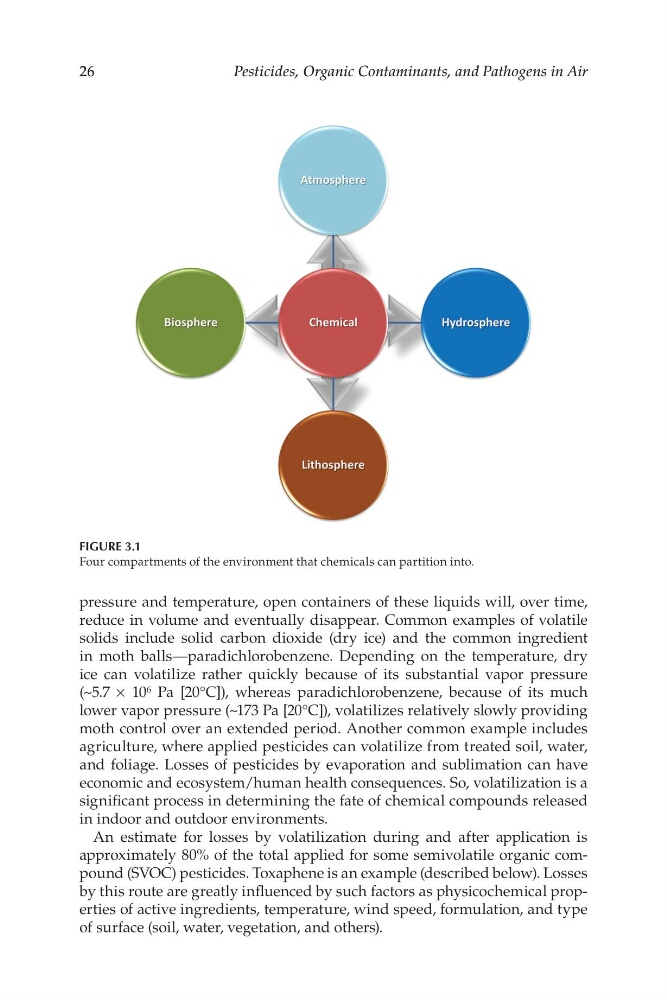
FIGURE 3.1
Four compartments of the environment that chemicals can partition into.
pressure and temperature, open containers of these liquids will, over time,
reduce in volume and eventually disappear. Common examples of volatile
solids include solid carbon dioxide (dry ice) and the common ingredient
in moth balls—paradichlorobenzene. Depending on the temperature, dry
ice can volatilize rather quickly because of its substantial vapor pressure
(~5.7 × 10 6 Pa [20°C]), whereas paradichlorobenzene, because of its much
lower vapor pressure (~173 Pa [20°C]), volatilizes relatively slowly providing
moth control over an extended period. Another common example includes
agriculture, where applied pesticides can volatilize from treated soil, water,
and foliage. Losses of pesticides by evaporation and sublimation can have
economic and ecosystem/human health consequences. So, volatilization is a
signifcant process in determining the fate of chemical compounds released
in indoor and outdoor environments.
An estimate for losses by volatilization during and after application is
approximately 80% of the total applied for some semivolatile organic compound (SVOC) pesticides. Toxaphene is an example (described below). Losses
by this route are greatly infuenced by such factors as physicochemical properties of active ingredients, temperature, wind speed, formulation, and type
of surface (soil, water, vegetation, and others).
Pesticides, Organic Contaminants, and Pathogens in Air
FIGURE 3.1
Four compartments of the environment that chemicals can partition into.
pressure and temperature, open containers of these liquids will, over time,
reduce in volume and eventually disappear. Common examples of volatile
solids include solid carbon dioxide (dry ice) and the common ingredient
in moth balls—paradichlorobenzene. Depending on the temperature, dry
ice can volatilize rather quickly because of its substantial vapor pressure
(~5.7 × 10 6 Pa [20°C]), whereas paradichlorobenzene, because of its much
lower vapor pressure (~173 Pa [20°C]), volatilizes relatively slowly providing
moth control over an extended period. Another common example includes
agriculture, where applied pesticides can volatilize from treated soil, water,
and foliage. Losses of pesticides by evaporation and sublimation can have
economic and ecosystem/human health consequences. So, volatilization is a
signifcant process in determining the fate of chemical compounds released
in indoor and outdoor environments.
An estimate for losses by volatilization during and after application is
approximately 80% of the total applied for some semivolatile organic compound (SVOC) pesticides. Toxaphene is an example (described below). Losses
by this route are greatly infuenced by such factors as physicochemical properties of active ingredients, temperature, wind speed, formulation, and type
of surface (soil, water, vegetation, and others).