

149
Trifuoroacetic Acid from CFC Replacements
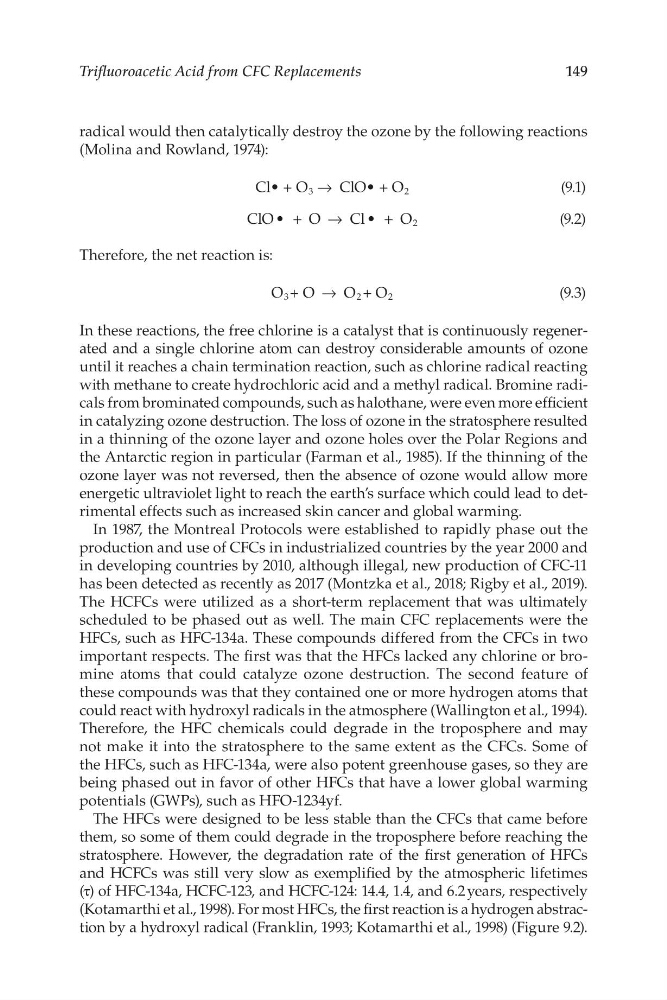
radical would then catalytically destroy the ozone by the following reactions
(Molina and Rowland, 1974):
Cl• + O 3 ˜ ClO• + O 2
(9.1)
ClO• + O ° Cl• + O 2
(9.2)
Therefore, the net reaction is:
O + O
3
˜ O 2 + O 2
(9.3)
In these reactions, the free chlorine is a catalyst that is continuously regenerated and a single chlorine atom can destroy considerable amounts of ozone
until it reaches a chain termination reaction, such as chlorine radical reacting
with methane to create hydrochloric acid and a methyl radical. Bromine radicals from brominated compounds, such as halothane, were even more effcient
in catalyzing ozone destruction. The loss of ozone in the stratosphere resulted
in a thinning of the ozone layer and ozone holes over the Polar Regions and
the Antarctic region in particular (Farman et al., 1985). If the thinning of the
ozone layer was not reversed, then the absence of ozone would allow more
energetic ultraviolet light to reach the earth’s surface which could lead to detrimental effects such as increased skin cancer and global warming.
In 1987, the Montreal Protocols were established to rapidly phase out the
production and use of CFCs in industrialized countries by the year 2000 and
in developing countries by 2010, although illegal, new production of CFC-11
has been detected as recently as 2017 (Montzka et al., 2018; Rigby et al., 2019).
The HCFCs were utilized as a short-term replacement that was ultimately
scheduled to be phased out as well. The main CFC replacements were the
HFCs, such as HFC-134a. These compounds differed from the CFCs in two
important respects. The frst was that the HFCs lacked any chlorine or bromine atoms that could catalyze ozone destruction. The second feature of
these compounds was that they contained one or more hydrogen atoms that
could react with hydroxyl radicals in the atmosphere (Wallington et al., 1994).
Therefore, the HFC chemicals could degrade in the troposphere and may
not make it into the stratosphere to the same extent as the CFCs. Some of
the HFCs, such as HFC-134a, were also potent greenhouse gases, so they are
being phased out in favor of other HFCs that have a lower global warming
potentials (GWPs), such as HFO-1234yf.
The HFCs were designed to be less stable than the CFCs that came before
them, so some of them could degrade in the troposphere before reaching the
stratosphere. However, the degradation rate of the frst generation of HFCs
and HCFCs was still very slow as exemplifed by the atmospheric lifetimes
(τ) of HFC-134a, HCFC-123, and HCFC-124: 14.4, 1.4, and 6.2 years, respectively
(Kotamarthi et al., 1998). For most HFCs, the frst reaction is a hydrogen abstraction by a hydroxyl radical (Franklin, 1993; Kotamarthi et al., 1998) (Figure 9.2).
Trifuoroacetic Acid from CFC Replacements
radical would then catalytically destroy the ozone by the following reactions
(Molina and Rowland, 1974):
Cl• + O 3 ˜ ClO• + O 2
(9.1)
ClO• + O ° Cl• + O 2
(9.2)
Therefore, the net reaction is:
O + O
3
˜ O 2 + O 2
(9.3)
In these reactions, the free chlorine is a catalyst that is continuously regenerated and a single chlorine atom can destroy considerable amounts of ozone
until it reaches a chain termination reaction, such as chlorine radical reacting
with methane to create hydrochloric acid and a methyl radical. Bromine radicals from brominated compounds, such as halothane, were even more effcient
in catalyzing ozone destruction. The loss of ozone in the stratosphere resulted
in a thinning of the ozone layer and ozone holes over the Polar Regions and
the Antarctic region in particular (Farman et al., 1985). If the thinning of the
ozone layer was not reversed, then the absence of ozone would allow more
energetic ultraviolet light to reach the earth’s surface which could lead to detrimental effects such as increased skin cancer and global warming.
In 1987, the Montreal Protocols were established to rapidly phase out the
production and use of CFCs in industrialized countries by the year 2000 and
in developing countries by 2010, although illegal, new production of CFC-11
has been detected as recently as 2017 (Montzka et al., 2018; Rigby et al., 2019).
The HCFCs were utilized as a short-term replacement that was ultimately
scheduled to be phased out as well. The main CFC replacements were the
HFCs, such as HFC-134a. These compounds differed from the CFCs in two
important respects. The frst was that the HFCs lacked any chlorine or bromine atoms that could catalyze ozone destruction. The second feature of
these compounds was that they contained one or more hydrogen atoms that
could react with hydroxyl radicals in the atmosphere (Wallington et al., 1994).
Therefore, the HFC chemicals could degrade in the troposphere and may
not make it into the stratosphere to the same extent as the CFCs. Some of
the HFCs, such as HFC-134a, were also potent greenhouse gases, so they are
being phased out in favor of other HFCs that have a lower global warming
potentials (GWPs), such as HFO-1234yf.
The HFCs were designed to be less stable than the CFCs that came before
them, so some of them could degrade in the troposphere before reaching the
stratosphere. However, the degradation rate of the frst generation of HFCs
and HCFCs was still very slow as exemplifed by the atmospheric lifetimes
(τ) of HFC-134a, HCFC-123, and HCFC-124: 14.4, 1.4, and 6.2 years, respectively
(Kotamarthi et al., 1998). For most HFCs, the frst reaction is a hydrogen abstraction by a hydroxyl radical (Franklin, 1993; Kotamarthi et al., 1998) (Figure 9.2).