

150
Pesticides, Organic Contaminants, and Pathogens in Air
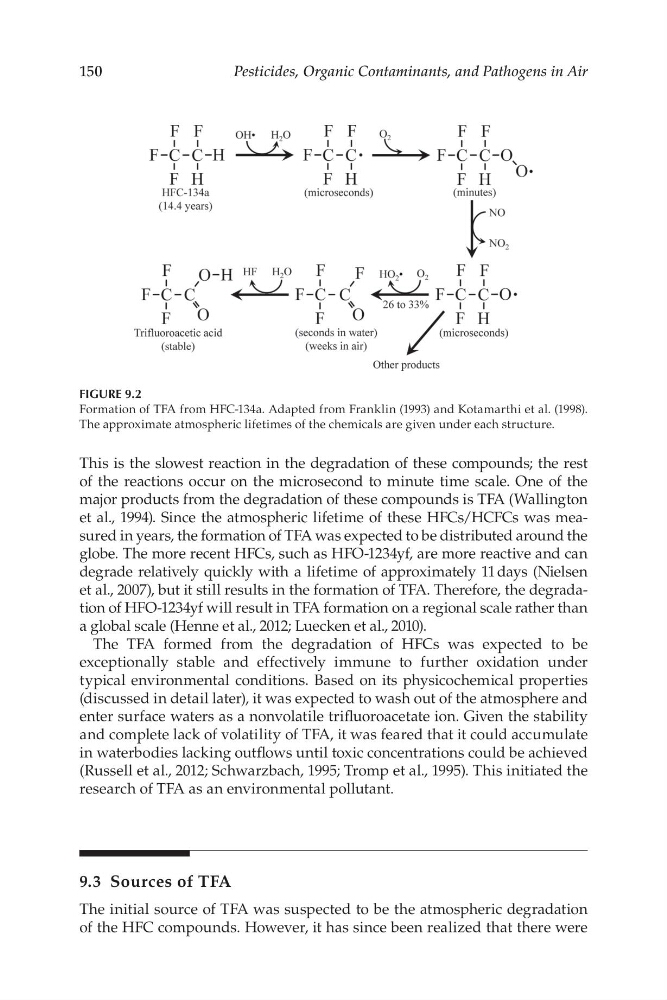
FIGURE 9.2
Formation of TFA from HFC-134a. Adapted from Franklin (1993) and Kotamarthi et al. (1998).
The approximate atmospheric lifetimes of the chemicals are given under each structure.
This is the slowest reaction in the degradation of these compounds; the rest
of the reactions occur on the microsecond to minute time scale. One of the
major products from the degradation of these compounds is TFA (Wallington
et al., 1994). Since the atmospheric lifetime of these HFCs/HCFCs was measured in years, the formation of TFA was expected to be distributed around the
globe. The more recent HFCs, such as HFO-1234yf, are more reactive and can
degrade relatively quickly with a lifetime of approximately 11 days (Nielsen
et al., 2007), but it still results in the formation of TFA. Therefore, the degradation of HFO-1234yf will result in TFA formation on a regional scale rather than
a global scale (Henne et al., 2012; Luecken et al., 2010).
The TFA formed from the degradation of HFCs was expected to be
exceptionally stable and effectively immune to further oxidation under
typical environmental conditions. Based on its physicochemical properties
(discussed in detail later), it was expected to wash out of the atmosphere and
enter surface waters as a nonvolatile trifuoroacetate ion. Given the stability
and complete lack of volatility of TFA, it was feared that it could accumulate
in waterbodies lacking outfows until toxic concentrations could be achieved
(Russell et al., 2012; Schwarzbach, 1995; Tromp et al., 1995). This initiated the
research of TFA as an environmental pollutant.
9.3 Sources of TFA
The initial source of TFA was suspected to be the atmospheric degradation
of the HFC compounds. However, it has since been realized that there were
Pesticides, Organic Contaminants, and Pathogens in Air
FIGURE 9.2
Formation of TFA from HFC-134a. Adapted from Franklin (1993) and Kotamarthi et al. (1998).
The approximate atmospheric lifetimes of the chemicals are given under each structure.
This is the slowest reaction in the degradation of these compounds; the rest
of the reactions occur on the microsecond to minute time scale. One of the
major products from the degradation of these compounds is TFA (Wallington
et al., 1994). Since the atmospheric lifetime of these HFCs/HCFCs was measured in years, the formation of TFA was expected to be distributed around the
globe. The more recent HFCs, such as HFO-1234yf, are more reactive and can
degrade relatively quickly with a lifetime of approximately 11 days (Nielsen
et al., 2007), but it still results in the formation of TFA. Therefore, the degradation of HFO-1234yf will result in TFA formation on a regional scale rather than
a global scale (Henne et al., 2012; Luecken et al., 2010).
The TFA formed from the degradation of HFCs was expected to be
exceptionally stable and effectively immune to further oxidation under
typical environmental conditions. Based on its physicochemical properties
(discussed in detail later), it was expected to wash out of the atmosphere and
enter surface waters as a nonvolatile trifuoroacetate ion. Given the stability
and complete lack of volatility of TFA, it was feared that it could accumulate
in waterbodies lacking outfows until toxic concentrations could be achieved
(Russell et al., 2012; Schwarzbach, 1995; Tromp et al., 1995). This initiated the
research of TFA as an environmental pollutant.
9.3 Sources of TFA
The initial source of TFA was suspected to be the atmospheric degradation
of the HFC compounds. However, it has since been realized that there were