

148
Pesticides, Organic Contaminants, and Pathogens in Air
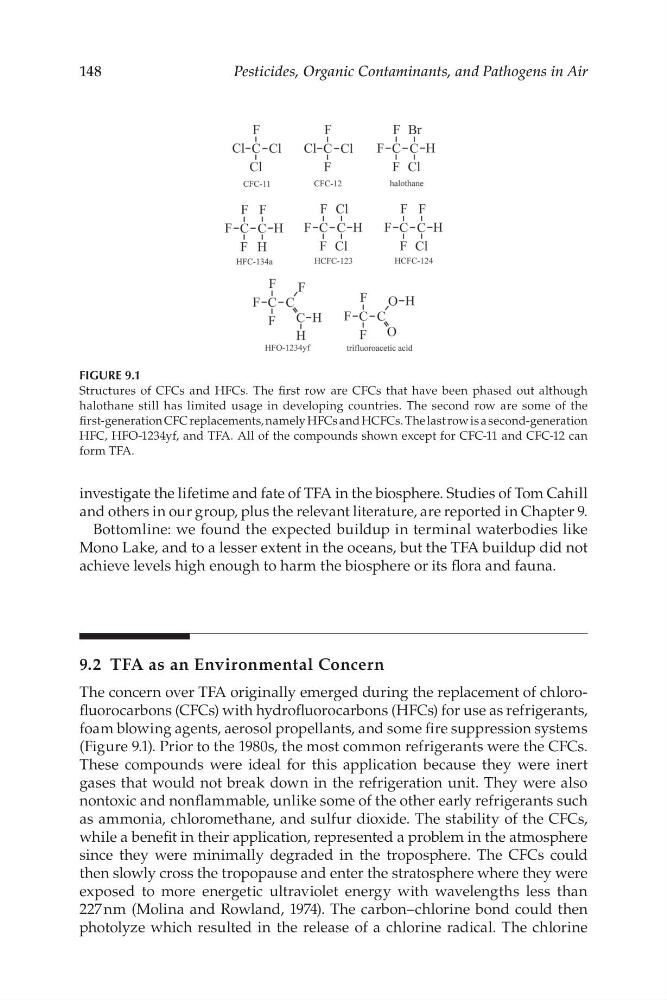
FIGURE 9.1
Structures of CFCs and HFCs. The frst row are CFCs that have been phased out although
halothane still has limited usage in developing countries. The second row are some of the
frst-generation CFC replacements, namely HFCs and HCFCs. The last row is a second-generation
HFC, HFO-1234yf, and TFA. All of the compounds shown except for CFC-11 and CFC-12 can
form TFA.
investigate the lifetime and fate of TFA in the biosphere. Studies of Tom Cahill
and others in our group, plus the relevant literature, are reported in Chapter 9.
Bottomline: we found the expected buildup in terminal waterbodies like
Mono Lake, and to a lesser extent in the oceans, but the TFA buildup did not
achieve levels high enough to harm the biosphere or its fora and fauna.
9.2 TFA as an Environmental Concern
The concern over TFA originally emerged during the replacement of chlorofuorocarbons (CFCs) with hydrofuorocarbons (HFCs) for use as refrigerants,
foam blowing agents, aerosol propellants, and some fre suppression systems
(Figure 9.1). Prior to the 1980s, the most common refrigerants were the CFCs.
These compounds were ideal for this application because they were inert
gases that would not break down in the refrigeration unit. They were also
nontoxic and nonfammable, unlike some of the other early refrigerants such
as ammonia, chloromethane, and sulfur dioxide. The stability of the CFCs,
while a beneft in their application, represented a problem in the atmosphere
since they were minimally degraded in the troposphere. The CFCs could
then slowly cross the tropopause and enter the stratosphere where they were
exposed to more energetic ultraviolet energy with wavelengths less than
227 nm (Molina and Rowland, 1974). The carbon–chlorine bond could then
photolyze which resulted in the release of a chlorine radical. The chlorine
Pesticides, Organic Contaminants, and Pathogens in Air
FIGURE 9.1
Structures of CFCs and HFCs. The frst row are CFCs that have been phased out although
halothane still has limited usage in developing countries. The second row are some of the
frst-generation CFC replacements, namely HFCs and HCFCs. The last row is a second-generation
HFC, HFO-1234yf, and TFA. All of the compounds shown except for CFC-11 and CFC-12 can
form TFA.
investigate the lifetime and fate of TFA in the biosphere. Studies of Tom Cahill
and others in our group, plus the relevant literature, are reported in Chapter 9.
Bottomline: we found the expected buildup in terminal waterbodies like
Mono Lake, and to a lesser extent in the oceans, but the TFA buildup did not
achieve levels high enough to harm the biosphere or its fora and fauna.
9.2 TFA as an Environmental Concern
The concern over TFA originally emerged during the replacement of chlorofuorocarbons (CFCs) with hydrofuorocarbons (HFCs) for use as refrigerants,
foam blowing agents, aerosol propellants, and some fre suppression systems
(Figure 9.1). Prior to the 1980s, the most common refrigerants were the CFCs.
These compounds were ideal for this application because they were inert
gases that would not break down in the refrigeration unit. They were also
nontoxic and nonfammable, unlike some of the other early refrigerants such
as ammonia, chloromethane, and sulfur dioxide. The stability of the CFCs,
while a beneft in their application, represented a problem in the atmosphere
since they were minimally degraded in the troposphere. The CFCs could
then slowly cross the tropopause and enter the stratosphere where they were
exposed to more energetic ultraviolet energy with wavelengths less than
227 nm (Molina and Rowland, 1974). The carbon–chlorine bond could then
photolyze which resulted in the release of a chlorine radical. The chlorine