

Fumigants
143
nuts, hops, and other crops are fumigated to kill termites, ants, fungi, and
other vermin in order to avoid losses in transit. This is often done in shipping
containers near the point of departure at ports and warehouse terminals.
Without proof of treatment, these containers may be turned away at customs
at the end of their journeys and not marketed. Even nonfood commodities
such as wood and lumber may need to be treated to kill termites and other
hitchhiking pests in furniture and clothing. How long to treat them, and
at what quantity or pressure are variables that are worked out in advance.
USDA-APHIS and ARS are the lead agencies for determining the conditions
for these quarantine treatments. See the homepage for sites such as the ARS
San Joaquin Valley Agricultural Sciences Center in Parlier, California, and
the West Side Research and Extension Center in Five Points, California.
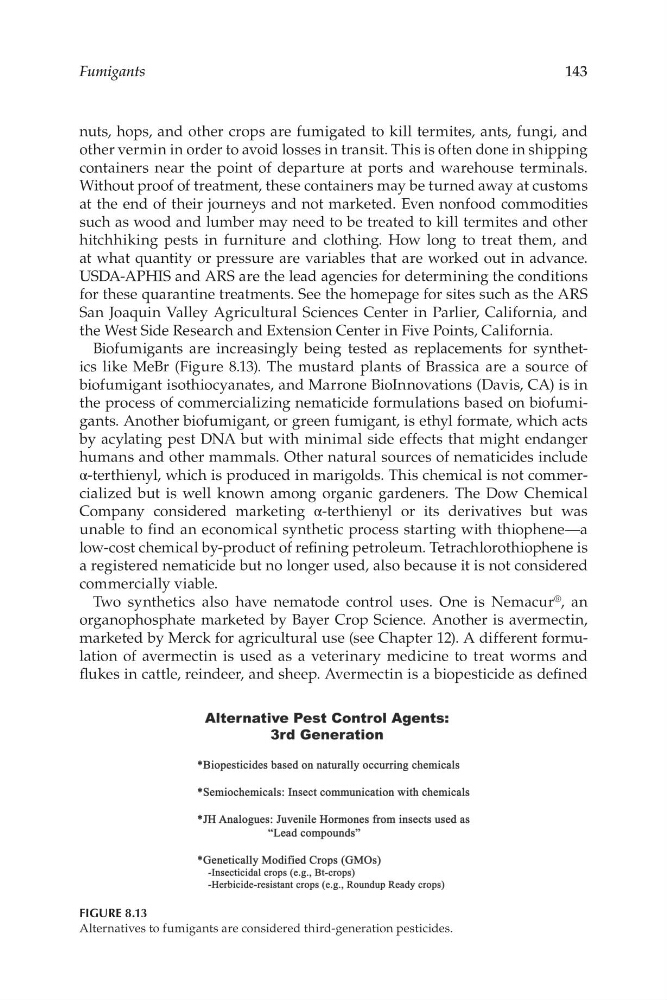
Biofumigants are increasingly being tested as replacements for synthetics like MeBr (Figure 8.13). The mustard plants of Brassica are a source of
biofumigant isothiocyanates, and Marrone BioInnovations (Davis, CA) is in
the process of commercializing nematicide formulations based on biofumigants. Another biofumigant, or green fumigant, is ethyl formate, which acts
by acylating pest DNA but with minimal side effects that might endanger
humans and other mammals. Other natural sources of nematicides include
α-terthienyl, which is produced in marigolds. This chemical is not commercialized but is well known among organic gardeners. The Dow Chemical
Company considered marketing α-terthienyl or its derivatives but was
unable to fnd an economical synthetic process starting with thiophene—a
low-cost chemical by-product of refning petroleum. Tetrachlorothiophene is
a registered nematicide but no longer used, also because it is not considered
commercially viable.
Two synthetics also have nematode control uses. One is Nemacur ® , an
organophosphate marketed by Bayer Crop Science. Another is avermectin,
marketed by Merck for agricultural use (see Chapter 12). A different formulation of avermectin is used as a veterinary medicine to treat worms and
fukes in cattle, reindeer, and sheep. Avermectin is a biopesticide as defned
FIGURE 8.13
Alternatives to fumigants are considered third-generation pesticides.
143
nuts, hops, and other crops are fumigated to kill termites, ants, fungi, and
other vermin in order to avoid losses in transit. This is often done in shipping
containers near the point of departure at ports and warehouse terminals.
Without proof of treatment, these containers may be turned away at customs
at the end of their journeys and not marketed. Even nonfood commodities
such as wood and lumber may need to be treated to kill termites and other
hitchhiking pests in furniture and clothing. How long to treat them, and
at what quantity or pressure are variables that are worked out in advance.
USDA-APHIS and ARS are the lead agencies for determining the conditions
for these quarantine treatments. See the homepage for sites such as the ARS
San Joaquin Valley Agricultural Sciences Center in Parlier, California, and
the West Side Research and Extension Center in Five Points, California.
Biofumigants are increasingly being tested as replacements for synthetics like MeBr (Figure 8.13). The mustard plants of Brassica are a source of
biofumigant isothiocyanates, and Marrone BioInnovations (Davis, CA) is in
the process of commercializing nematicide formulations based on biofumigants. Another biofumigant, or green fumigant, is ethyl formate, which acts
by acylating pest DNA but with minimal side effects that might endanger
humans and other mammals. Other natural sources of nematicides include
α-terthienyl, which is produced in marigolds. This chemical is not commercialized but is well known among organic gardeners. The Dow Chemical
Company considered marketing α-terthienyl or its derivatives but was
unable to fnd an economical synthetic process starting with thiophene—a
low-cost chemical by-product of refning petroleum. Tetrachlorothiophene is
a registered nematicide but no longer used, also because it is not considered
commercially viable.
Two synthetics also have nematode control uses. One is Nemacur ® , an
organophosphate marketed by Bayer Crop Science. Another is avermectin,
marketed by Merck for agricultural use (see Chapter 12). A different formulation of avermectin is used as a veterinary medicine to treat worms and
fukes in cattle, reindeer, and sheep. Avermectin is a biopesticide as defned
FIGURE 8.13
Alternatives to fumigants are considered third-generation pesticides.