

144
Pesticides, Organic Contaminants, and Pathogens in Air
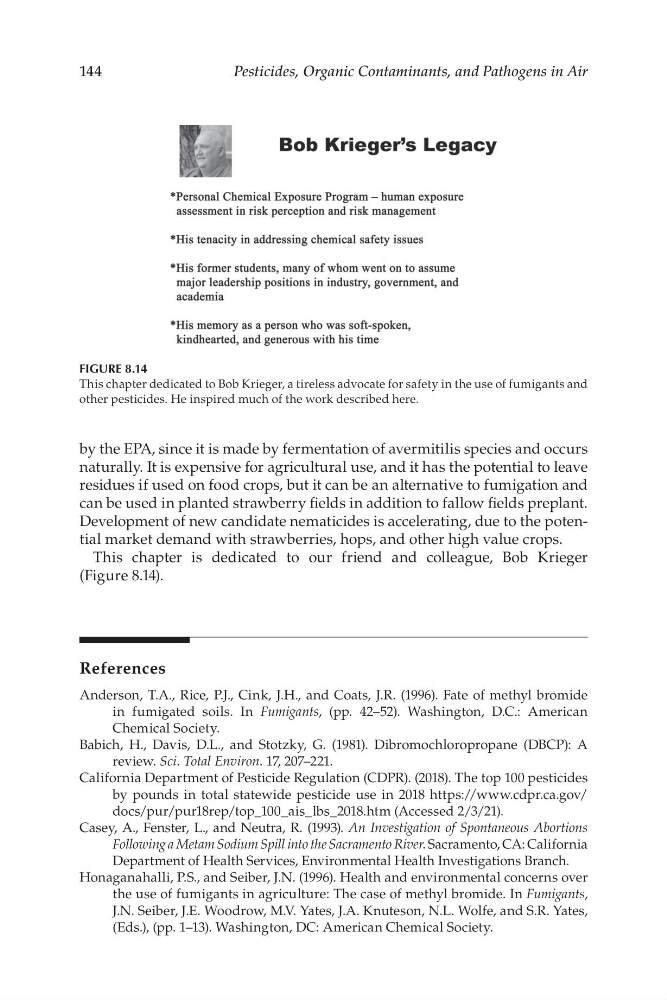
FIGURE 8.14
This chapter dedicated to Bob Krieger, a tireless advocate for safety in the use of fumigants and
other pesticides. He inspired much of the work described here.
by the EPA, since it is made by fermentation of avermitilis species and occurs
naturally. It is expensive for agricultural use, and it has the potential to leave
residues if used on food crops, but it can be an alternative to fumigation and
can be used in planted strawberry felds in addition to fallow felds preplant.
Development of new candidate nematicides is accelerating, due to the potential market demand with strawberries, hops, and other high value crops.
This chapter is dedicated to our friend and colleague, Bob Krieger
(Figure 8.14).
References
Anderson, T.A., Rice, P.J., Cink, J.H., and Coats, J.R. (1996). Fate of methyl bromide
in fumigated soils. In Fumigants, (pp. 42–52). Washington, D.C.: American
Chemical Society.
Babich, H., Davis, D.L., and Stotzky, G. (1981). Dibromochloropropane (DBCP): A
review. Sci. Total Environ. 17, 207–221.
California Department of Pesticide Regulation (CDPR). (2018). The top 100 pesticides
by pounds in total statewide pesticide use in 2018 https://www.cdpr.ca.gov/
docs/pur/pur18rep/top_100_ais_lbs_2018.htm (Accessed 2/3/21).
Casey, A., Fenster, L., and Neutra, R. (1993). An Investigation of Spontaneous Abortions
Following a Metam Sodium Spill into the Sacramento River. Sacramento, CA: California
Department of Health Services, Environmental Health Investigations Branch.
Honaganahalli, P.S., and Seiber, J.N. (1996). Health and environmental concerns over
the use of fumigants in agriculture: The case of methyl bromide. In Fumigants,
J.N. Seiber, J.E. Woodrow, M.V. Yates, J.A. Knuteson, N.L. Wolfe, and S.R. Yates,
(Eds.), (pp. 1–13). Washington, DC: American Chemical Society.