

142
Pesticides, Organic Contaminants, and Pathogens in Air
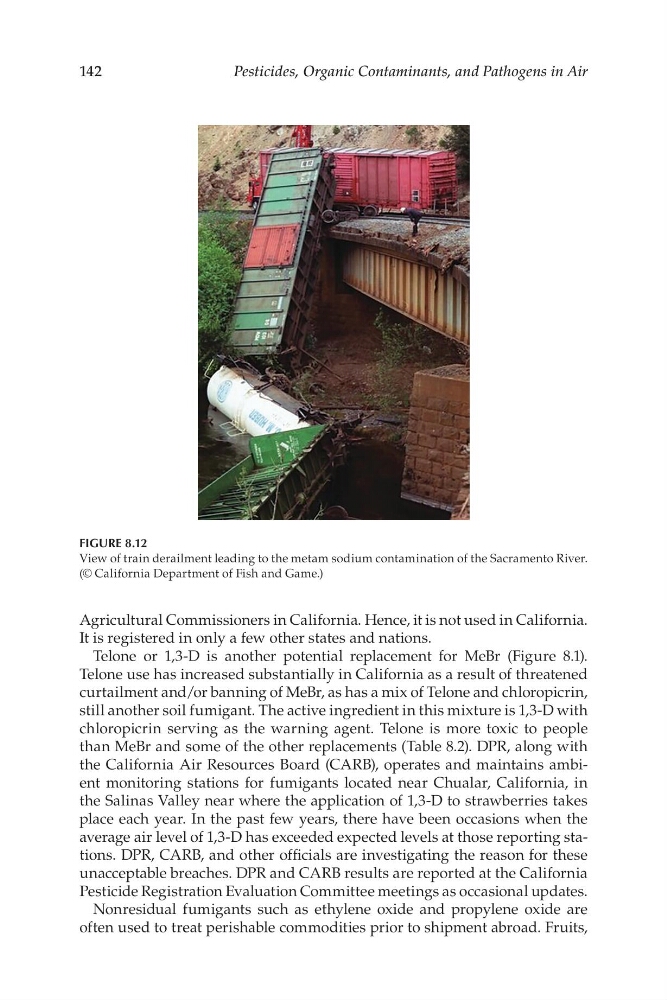
FIGURE 8.12
View of train derailment leading to the metam sodium contamination of the Sacramento River.
(© California Department of Fish and Game.)
Agricultural Commissioners in California. Hence, it is not used in California.
It is registered in only a few other states and nations.
Telone or 1,3-D is another potential replacement for MeBr (Figure 8.1).
Telone use has increased substantially in California as a result of threatened
curtailment and/or banning of MeBr, as has a mix of Telone and chloropicrin,
still another soil fumigant. The active ingredient in this mixture is 1,3-D with
chloropicrin serving as the warning agent. Telone is more toxic to people
than MeBr and some of the other replacements (Table 8.2). DPR, along with
the California Air Resources Board (CARB), operates and maintains ambient monitoring stations for fumigants located near Chualar, California, in
the Salinas Valley near where the application of 1,3-D to strawberries takes
place each year. In the past few years, there have been occasions when the
average air level of 1,3-D has exceeded expected levels at those reporting stations. DPR, CARB, and other offcials are investigating the reason for these
unacceptable breaches. DPR and CARB results are reported at the California
Pesticide Registration Evaluation Committee meetings as occasional updates.
Nonresidual fumigants such as ethylene oxide and propylene oxide are
often used to treat perishable commodities prior to shipment abroad. Fruits,
Pesticides, Organic Contaminants, and Pathogens in Air
FIGURE 8.12
View of train derailment leading to the metam sodium contamination of the Sacramento River.
(© California Department of Fish and Game.)
Agricultural Commissioners in California. Hence, it is not used in California.
It is registered in only a few other states and nations.
Telone or 1,3-D is another potential replacement for MeBr (Figure 8.1).
Telone use has increased substantially in California as a result of threatened
curtailment and/or banning of MeBr, as has a mix of Telone and chloropicrin,
still another soil fumigant. The active ingredient in this mixture is 1,3-D with
chloropicrin serving as the warning agent. Telone is more toxic to people
than MeBr and some of the other replacements (Table 8.2). DPR, along with
the California Air Resources Board (CARB), operates and maintains ambient monitoring stations for fumigants located near Chualar, California, in
the Salinas Valley near where the application of 1,3-D to strawberries takes
place each year. In the past few years, there have been occasions when the
average air level of 1,3-D has exceeded expected levels at those reporting stations. DPR, CARB, and other offcials are investigating the reason for these
unacceptable breaches. DPR and CARB results are reported at the California
Pesticide Registration Evaluation Committee meetings as occasional updates.
Nonresidual fumigants such as ethylene oxide and propylene oxide are
often used to treat perishable commodities prior to shipment abroad. Fruits,