

Fumigants
141
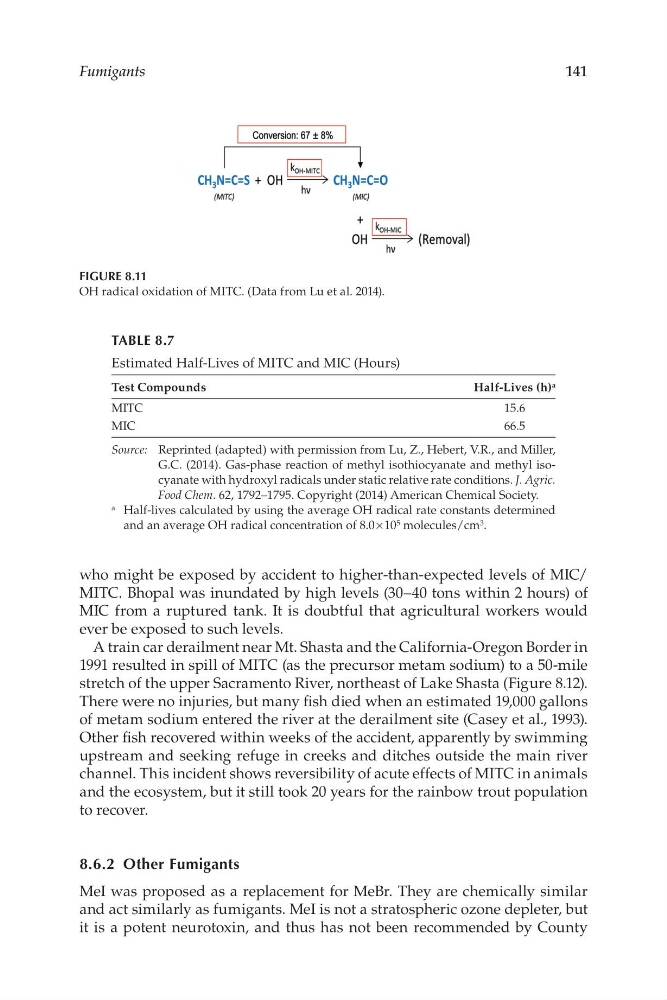
FIGURE 8.11
OH radical oxidation of MITC. (Data from Lu et al. 2014).
TABLE 8.7
Estimated Half-Lives of MITC and MIC (Hours)
Test Compounds
Half-Lives (h) a
MITC
15.6
MIC
66.5
Source: Reprinted (adapted) with permission from Lu, Z., Hebert, V.R., and Miller,
G.C. (2014). Gas-phase reaction of methyl isothiocyanate and methyl isocyanate with hydroxyl radicals under static relative rate conditions. J. Agric.
Food Chem. 62, 1792–1795. Copyright (2014) American Chemical Society.
a Half-lives calculated by using the average OH radical rate constants determined
and an average OH radical concentration of 8.0 × 10 5 molecules/cm 3 .
who might be exposed by accident to higher-than-expected levels of MIC/
MITC. Bhopal was inundated by high levels (30–40 tons within 2 hours) of
MIC from a ruptured tank. It is doubtful that agricultural workers would
ever be exposed to such levels.
A train car derailment near Mt. Shasta and the California-Oregon Border in
1991 resulted in spill of MITC (as the precursor metam sodium) to a 50-mile
stretch of the upper Sacramento River, northeast of Lake Shasta (Figure 8.12).
There were no injuries, but many fsh died when an estimated 19,000 gallons
of metam sodium entered the river at the derailment site (Casey et al., 1993).
Other fsh recovered within weeks of the accident, apparently by swimming
upstream and seeking refuge in creeks and ditches outside the main river
channel. This incident shows reversibility of acute effects of MITC in animals
and the ecosystem, but it still took 20 years for the rainbow trout population
to recover.
8.6.2 Other Fumigants
MeI was proposed as a replacement for MeBr. They are chemically similar
and act similarly as fumigants. MeI is not a stratospheric ozone depleter, but
it is a potent neurotoxin, and thus has not been recommended by County
141
FIGURE 8.11
OH radical oxidation of MITC. (Data from Lu et al. 2014).
TABLE 8.7
Estimated Half-Lives of MITC and MIC (Hours)
Test Compounds
Half-Lives (h) a
MITC
15.6
MIC
66.5
Source: Reprinted (adapted) with permission from Lu, Z., Hebert, V.R., and Miller,
G.C. (2014). Gas-phase reaction of methyl isothiocyanate and methyl isocyanate with hydroxyl radicals under static relative rate conditions. J. Agric.
Food Chem. 62, 1792–1795. Copyright (2014) American Chemical Society.
a Half-lives calculated by using the average OH radical rate constants determined
and an average OH radical concentration of 8.0 × 10 5 molecules/cm 3 .
who might be exposed by accident to higher-than-expected levels of MIC/
MITC. Bhopal was inundated by high levels (30–40 tons within 2 hours) of
MIC from a ruptured tank. It is doubtful that agricultural workers would
ever be exposed to such levels.
A train car derailment near Mt. Shasta and the California-Oregon Border in
1991 resulted in spill of MITC (as the precursor metam sodium) to a 50-mile
stretch of the upper Sacramento River, northeast of Lake Shasta (Figure 8.12).
There were no injuries, but many fsh died when an estimated 19,000 gallons
of metam sodium entered the river at the derailment site (Casey et al., 1993).
Other fsh recovered within weeks of the accident, apparently by swimming
upstream and seeking refuge in creeks and ditches outside the main river
channel. This incident shows reversibility of acute effects of MITC in animals
and the ecosystem, but it still took 20 years for the rainbow trout population
to recover.
8.6.2 Other Fumigants
MeI was proposed as a replacement for MeBr. They are chemically similar
and act similarly as fumigants. MeI is not a stratospheric ozone depleter, but
it is a potent neurotoxin, and thus has not been recommended by County