

108
Pesticides, Organic Contaminants, and Pathogens in Air
in fog (Glotfelty et al., 1986, 1987). They discovered that a variety of pesticides and their toxic alteration products are present in fog, and that they can
reach high concentrations relative to rainwater and other atmospheric water
samples. Also, in measuring the air–water distribution of pesticides between
the suspended liquid phase in fogwater and the interstitial air, they found
that some chemicals are enriched several thousand-fold in the suspended
liquid when compared with distributions expected based upon Henry’s law
coeffcients for pure air–water distribution systems.
These fog samples were collected at the USDA Beltsville Agricultural
Research Center in Beltsville, MD, and at several locations in California’s
San Joaquin Valley. Beltsville samples were often dark in color, with large
amounts of black particles (largely carbonaceous) which settled out when
left to stand, leaving an off-yellow supernatant. Several common pesticides
such as malathion were present in measurable levels. Industrial organophosphorus chemicals, polycyclic aromatic hydrocarbons, and phthalate esters
were present in these samples as well. Although the USDA Beltsville Center
is agricultural, it is surrounded by a densely populated, partially industrial
area with heavy vehicular traffc.
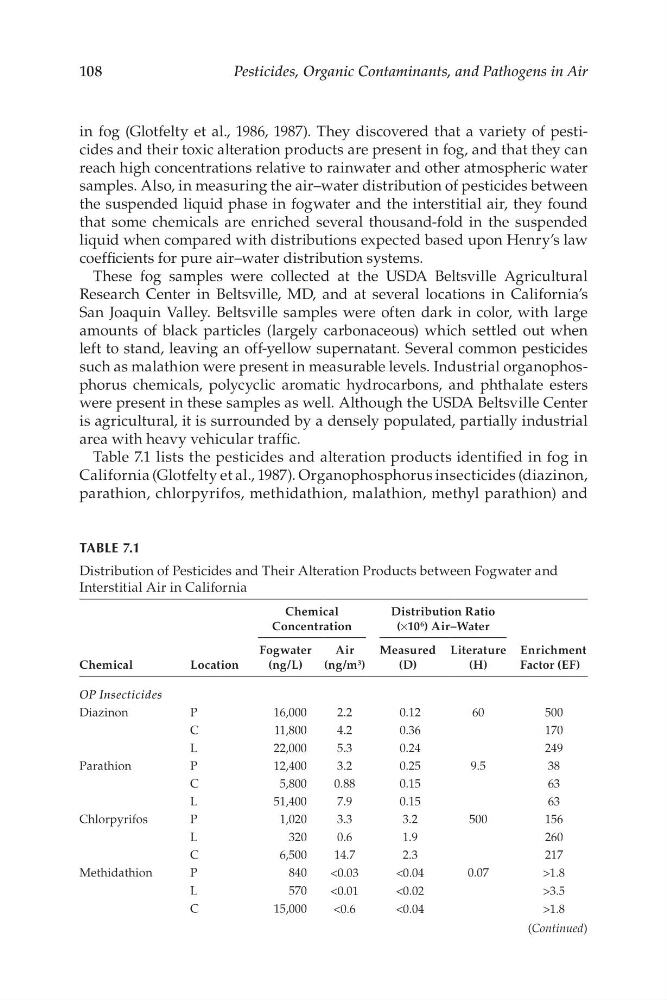
Table 7.1 lists the pesticides and alteration products identifed in fog in
California (Glotfelty et al., 1987). Organophosphorus insecticides (diazinon,
parathion, chlorpyrifos, methidathion, malathion, methyl parathion) and
TABLE 7.1
Distribution of Pesticides and Their Alteration Products between Fogwater and
Interstitial Air in California
Chemical
Distribution Ratio
Concentration
(×10 6 ) Air–Water
Fogwater
Air
Measured Literature Enrichment
Chemical
Location
(ng/L)
(ng/m 3 )
(D)
(H)
Factor (EF)
OP Insecticides
Diazinon
P
16,000
2.2
0.12
60
500
C
11,800
4.2
0.36
170
L
22,000
5.3
0.24
249
Parathion
P
12,400
3.2
0.25
9.5
38
C
5,800
0.88
0.15
63
L
51,400
7.9
0.15
63
Chlorpyrifos
P
1,020
3.3
3.2
500
156
L
320
0.6
1.9
260
C
6,500
14.7
2.3
217
Methidathion
P
840
<0.03
<0.04
0.07
>1.8
L
570
<0.01
<0.02
>3.5
C
15,000
<0.6
<0.04
>1.8
(Continued)
Pesticides, Organic Contaminants, and Pathogens in Air
in fog (Glotfelty et al., 1986, 1987). They discovered that a variety of pesticides and their toxic alteration products are present in fog, and that they can
reach high concentrations relative to rainwater and other atmospheric water
samples. Also, in measuring the air–water distribution of pesticides between
the suspended liquid phase in fogwater and the interstitial air, they found
that some chemicals are enriched several thousand-fold in the suspended
liquid when compared with distributions expected based upon Henry’s law
coeffcients for pure air–water distribution systems.
These fog samples were collected at the USDA Beltsville Agricultural
Research Center in Beltsville, MD, and at several locations in California’s
San Joaquin Valley. Beltsville samples were often dark in color, with large
amounts of black particles (largely carbonaceous) which settled out when
left to stand, leaving an off-yellow supernatant. Several common pesticides
such as malathion were present in measurable levels. Industrial organophosphorus chemicals, polycyclic aromatic hydrocarbons, and phthalate esters
were present in these samples as well. Although the USDA Beltsville Center
is agricultural, it is surrounded by a densely populated, partially industrial
area with heavy vehicular traffc.
Table 7.1 lists the pesticides and alteration products identifed in fog in
California (Glotfelty et al., 1987). Organophosphorus insecticides (diazinon,
parathion, chlorpyrifos, methidathion, malathion, methyl parathion) and
TABLE 7.1
Distribution of Pesticides and Their Alteration Products between Fogwater and
Interstitial Air in California
Chemical
Distribution Ratio
Concentration
(×10 6 ) Air–Water
Fogwater
Air
Measured Literature Enrichment
Chemical
Location
(ng/L)
(ng/m 3 )
(D)
(H)
Factor (EF)
OP Insecticides
Diazinon
P
16,000
2.2
0.12
60
500
C
11,800
4.2
0.36
170
L
22,000
5.3
0.24
249
Parathion
P
12,400
3.2
0.25
9.5
38
C
5,800
0.88
0.15
63
L
51,400
7.9
0.15
63
Chlorpyrifos
P
1,020
3.3
3.2
500
156
L
320
0.6
1.9
260
C
6,500
14.7
2.3
217
Methidathion
P
840
<0.03
<0.04
0.07
>1.8
L
570
<0.01
<0.02
>3.5
C
15,000
<0.6
<0.04
>1.8
(Continued)