

107
Pesticides in Fog
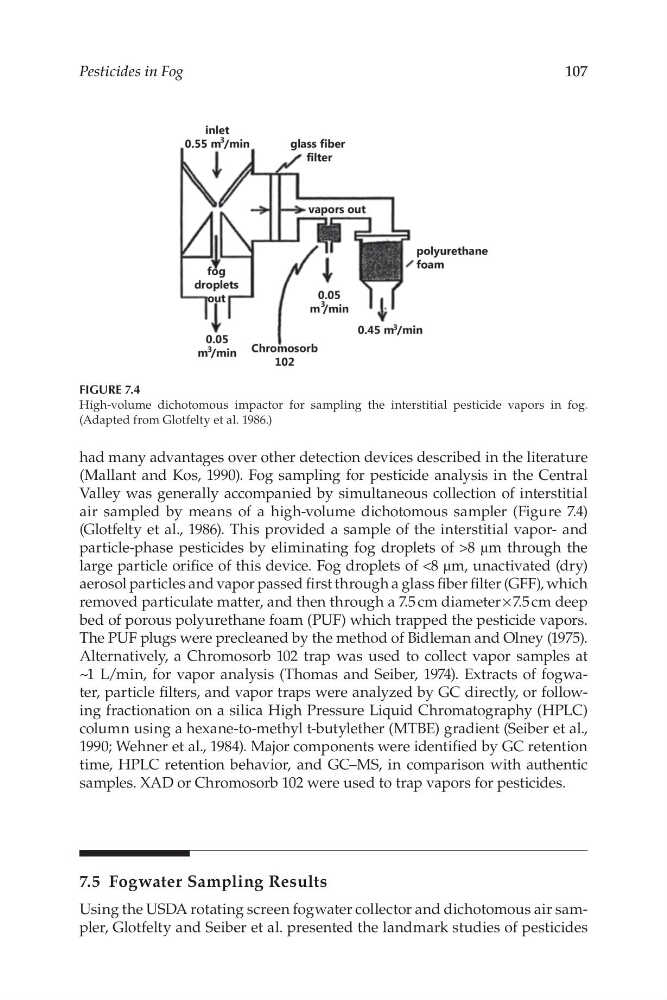
FIGURE 7.4
High-volume dichotomous impactor for sampling the interstitial pesticide vapors in fog.
(Adapted from Glotfelty et al. 1986.)
had many advantages over other detection devices described in the literature
(Mallant and Kos, 1990). Fog sampling for pesticide analysis in the Central
Valley was generally accompanied by simultaneous collection of interstitial
air sampled by means of a high-volume dichotomous sampler (Figure 7.4)
(Glotfelty et al., 1986). This provided a sample of the interstitial vapor- and
particle-phase pesticides by eliminating fog droplets of >8 µm through the
large particle orifce of this device. Fog droplets of <8 µm, unactivated (dry)
aerosol particles and vapor passed frst through a glass fber flter (GFF), which
removed particulate matter, and then through a 7.5 cm diameter × 7.5 cm deep
bed of porous polyurethane foam (PUF) which trapped the pesticide vapors.
The PUF plugs were precleaned by the method of Bidleman and Olney (1975).
Alternatively, a Chromosorb 102 trap was used to collect vapor samples at
~1 L/min, for vapor analysis (Thomas and Seiber, 1974). Extracts of fogwater, particle flters, and vapor traps were analyzed by GC directly, or following fractionation on a silica High Pressure Liquid Chromatography (HPLC)
column using a hexane-to-methyl t-butylether (MTBE) gradient (Seiber et al.,
1990; Wehner et al., 1984). Major components were identifed by GC retention
time, HPLC retention behavior, and GC–MS, in comparison with authentic
samples. XAD or Chromosorb 102 were used to trap vapors for pesticides.
7.5 Fogwater Sampling Results
Using the USDA rotating screen fogwater collector and dichotomous air sampler, Glotfelty and Seiber et al. presented the landmark studies of pesticides
Pesticides in Fog
FIGURE 7.4
High-volume dichotomous impactor for sampling the interstitial pesticide vapors in fog.
(Adapted from Glotfelty et al. 1986.)
had many advantages over other detection devices described in the literature
(Mallant and Kos, 1990). Fog sampling for pesticide analysis in the Central
Valley was generally accompanied by simultaneous collection of interstitial
air sampled by means of a high-volume dichotomous sampler (Figure 7.4)
(Glotfelty et al., 1986). This provided a sample of the interstitial vapor- and
particle-phase pesticides by eliminating fog droplets of >8 µm through the
large particle orifce of this device. Fog droplets of <8 µm, unactivated (dry)
aerosol particles and vapor passed frst through a glass fber flter (GFF), which
removed particulate matter, and then through a 7.5 cm diameter × 7.5 cm deep
bed of porous polyurethane foam (PUF) which trapped the pesticide vapors.
The PUF plugs were precleaned by the method of Bidleman and Olney (1975).
Alternatively, a Chromosorb 102 trap was used to collect vapor samples at
~1 L/min, for vapor analysis (Thomas and Seiber, 1974). Extracts of fogwater, particle flters, and vapor traps were analyzed by GC directly, or following fractionation on a silica High Pressure Liquid Chromatography (HPLC)
column using a hexane-to-methyl t-butylether (MTBE) gradient (Seiber et al.,
1990; Wehner et al., 1984). Major components were identifed by GC retention
time, HPLC retention behavior, and GC–MS, in comparison with authentic
samples. XAD or Chromosorb 102 were used to trap vapors for pesticides.
7.5 Fogwater Sampling Results
Using the USDA rotating screen fogwater collector and dichotomous air sampler, Glotfelty and Seiber et al. presented the landmark studies of pesticides