

106
Pesticides, Organic Contaminants, and Pathogens in Air
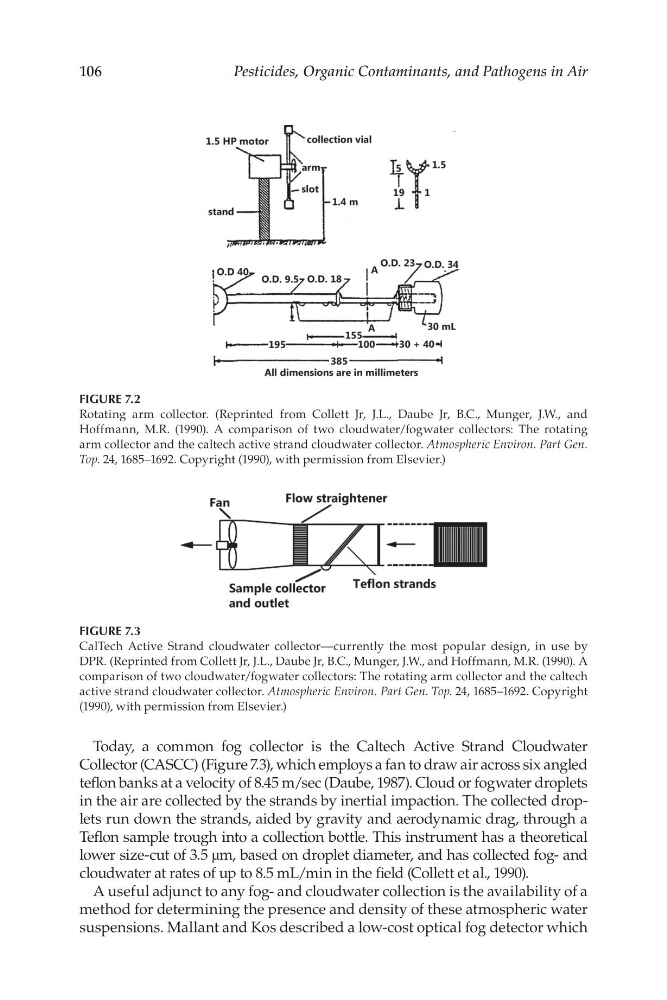
FIGURE 7.2
Rotating arm collector. (Reprinted from Collett Jr, J.L., Daube Jr, B.C., Munger, J.W., and
Hoffmann, M.R. (1990). A comparison of two cloudwater/fogwater collectors: The rotating
arm collector and the caltech active strand cloudwater collector. Atmospheric Environ. Part Gen.
Top. 24, 1685–1692. Copyright (1990), with permission from Elsevier.)
FIGURE 7.3
CalTech Active Strand cloudwater collector—currently the most popular design, in use by
DPR. (Reprinted from Collett Jr, J.L., Daube Jr, B.C., Munger, J.W., and Hoffmann, M.R. (1990). A
comparison of two cloudwater/fogwater collectors: The rotating arm collector and the caltech
active strand cloudwater collector. Atmospheric Environ. Part Gen. Top. 24, 1685–1692. Copyright
(1990), with permission from Elsevier.)
Today, a common fog collector is the Caltech Active Strand Cloudwater
Collector (CASCC) (Figure 7.3), which employs a fan to draw air across six angled
tefon banks at a velocity of 8.45 m/sec (Daube, 1987). Cloud or fogwater droplets
in the air are collected by the strands by inertial impaction. The collected droplets run down the strands, aided by gravity and aerodynamic drag, through a
Tefon sample trough into a collection bottle. This instrument has a theoretical
lower size-cut of 3.5 µm, based on droplet diameter, and has collected fog- and
cloudwater at rates of up to 8.5 mL/min in the feld (Collett et al., 1990).
A useful adjunct to any fog- and cloudwater collection is the availability of a
method for determining the presence and density of these atmospheric water
suspensions. Mallant and Kos described a low-cost optical fog detector which
Pesticides, Organic Contaminants, and Pathogens in Air
FIGURE 7.2
Rotating arm collector. (Reprinted from Collett Jr, J.L., Daube Jr, B.C., Munger, J.W., and
Hoffmann, M.R. (1990). A comparison of two cloudwater/fogwater collectors: The rotating
arm collector and the caltech active strand cloudwater collector. Atmospheric Environ. Part Gen.
Top. 24, 1685–1692. Copyright (1990), with permission from Elsevier.)
FIGURE 7.3
CalTech Active Strand cloudwater collector—currently the most popular design, in use by
DPR. (Reprinted from Collett Jr, J.L., Daube Jr, B.C., Munger, J.W., and Hoffmann, M.R. (1990). A
comparison of two cloudwater/fogwater collectors: The rotating arm collector and the caltech
active strand cloudwater collector. Atmospheric Environ. Part Gen. Top. 24, 1685–1692. Copyright
(1990), with permission from Elsevier.)
Today, a common fog collector is the Caltech Active Strand Cloudwater
Collector (CASCC) (Figure 7.3), which employs a fan to draw air across six angled
tefon banks at a velocity of 8.45 m/sec (Daube, 1987). Cloud or fogwater droplets
in the air are collected by the strands by inertial impaction. The collected droplets run down the strands, aided by gravity and aerodynamic drag, through a
Tefon sample trough into a collection bottle. This instrument has a theoretical
lower size-cut of 3.5 µm, based on droplet diameter, and has collected fog- and
cloudwater at rates of up to 8.5 mL/min in the feld (Collett et al., 1990).
A useful adjunct to any fog- and cloudwater collection is the availability of a
method for determining the presence and density of these atmospheric water
suspensions. Mallant and Kos described a low-cost optical fog detector which