

97
Sampling and Analysis
Volatile pesticides can be separated by capillary gas chromatography (GC)
and detected by MS and tandem mass spectrometry (MS/MS) or the various other GC detectors including electron-capture detector, fame ionization
detector, etc. Polar compounds can be detected with liquid chromatography
and MS, MS/MS, or a UV detector. Alternatives include Fourier Transform
spectroscopy (though it generally has a high LOD) and immunoassay (for
targeted analysis).
Toxaphene is comprised of 175-plus discrete polychlorinated terpenes—
primarily camphenes and bornanes, CxHyClz (PubChem, 2005). Toxaphene
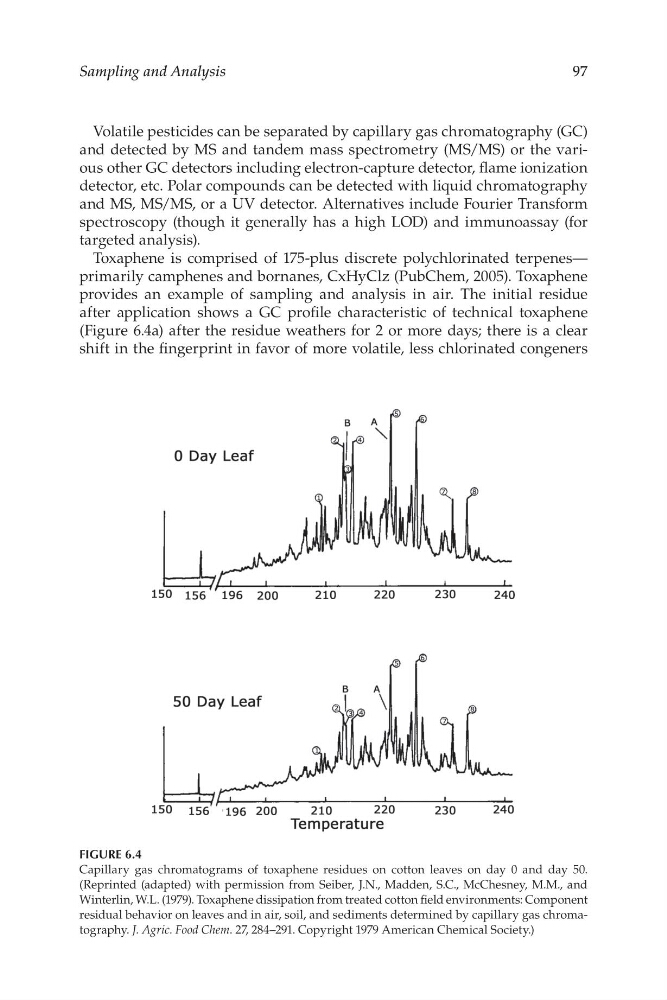
provides an example of sampling and analysis in air. The initial residue
after application shows a GC profle characteristic of technical toxaphene
(Figure 6.4a) after the residue weathers for 2 or more days; there is a clear
shift in the fngerprint in favor of more volatile, less chlorinated congeners
FIGURE 6.4
Capillary gas chromatograms of toxaphene residues on cotton leaves on day 0 and day 50.
(Reprinted (adapted) with permission from Seiber, J.N., Madden, S.C., McChesney, M.M., and
Winterlin, W.L. (1979). Toxaphene dissipation from treated cotton feld environments: Component
residual behavior on leaves and in air, soil, and sediments determined by capillary gas chromatography. J. Agric. Food Chem. 27, 284–291. Copyright 1979 American Chemical Society.)
Sampling and Analysis
Volatile pesticides can be separated by capillary gas chromatography (GC)
and detected by MS and tandem mass spectrometry (MS/MS) or the various other GC detectors including electron-capture detector, fame ionization
detector, etc. Polar compounds can be detected with liquid chromatography
and MS, MS/MS, or a UV detector. Alternatives include Fourier Transform
spectroscopy (though it generally has a high LOD) and immunoassay (for
targeted analysis).
Toxaphene is comprised of 175-plus discrete polychlorinated terpenes—
primarily camphenes and bornanes, CxHyClz (PubChem, 2005). Toxaphene
provides an example of sampling and analysis in air. The initial residue
after application shows a GC profle characteristic of technical toxaphene
(Figure 6.4a) after the residue weathers for 2 or more days; there is a clear
shift in the fngerprint in favor of more volatile, less chlorinated congeners
FIGURE 6.4
Capillary gas chromatograms of toxaphene residues on cotton leaves on day 0 and day 50.
(Reprinted (adapted) with permission from Seiber, J.N., Madden, S.C., McChesney, M.M., and
Winterlin, W.L. (1979). Toxaphene dissipation from treated cotton feld environments: Component
residual behavior on leaves and in air, soil, and sediments determined by capillary gas chromatography. J. Agric. Food Chem. 27, 284–291. Copyright 1979 American Chemical Society.)