

96
Pesticides, Organic Contaminants, and Pathogens in Air
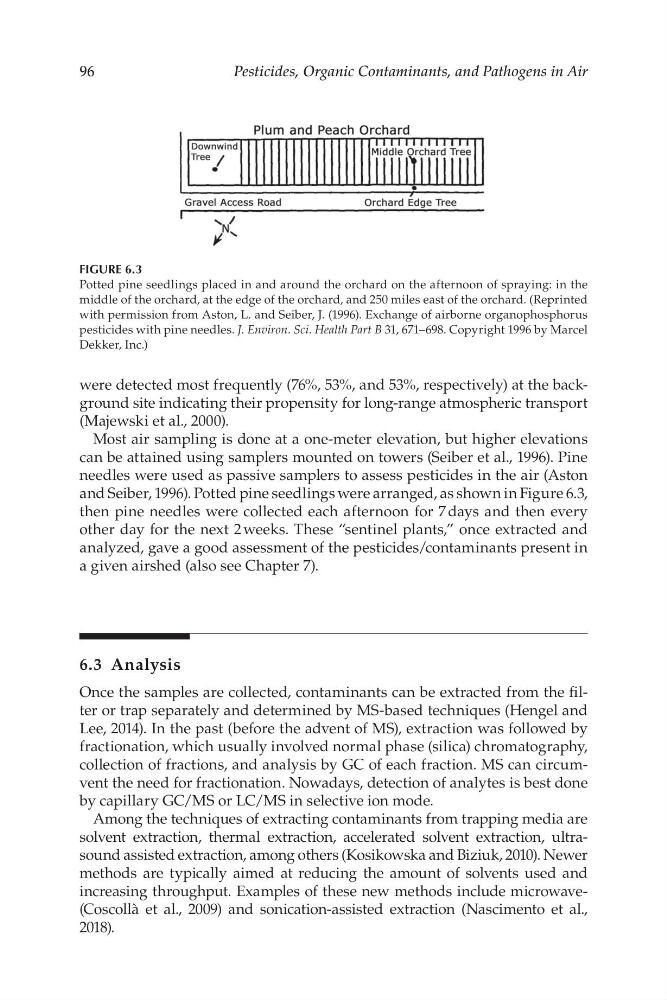
FIGURE 6.3
Potted pine seedlings placed in and around the orchard on the afternoon of spraying: in the
middle of the orchard, at the edge of the orchard, and 250 miles east of the orchard. (Reprinted
with permission from Aston, L. and Seiber, J. (1996). Exchange of airborne organophosphorus
pesticides with pine needles. J. Environ. Sci. Health Part B 31, 671–698. Copyright 1996 by Marcel
Dekker, Inc.)
were detected most frequently (76%, 53%, and 53%, respectively) at the background site indicating their propensity for long-range atmospheric transport
(Majewski et al., 2000).
Most air sampling is done at a one-meter elevation, but higher elevations
can be attained using samplers mounted on towers (Seiber et al., 1996). Pine
needles were used as passive samplers to assess pesticides in the air (Aston
and Seiber, 1996). Potted pine seedlings were arranged, as shown in Figure 6.3,
then pine needles were collected each afternoon for 7 days and then every
other day for the next 2 weeks. These “sentinel plants,” once extracted and
analyzed, gave a good assessment of the pesticides/contaminants present in
a given airshed (also see Chapter 7).
6.3 Analysis
Once the samples are collected, contaminants can be extracted from the flter or trap separately and determined by MS-based techniques (Hengel and
Lee, 2014). In the past (before the advent of MS), extraction was followed by
fractionation, which usually involved normal phase (silica) chromatography,
collection of fractions, and analysis by GC of each fraction. MS can circumvent the need for fractionation. Nowadays, detection of analytes is best done
by capillary GC/MS or LC/MS in selective ion mode.
Among the techniques of extracting contaminants from trapping media are
solvent extraction, thermal extraction, accelerated solvent extraction, ultrasound assisted extraction, among others (Kosikowska and Biziuk, 2010). Newer
methods are typically aimed at reducing the amount of solvents used and
increasing throughput. Examples of these new methods include microwave(Coscollà et al., 2009) and sonication-assisted extraction (Nascimento et al.,
2018).
Pesticides, Organic Contaminants, and Pathogens in Air
FIGURE 6.3
Potted pine seedlings placed in and around the orchard on the afternoon of spraying: in the
middle of the orchard, at the edge of the orchard, and 250 miles east of the orchard. (Reprinted
with permission from Aston, L. and Seiber, J. (1996). Exchange of airborne organophosphorus
pesticides with pine needles. J. Environ. Sci. Health Part B 31, 671–698. Copyright 1996 by Marcel
Dekker, Inc.)
were detected most frequently (76%, 53%, and 53%, respectively) at the background site indicating their propensity for long-range atmospheric transport
(Majewski et al., 2000).
Most air sampling is done at a one-meter elevation, but higher elevations
can be attained using samplers mounted on towers (Seiber et al., 1996). Pine
needles were used as passive samplers to assess pesticides in the air (Aston
and Seiber, 1996). Potted pine seedlings were arranged, as shown in Figure 6.3,
then pine needles were collected each afternoon for 7 days and then every
other day for the next 2 weeks. These “sentinel plants,” once extracted and
analyzed, gave a good assessment of the pesticides/contaminants present in
a given airshed (also see Chapter 7).
6.3 Analysis
Once the samples are collected, contaminants can be extracted from the flter or trap separately and determined by MS-based techniques (Hengel and
Lee, 2014). In the past (before the advent of MS), extraction was followed by
fractionation, which usually involved normal phase (silica) chromatography,
collection of fractions, and analysis by GC of each fraction. MS can circumvent the need for fractionation. Nowadays, detection of analytes is best done
by capillary GC/MS or LC/MS in selective ion mode.
Among the techniques of extracting contaminants from trapping media are
solvent extraction, thermal extraction, accelerated solvent extraction, ultrasound assisted extraction, among others (Kosikowska and Biziuk, 2010). Newer
methods are typically aimed at reducing the amount of solvents used and
increasing throughput. Examples of these new methods include microwave(Coscollà et al., 2009) and sonication-assisted extraction (Nascimento et al.,
2018).