

82
Pesticides, Organic Contaminants, and Pathogens in Air
variable emission rates, downwind deposition rates, simple terrain, complex
terrain, building downwash, variable temperature, variable windspeed, etc.
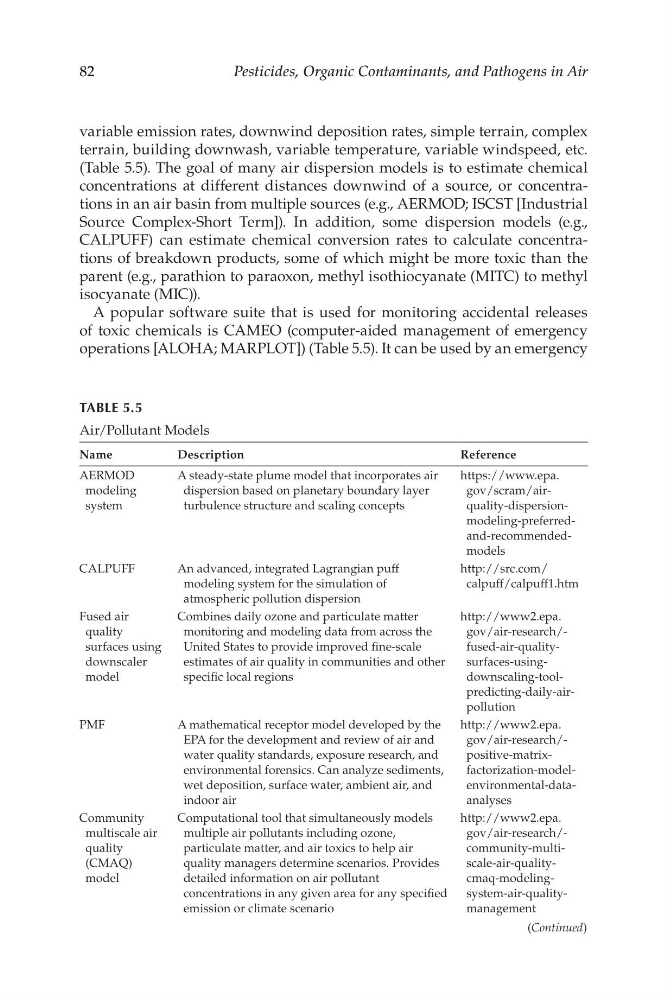
(Table 5.5). The goal of many air dispersion models is to estimate chemical
concentrations at different distances downwind of a source, or concentrations in an air basin from multiple sources (e.g., AERMOD; ISCST [Industrial
Source Complex-Short Term]). In addition, some dispersion models (e.g.,
CALPUFF) can estimate chemical conversion rates to calculate concentrations of breakdown products, some of which might be more toxic than the
parent (e.g., parathion to paraoxon, methyl isothiocyanate (MITC) to methyl
isocyanate (MIC)).
A popular software suite that is used for monitoring accidental releases
of toxic chemicals is CAMEO (computer-aided management of emergency
operations [ALOHA; MARPLOT]) (Table 5.5). It can be used by an emergency
TABLE 5.5
Air/Pollutant Models
Name
Description
Reference
AERMOD
A steady-state plume model that incorporates air
modeling
dispersion based on planetary boundary layer
system
turbulence structure and scaling concepts
CALPUFF
An advanced, integrated Lagrangian puff
modeling system for the simulation of
atmospheric pollution dispersion
Fused air
Combines daily ozone and particulate matter
quality
monitoring and modeling data from across the
surfaces using
United States to provide improved fne-scale
downscaler
estimates of air quality in communities and other
model
specifc local regions
PMF
A mathematical receptor model developed by the
EPA for the development and review of air and
water quality standards, exposure research, and
environmental forensics. Can analyze sediments,
wet deposition, surface water, ambient air, and
indoor air
Community
Computational tool that simultaneously models
multiscale air
multiple air pollutants including ozone,
quality
particulate matter, and air toxics to help air
(CMAQ)
quality managers determine scenarios. Provides
model
detailed information on air pollutant
concentrations in any given area for any specifed
emission or climate scenario
https://www.epa.
and-recommendedmodels
http://src.com/
calpuff/calpuff1.htm
http://www2.epa.
gov/air-research/ -
predicting-daily-airpollution
http://www2.epa.
gov/air-research/ -
environmental-dataanalyses
http://www2.epa.
gov/air-research/ -
system-air-qualitymanagement
(Continued)
Pesticides, Organic Contaminants, and Pathogens in Air
variable emission rates, downwind deposition rates, simple terrain, complex
terrain, building downwash, variable temperature, variable windspeed, etc.
(Table 5.5). The goal of many air dispersion models is to estimate chemical
concentrations at different distances downwind of a source, or concentrations in an air basin from multiple sources (e.g., AERMOD; ISCST [Industrial
Source Complex-Short Term]). In addition, some dispersion models (e.g.,
CALPUFF) can estimate chemical conversion rates to calculate concentrations of breakdown products, some of which might be more toxic than the
parent (e.g., parathion to paraoxon, methyl isothiocyanate (MITC) to methyl
isocyanate (MIC)).
A popular software suite that is used for monitoring accidental releases
of toxic chemicals is CAMEO (computer-aided management of emergency
operations [ALOHA; MARPLOT]) (Table 5.5). It can be used by an emergency
TABLE 5.5
Air/Pollutant Models
Name
Description
Reference
AERMOD
A steady-state plume model that incorporates air
modeling
dispersion based on planetary boundary layer
system
turbulence structure and scaling concepts
CALPUFF
An advanced, integrated Lagrangian puff
modeling system for the simulation of
atmospheric pollution dispersion
Fused air
Combines daily ozone and particulate matter
quality
monitoring and modeling data from across the
surfaces using
United States to provide improved fne-scale
downscaler
estimates of air quality in communities and other
model
specifc local regions
PMF
A mathematical receptor model developed by the
EPA for the development and review of air and
water quality standards, exposure research, and
environmental forensics. Can analyze sediments,
wet deposition, surface water, ambient air, and
indoor air
Community
Computational tool that simultaneously models
multiscale air
multiple air pollutants including ozone,
quality
particulate matter, and air toxics to help air
(CMAQ)
quality managers determine scenarios. Provides
model
detailed information on air pollutant
concentrations in any given area for any specifed
emission or climate scenario
https://www.epa.
and-recommendedmodels
http://src.com/
calpuff/calpuff1.htm
http://www2.epa.
gov/air-research/ -
predicting-daily-airpollution
http://www2.epa.
gov/air-research/ -
environmental-dataanalyses
http://www2.epa.
gov/air-research/ -
system-air-qualitymanagement
(Continued)