

81
Environmental Fate Models
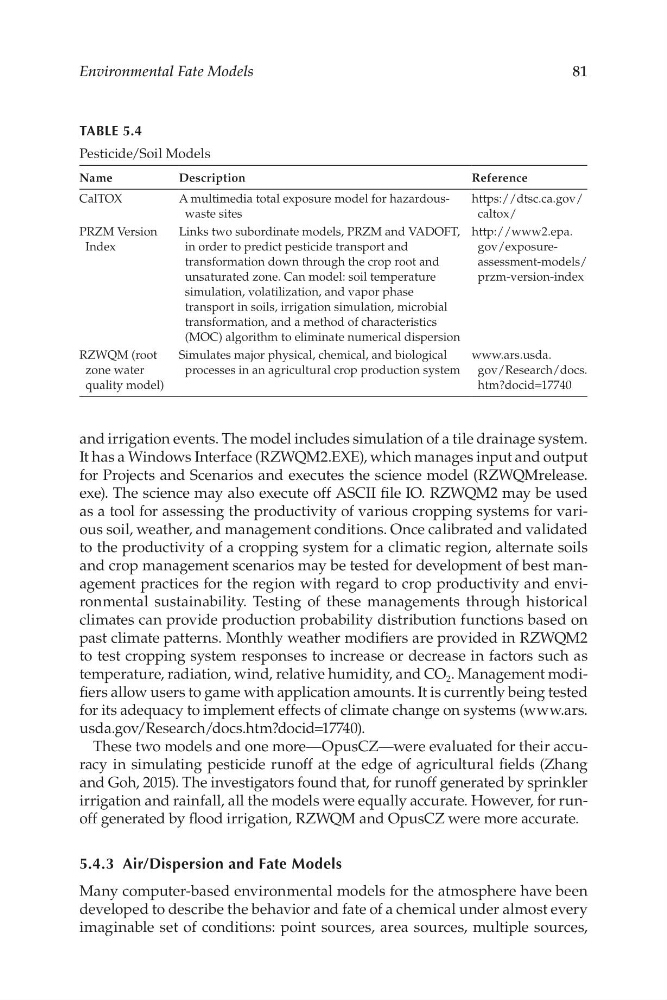
TABLE 5.4
Pesticide/Soil Models
Name
Description
Reference
CalTOX
PRZM Version
Index
RZWQM (root
zone water
quality model)
A multimedia total exposure model for hazardouswaste sites
Links two subordinate models, PRZM and VADOFT,
in order to predict pesticide transport and
transformation down through the crop root and
unsaturated zone. Can model: soil temperature
simulation, volatilization, and vapor phase
transport in soils, irrigation simulation, microbial
transformation, and a method of characteristics
(MOC) algorithm to eliminate numerical dispersion
Simulates major physical, chemical, and biological
processes in an agricultural crop production system
https://dtsc.ca.gov/
caltox/
http://www2.epa.
gov/exposureassessment-models/
przm-version-index
www.ars.usda.
gov/Research/docs.
htm?docid=17740
and irrigation events. The model includes simulation of a tile drainage system.
It has a Windows Interface (RZWQM2.EXE), which manages input and output
for Projects and Scenarios and executes the science model (RZWQMrelease.
exe). The science may also execute off ASCII fle IO. RZWQM2 may be used
as a tool for assessing the productivity of various cropping systems for various soil, weather, and management conditions. Once calibrated and validated
to the productivity of a cropping system for a climatic region, alternate soils
and crop management scenarios may be tested for development of best management practices for the region with regard to crop productivity and environmental sustainability. Testing of these managements through historical
climates can provide production probability distribution functions based on
past climate patterns. Monthly weather modifers are provided in RZWQM2
to test cropping system responses to increase or decrease in factors such as
temperature, radiation, wind, relative humidity, and CO 2 . Management modifers allow users to game with application amounts. It is currently being tested
for its adequacy to implement effects of climate change on systems (www.ars.
usda.gov/Research/docs.htm?docid=17740).
These two models and one more—OpusCZ—were evaluated for their accuracy in simulating pesticide runoff at the edge of agricultural felds (Zhang
and Goh, 2015). The investigators found that, for runoff generated by sprinkler
irrigation and rainfall, all the models were equally accurate. However, for runoff generated by food irrigation, RZWQM and OpusCZ were more accurate.
5.4.3 Air/Dispersion and Fate Models
Many computer-based environmental models for the atmosphere have been
developed to describe the behavior and fate of a chemical under almost every
imaginable set of conditions: point sources, area sources, multiple sources,
Environmental Fate Models
TABLE 5.4
Pesticide/Soil Models
Name
Description
Reference
CalTOX
PRZM Version
Index
RZWQM (root
zone water
quality model)
A multimedia total exposure model for hazardouswaste sites
Links two subordinate models, PRZM and VADOFT,
in order to predict pesticide transport and
transformation down through the crop root and
unsaturated zone. Can model: soil temperature
simulation, volatilization, and vapor phase
transport in soils, irrigation simulation, microbial
transformation, and a method of characteristics
(MOC) algorithm to eliminate numerical dispersion
Simulates major physical, chemical, and biological
processes in an agricultural crop production system
https://dtsc.ca.gov/
caltox/
http://www2.epa.
gov/exposureassessment-models/
przm-version-index
www.ars.usda.
gov/Research/docs.
htm?docid=17740
and irrigation events. The model includes simulation of a tile drainage system.
It has a Windows Interface (RZWQM2.EXE), which manages input and output
for Projects and Scenarios and executes the science model (RZWQMrelease.
exe). The science may also execute off ASCII fle IO. RZWQM2 may be used
as a tool for assessing the productivity of various cropping systems for various soil, weather, and management conditions. Once calibrated and validated
to the productivity of a cropping system for a climatic region, alternate soils
and crop management scenarios may be tested for development of best management practices for the region with regard to crop productivity and environmental sustainability. Testing of these managements through historical
climates can provide production probability distribution functions based on
past climate patterns. Monthly weather modifers are provided in RZWQM2
to test cropping system responses to increase or decrease in factors such as
temperature, radiation, wind, relative humidity, and CO 2 . Management modifers allow users to game with application amounts. It is currently being tested
for its adequacy to implement effects of climate change on systems (www.ars.
usda.gov/Research/docs.htm?docid=17740).
These two models and one more—OpusCZ—were evaluated for their accuracy in simulating pesticide runoff at the edge of agricultural felds (Zhang
and Goh, 2015). The investigators found that, for runoff generated by sprinkler
irrigation and rainfall, all the models were equally accurate. However, for runoff generated by food irrigation, RZWQM and OpusCZ were more accurate.
5.4.3 Air/Dispersion and Fate Models
Many computer-based environmental models for the atmosphere have been
developed to describe the behavior and fate of a chemical under almost every
imaginable set of conditions: point sources, area sources, multiple sources,