

83
Environmental Fate Models
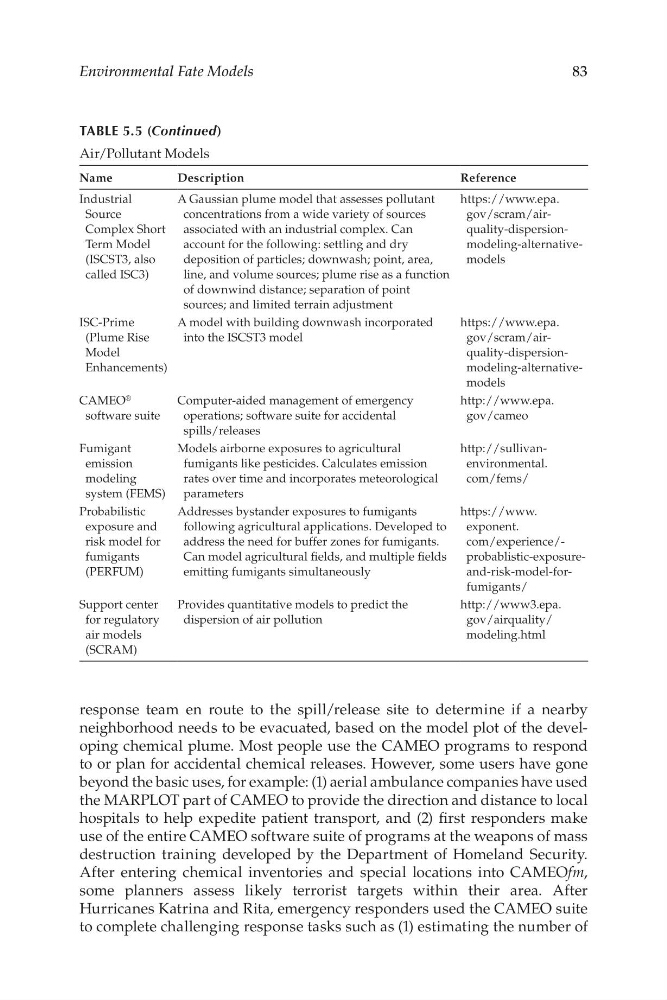
TABLE 5.5 (Continued)
Air/Pollutant Models
Name
Description
Reference
Industrial
Source
Complex Short
Term Model
(ISCST3, also
called ISC3)
ISC-Prime
(Plume Rise
Model
Enhancements)
CAMEO ®
software suite
Fumigant
emission
modeling
system (FEMS)
Probabilistic
exposure and
risk model for
fumigants
(PERFUM)
Support center
for regulatory
air models
(SCRAM)
A Gaussian plume model that assesses pollutant
concentrations from a wide variety of sources
associated with an industrial complex. Can
account for the following: settling and dry
deposition of particles; downwash; point, area,
line, and volume sources; plume rise as a function
of downwind distance; separation of point
sources; and limited terrain adjustment
A model with building downwash incorporated
into the ISCST3 model
Computer-aided management of emergency
operations; software suite for accidental
spills/releases
Models airborne exposures to agricultural
fumigants like pesticides. Calculates emission
rates over time and incorporates meteorological
parameters
Addresses bystander exposures to fumigants
following agricultural applications. Developed to
address the need for buffer zones for fumigants.
Can model agricultural felds, and multiple felds
emitting fumigants simultaneously
Provides quantitative models to predict the
dispersion of air pollution
https://www.epa.
modeling-alternativemodels
https://www.epa.
modeling-alternativemodels
http://www.epa.
gov/cameo
http://sullivanenvironmental.
com/fems/
https://www.
exponent.
com/experience/ -
and-risk-model-forfumigants/
http://www3.epa.
gov/airquality/
modeling.html
response team en route to the spill/release site to determine if a nearby
neighborhood needs to be evacuated, based on the model plot of the developing chemical plume. Most people use the CAMEO programs to respond
to or plan for accidental chemical releases. However, some users have gone
beyond the basic uses, for example: (1) aerial ambulance companies have used
the MARPLOT part of CAMEO to provide the direction and distance to local
hospitals to help expedite patient transport, and (2) frst responders make
use of the entire CAMEO software suite of programs at the weapons of mass
destruction training developed by the Department of Homeland Security.
After entering chemical inventories and special locations into CAMEOfm,
some planners assess likely terrorist targets within their area. After
Hurricanes Katrina and Rita, emergency responders used the CAMEO suite
to complete challenging response tasks such as (1) estimating the number of
Environmental Fate Models
TABLE 5.5 (Continued)
Air/Pollutant Models
Name
Description
Reference
Industrial
Source
Complex Short
Term Model
(ISCST3, also
called ISC3)
ISC-Prime
(Plume Rise
Model
Enhancements)
CAMEO ®
software suite
Fumigant
emission
modeling
system (FEMS)
Probabilistic
exposure and
risk model for
fumigants
(PERFUM)
Support center
for regulatory
air models
(SCRAM)
A Gaussian plume model that assesses pollutant
concentrations from a wide variety of sources
associated with an industrial complex. Can
account for the following: settling and dry
deposition of particles; downwash; point, area,
line, and volume sources; plume rise as a function
of downwind distance; separation of point
sources; and limited terrain adjustment
A model with building downwash incorporated
into the ISCST3 model
Computer-aided management of emergency
operations; software suite for accidental
spills/releases
Models airborne exposures to agricultural
fumigants like pesticides. Calculates emission
rates over time and incorporates meteorological
parameters
Addresses bystander exposures to fumigants
following agricultural applications. Developed to
address the need for buffer zones for fumigants.
Can model agricultural felds, and multiple felds
emitting fumigants simultaneously
Provides quantitative models to predict the
dispersion of air pollution
https://www.epa.
modeling-alternativemodels
https://www.epa.
modeling-alternativemodels
http://www.epa.
gov/cameo
http://sullivanenvironmental.
com/fems/
https://www.
exponent.
com/experience/ -
and-risk-model-forfumigants/
http://www3.epa.
gov/airquality/
modeling.html
response team en route to the spill/release site to determine if a nearby
neighborhood needs to be evacuated, based on the model plot of the developing chemical plume. Most people use the CAMEO programs to respond
to or plan for accidental chemical releases. However, some users have gone
beyond the basic uses, for example: (1) aerial ambulance companies have used
the MARPLOT part of CAMEO to provide the direction and distance to local
hospitals to help expedite patient transport, and (2) frst responders make
use of the entire CAMEO software suite of programs at the weapons of mass
destruction training developed by the Department of Homeland Security.
After entering chemical inventories and special locations into CAMEOfm,
some planners assess likely terrorist targets within their area. After
Hurricanes Katrina and Rita, emergency responders used the CAMEO suite
to complete challenging response tasks such as (1) estimating the number of