

184
Subtle Agroecologies
THE INFLUENCE OF THE AGRICULTURAL METHOD
The method also shows differences between products from conventional, organic and biodynamic
origin. Organic/biodynamic agriculture wields a systemic approach which aims towards healthy
and resilient plants and animals that have a strong immune system and thus omits the need for
pesticides.
One aspect I often see in crystallisation images from products originating from conventional
agriculture is that the differentiation phase seems to be missing. This phase, which can be considered the refnement or fnishing touch of the crop’s development, is irreducibly connected to
a harmoniously developed product. These conventional products are often fertilised too heavily, causing a one-sided growth. Instead of quietly maturing, degradation trends already start to
dominate in the growth phase. To put it more simply, the plants in which growth predominates
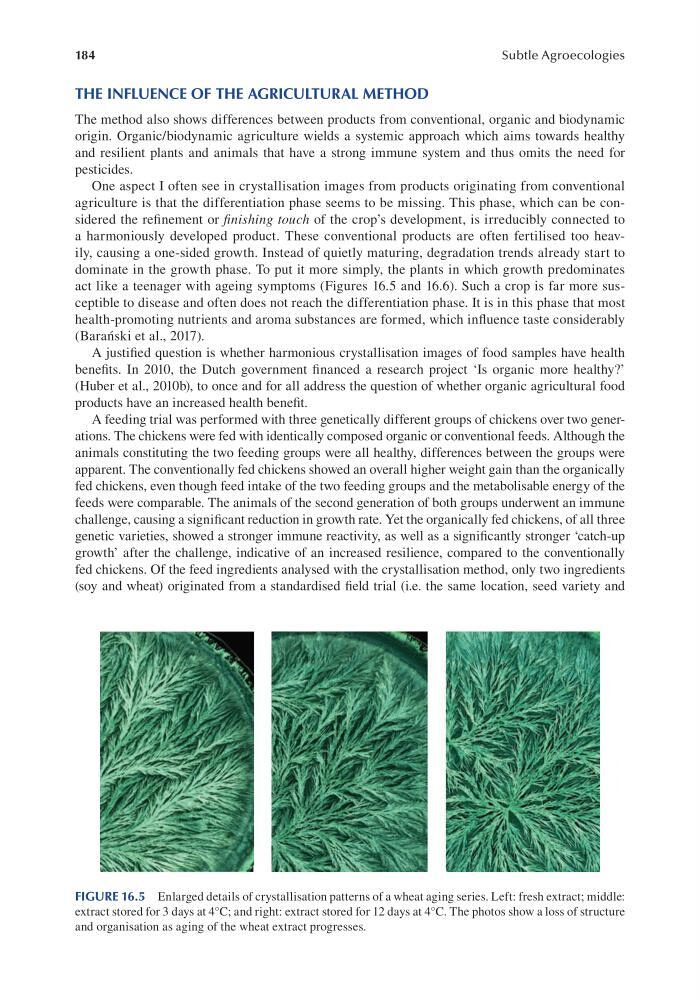
act like a teenager with ageing symptoms (Figures 16.5 and 16.6). Such a crop is far more susceptible to disease and often does not reach the differentiation phase. It is in this phase that most
health-promoting nutrients and aroma substances are formed, which infuence taste considerably
(Barański et al., 2017).
A justifed question is whether harmonious crystallisation images of food samples have health
benefts. In 2010, the Dutch government fnanced a research project ‘Is organic more healthy?’
(Huber et al., 2010b), to once and for all address the question of whether organic agricultural food
products have an increased health beneft.
A feeding trial was performed with three genetically different groups of chickens over two generations. The chickens were fed with identically composed organic or conventional feeds. Although the
animals constituting the two feeding groups were all healthy, differences between the groups were
apparent. The conventionally fed chickens showed an overall higher weight gain than the organically
fed chickens, even though feed intake of the two feeding groups and the metabolisable energy of the
feeds were comparable. The animals of the second generation of both groups underwent an immune
challenge, causing a signifcant reduction in growth rate. Yet the organically fed chickens, of all three
genetic varieties, showed a stronger immune reactivity, as well as a signifcantly stronger ‘catch-up
growth’ after the challenge, indicative of an increased resilience, compared to the conventionally
fed chickens. Of the feed ingredients analysed with the crystallisation method, only two ingredients
(soy and wheat) originated from a standardised feld trial (i.e. the same location, seed variety and
FIGURE 16.5 Enlarged details of crystallisation patterns of a wheat aging series. Left: fresh extract; middle:
extract stored for 3 days at 4°C; and right: extract stored for 12 days at 4°C. The photos show a loss of structure
and organisation as aging of the wheat extract progresses.