

182
Subtle Agroecologies
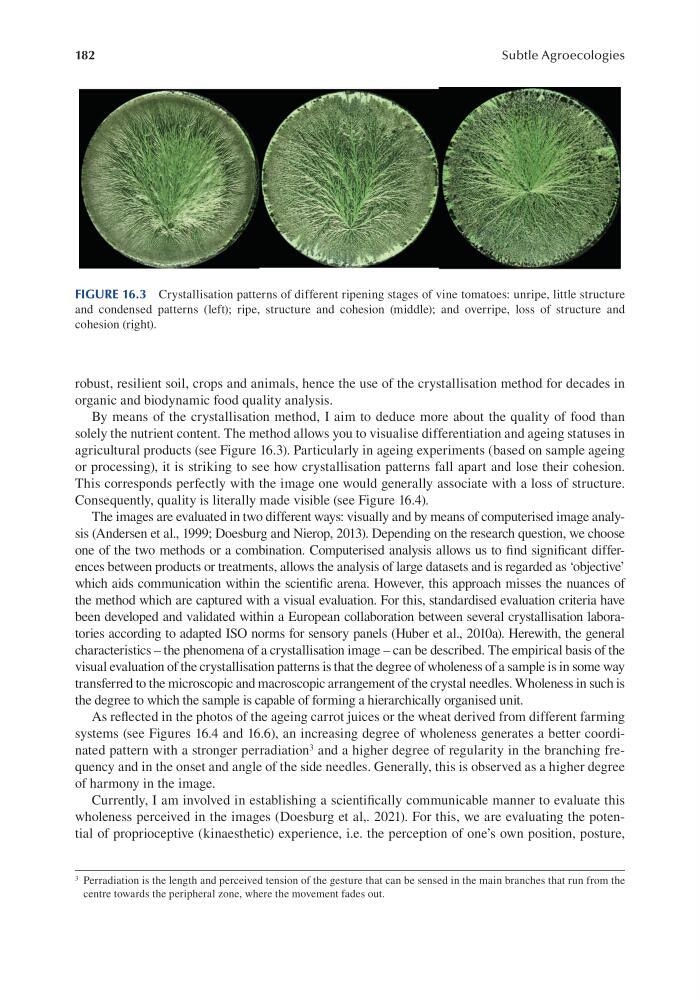
FIGURE 16.3 Crystallisation patterns of different ripening stages of vine tomatoes: unripe, little structure
and condensed patterns (left); ripe, structure and cohesion (middle); and overripe, loss of structure and
cohesion (right).
robust, resilient soil, crops and animals, hence the use of the crystallisation method for decades in
organic and biodynamic food quality analysis.
By means of the crystallisation method, I aim to deduce more about the quality of food than
solely the nutrient content. The method allows you to visualise differentiation and ageing statuses in
agricultural products (see Figure 16.3). Particularly in ageing experiments (based on sample ageing
or processing), it is striking to see how crystallisation patterns fall apart and lose their cohesion.
This corresponds perfectly with the image one would generally associate with a loss of structure.
Consequently, quality is literally made visible (see Figure 16.4).
The images are evaluated in two different ways: visually and by means of computerised image analysis (Andersen et al., 1999; Doesburg and Nierop, 2013). Depending on the research question, we choose
one of the two methods or a combination. Computerised analysis allows us to fnd signifcant differences between products or treatments, allows the analysis of large datasets and is regarded as ‘objective’
which aids communication within the scientifc arena. However, this approach misses the nuances of
the method which are captured with a visual evaluation. For this, standardised evaluation criteria have
been developed and validated within a European collaboration between several crystallisation laboratories according to adapted ISO norms for sensory panels (Huber et al., 2010a). Herewith, the general
characteristics – the phenomena of a crystallisation image – can be described. The empirical basis of the
visual evaluation of the crystallisation patterns is that the degree of wholeness of a sample is in some way
transferred to the microscopic and macroscopic arrangement of the crystal needles. Wholeness in such is
the degree to which the sample is capable of forming a hierarchically organised unit.
As refected in the photos of the ageing carrot juices or the wheat derived from different farming
systems (see Figures 16.4 and 16.6), an increasing degree of wholeness generates a better coordinated pattern with a stronger perradiation 3 and a higher degree of regularity in the branching frequency and in the onset and angle of the side needles. Generally, this is observed as a higher degree
of harmony in the image.
Currently, I am involved in establishing a scientifcally communicable manner to evaluate this
wholeness perceived in the images (Doesburg et al,. 2021). For this, we are evaluating the potential of proprioceptive (kinaesthetic) experience, i.e. the perception of one’s own position, posture,
3 Perradiation is the length and perceived tension of the gesture that can be sensed in the main branches that run from the
centre towards the peripheral zone, where the movement fades out.