

134
Subtle Agroecologies
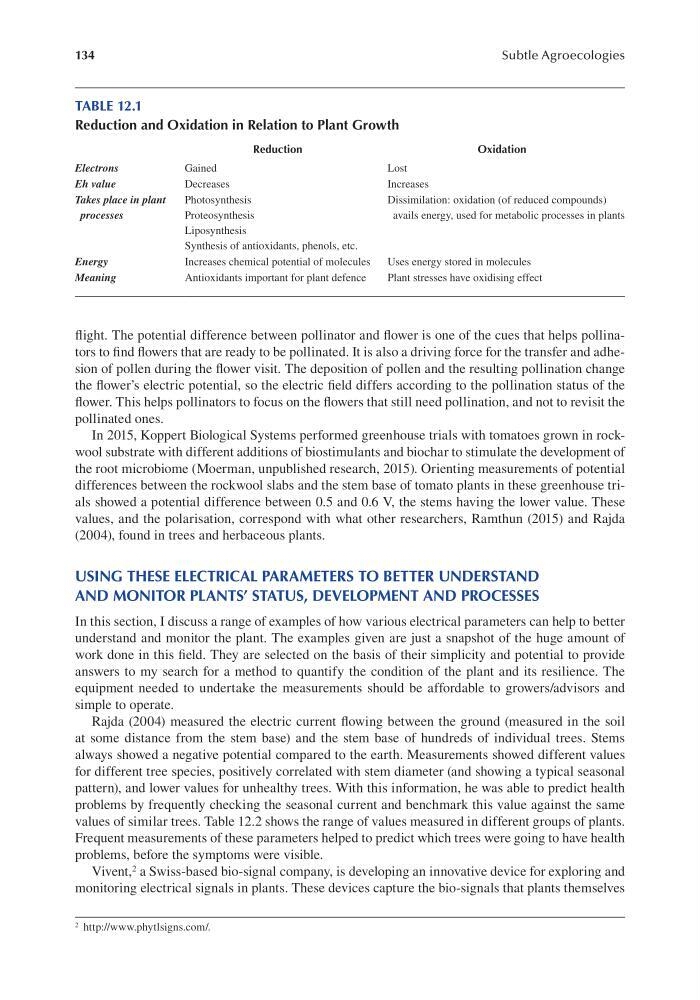
TABLE 12.1
Reduction and Oxidation in Relation to Plant Growth
Reduction
Oxidation
Electrons
Gained
Lost
Eh value
Decreases
Increases
Takes place in plant
Photosynthesis
Dissimilation: oxidation (of reduced compounds)
processes
Proteosynthesis
avails energy, used for metabolic processes in plants
Liposynthesis
Synthesis of antioxidants, phenols, etc.
Energy
Increases chemical potential of molecules
Uses energy stored in molecules
Meaning
Antioxidants important for plant defence
Plant stresses have oxidising effect
fight. The potential difference between pollinator and fower is one of the cues that helps pollinators to fnd fowers that are ready to be pollinated. It is also a driving force for the transfer and adhesion of pollen during the fower visit. The deposition of pollen and the resulting pollination change
the fower’s electric potential, so the electric feld differs according to the pollination status of the
fower. This helps pollinators to focus on the fowers that still need pollination, and not to revisit the
pollinated ones.
In 2015, Koppert Biological Systems performed greenhouse trials with tomatoes grown in rockwool substrate with different additions of biostimulants and biochar to stimulate the development of
the root microbiome (Moerman, unpublished research, 2015). Orienting measurements of potential
differences between the rockwool slabs and the stem base of tomato plants in these greenhouse trials showed a potential difference between 0.5 and 0.6 V, the stems having the lower value. These
values, and the polarisation, correspond with what other researchers, Ramthun (2015) and Rajda
(2004), found in trees and herbaceous plants.
USING THESE ELECTRICAL PARAMETERS TO BETTER UNDERSTAND
AND MONITOR PLANTS’ STATUS, DEVELOPMENT AND PROCESSES
In this section, I discuss a range of examples of how various electrical parameters can help to better
understand and monitor the plant. The examples given are just a snapshot of the huge amount of
work done in this feld. They are selected on the basis of their simplicity and potential to provide
answers to my search for a method to quantify the condition of the plant and its resilience. The
equipment needed to undertake the measurements should be affordable to growers/advisors and
simple to operate.
Rajda (2004) measured the electric current fowing between the ground (measured in the soil
at some distance from the stem base) and the stem base of hundreds of individual trees. Stems
always showed a negative potential compared to the earth. Measurements showed different values
for different tree species, positively correlated with stem diameter (and showing a typical seasonal
pattern), and lower values for unhealthy trees. With this information, he was able to predict health
problems by frequently checking the seasonal current and benchmark this value against the same
values of similar trees. Table 12.2 shows the range of values measured in different groups of plants.
Frequent measurements of these parameters helped to predict which trees were going to have health
problems, before the symptoms were visible.
Vivent, 2 a Swiss-based bio-signal company, is developing an innovative device for exploring and
monitoring electrical signals in plants. These devices capture the bio-signals that plants themselves
2 http://www.phytlsigns.com/.
Subtle Agroecologies
TABLE 12.1
Reduction and Oxidation in Relation to Plant Growth
Reduction
Oxidation
Electrons
Gained
Lost
Eh value
Decreases
Increases
Takes place in plant
Photosynthesis
Dissimilation: oxidation (of reduced compounds)
processes
Proteosynthesis
avails energy, used for metabolic processes in plants
Liposynthesis
Synthesis of antioxidants, phenols, etc.
Energy
Increases chemical potential of molecules
Uses energy stored in molecules
Meaning
Antioxidants important for plant defence
Plant stresses have oxidising effect
fight. The potential difference between pollinator and fower is one of the cues that helps pollinators to fnd fowers that are ready to be pollinated. It is also a driving force for the transfer and adhesion of pollen during the fower visit. The deposition of pollen and the resulting pollination change
the fower’s electric potential, so the electric feld differs according to the pollination status of the
fower. This helps pollinators to focus on the fowers that still need pollination, and not to revisit the
pollinated ones.
In 2015, Koppert Biological Systems performed greenhouse trials with tomatoes grown in rockwool substrate with different additions of biostimulants and biochar to stimulate the development of
the root microbiome (Moerman, unpublished research, 2015). Orienting measurements of potential
differences between the rockwool slabs and the stem base of tomato plants in these greenhouse trials showed a potential difference between 0.5 and 0.6 V, the stems having the lower value. These
values, and the polarisation, correspond with what other researchers, Ramthun (2015) and Rajda
(2004), found in trees and herbaceous plants.
USING THESE ELECTRICAL PARAMETERS TO BETTER UNDERSTAND
AND MONITOR PLANTS’ STATUS, DEVELOPMENT AND PROCESSES
In this section, I discuss a range of examples of how various electrical parameters can help to better
understand and monitor the plant. The examples given are just a snapshot of the huge amount of
work done in this feld. They are selected on the basis of their simplicity and potential to provide
answers to my search for a method to quantify the condition of the plant and its resilience. The
equipment needed to undertake the measurements should be affordable to growers/advisors and
simple to operate.
Rajda (2004) measured the electric current fowing between the ground (measured in the soil
at some distance from the stem base) and the stem base of hundreds of individual trees. Stems
always showed a negative potential compared to the earth. Measurements showed different values
for different tree species, positively correlated with stem diameter (and showing a typical seasonal
pattern), and lower values for unhealthy trees. With this information, he was able to predict health
problems by frequently checking the seasonal current and benchmark this value against the same
values of similar trees. Table 12.2 shows the range of values measured in different groups of plants.
Frequent measurements of these parameters helped to predict which trees were going to have health
problems, before the symptoms were visible.
Vivent, 2 a Swiss-based bio-signal company, is developing an innovative device for exploring and
monitoring electrical signals in plants. These devices capture the bio-signals that plants themselves
2 http://www.phytlsigns.com/.