

135
Electromagnetic Parameters
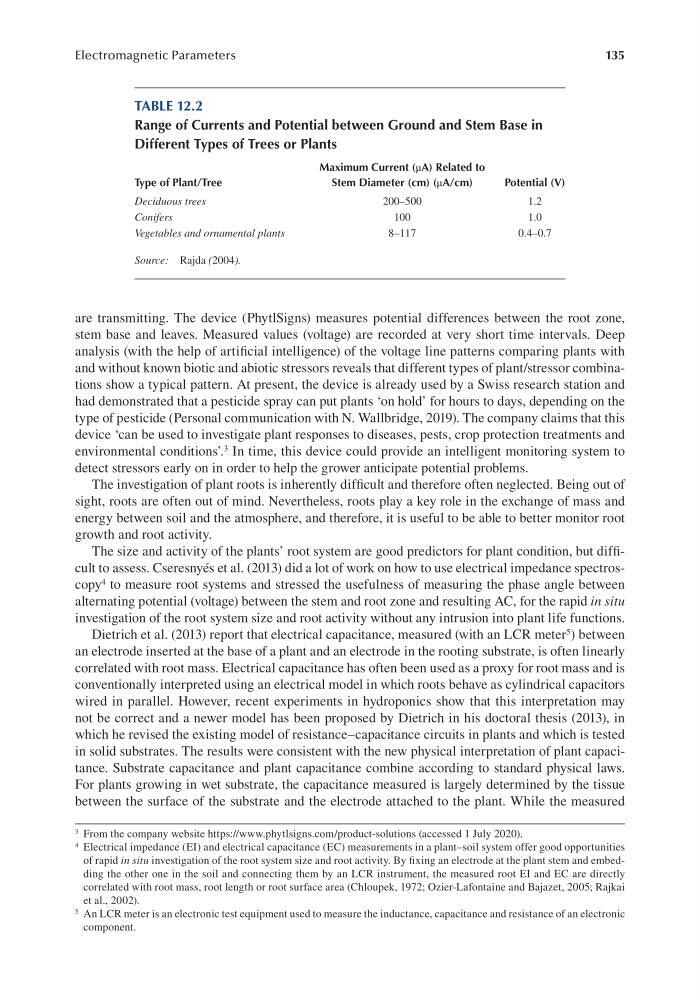
TABLE 12.2
Range of Currents and Potential between Ground and Stem Base in
Different Types of Trees or Plants
Maximum Current (μA) Related to
Type of Plant/Tree
Stem Diameter (cm) (μA/cm)
Potential (V)
Deciduous trees
200–500
1.2
Conifers
100
1.0
Vegetables and ornamental plants
8–117
0.4–0.7
Source: Rajda (2004).
are transmitting. The device (PhytlSigns) measures potential differences between the root zone,
stem base and leaves. Measured values (voltage) are recorded at very short time intervals. Deep
analysis (with the help of artifcial intelligence) of the voltage line patterns comparing plants with
and without known biotic and abiotic stressors reveals that different types of plant/stressor combinations show a typical pattern. At present, the device is already used by a Swiss research station and
had demonstrated that a pesticide spray can put plants ‘on hold’ for hours to days, depending on the
type of pesticide (Personal communication with N. Wallbridge, 2019). The company claims that this
device ‘can be used to investigate plant responses to diseases, pests, crop protection treatments and
environmental conditions’. 3 In time, this device could provide an intelligent monitoring system to
detect stressors early on in order to help the grower anticipate potential problems.
The investigation of plant roots is inherently diffcult and therefore often neglected. Being out of
sight, roots are often out of mind. Nevertheless, roots play a key role in the exchange of mass and
energy between soil and the atmosphere, and therefore, it is useful to be able to better monitor root
growth and root activity.
The size and activity of the plants’ root system are good predictors for plant condition, but diffcult to assess. Cseresnyés et al. (2013) did a lot of work on how to use electrical impedance spectroscopy 4 to measure root systems and stressed the usefulness of measuring the phase angle between
alternating potential (voltage) between the stem and root zone and resulting AC, for the rapid in situ
investigation of the root system size and root activity without any intrusion into plant life functions.
Dietrich et al. (2013) report that electrical capacitance, measured (with an LCR meter 5 ) between
an electrode inserted at the base of a plant and an electrode in the rooting substrate, is often linearly
correlated with root mass. Electrical capacitance has often been used as a proxy for root mass and is
conventionally interpreted using an electrical model in which roots behave as cylindrical capacitors
wired in parallel. However, recent experiments in hydroponics show that this interpretation may
not be correct and a newer model has been proposed by Dietrich in his doctoral thesis (2013), in
which he revised the existing model of resistance–capacitance circuits in plants and which is tested
in solid substrates. The results were consistent with the new physical interpretation of plant capacitance. Substrate capacitance and plant capacitance combine according to standard physical laws.
For plants growing in wet substrate, the capacitance measured is largely determined by the tissue
between the surface of the substrate and the electrode attached to the plant. While the measured
3 From the company website https://www.phytlsigns.com/product-solutions (accessed 1 July 2020).
4 Electrical impedance (EI) and electrical capacitance (EC) measurements in a plant–soil system offer good opportunities
of rapid in situ investigation of the root system size and root activity. By fxing an electrode at the plant stem and embedding the other one in the soil and connecting them by an LCR instrument, the measured root EI and EC are directly
correlated with root mass, root length or root surface area (Chloupek, 1972; Ozier-Lafontaine and Bajazet, 2005; Rajkai
et al., 2002).
5 An LCR meter is an electronic test equipment used to measure the inductance, capacitance and resistance of an electronic
component.
Electromagnetic Parameters
TABLE 12.2
Range of Currents and Potential between Ground and Stem Base in
Different Types of Trees or Plants
Maximum Current (μA) Related to
Type of Plant/Tree
Stem Diameter (cm) (μA/cm)
Potential (V)
Deciduous trees
200–500
1.2
Conifers
100
1.0
Vegetables and ornamental plants
8–117
0.4–0.7
Source: Rajda (2004).
are transmitting. The device (PhytlSigns) measures potential differences between the root zone,
stem base and leaves. Measured values (voltage) are recorded at very short time intervals. Deep
analysis (with the help of artifcial intelligence) of the voltage line patterns comparing plants with
and without known biotic and abiotic stressors reveals that different types of plant/stressor combinations show a typical pattern. At present, the device is already used by a Swiss research station and
had demonstrated that a pesticide spray can put plants ‘on hold’ for hours to days, depending on the
type of pesticide (Personal communication with N. Wallbridge, 2019). The company claims that this
device ‘can be used to investigate plant responses to diseases, pests, crop protection treatments and
environmental conditions’. 3 In time, this device could provide an intelligent monitoring system to
detect stressors early on in order to help the grower anticipate potential problems.
The investigation of plant roots is inherently diffcult and therefore often neglected. Being out of
sight, roots are often out of mind. Nevertheless, roots play a key role in the exchange of mass and
energy between soil and the atmosphere, and therefore, it is useful to be able to better monitor root
growth and root activity.
The size and activity of the plants’ root system are good predictors for plant condition, but diffcult to assess. Cseresnyés et al. (2013) did a lot of work on how to use electrical impedance spectroscopy 4 to measure root systems and stressed the usefulness of measuring the phase angle between
alternating potential (voltage) between the stem and root zone and resulting AC, for the rapid in situ
investigation of the root system size and root activity without any intrusion into plant life functions.
Dietrich et al. (2013) report that electrical capacitance, measured (with an LCR meter 5 ) between
an electrode inserted at the base of a plant and an electrode in the rooting substrate, is often linearly
correlated with root mass. Electrical capacitance has often been used as a proxy for root mass and is
conventionally interpreted using an electrical model in which roots behave as cylindrical capacitors
wired in parallel. However, recent experiments in hydroponics show that this interpretation may
not be correct and a newer model has been proposed by Dietrich in his doctoral thesis (2013), in
which he revised the existing model of resistance–capacitance circuits in plants and which is tested
in solid substrates. The results were consistent with the new physical interpretation of plant capacitance. Substrate capacitance and plant capacitance combine according to standard physical laws.
For plants growing in wet substrate, the capacitance measured is largely determined by the tissue
between the surface of the substrate and the electrode attached to the plant. While the measured
3 From the company website https://www.phytlsigns.com/product-solutions (accessed 1 July 2020).
4 Electrical impedance (EI) and electrical capacitance (EC) measurements in a plant–soil system offer good opportunities
of rapid in situ investigation of the root system size and root activity. By fxing an electrode at the plant stem and embedding the other one in the soil and connecting them by an LCR instrument, the measured root EI and EC are directly
correlated with root mass, root length or root surface area (Chloupek, 1972; Ozier-Lafontaine and Bajazet, 2005; Rajkai
et al., 2002).
5 An LCR meter is an electronic test equipment used to measure the inductance, capacitance and resistance of an electronic
component.