

133
Electromagnetic Parameters
providing space for it to spread out. A capacitor has a capacitance, measured in farads (F), or more
often microfarads.
An electric feld is created by a charged body in the space that surrounds it, and results in a force
exerted on any other charges placed within the feld. The electric power produced by an electric
current (I) passing through an electric potential (V) difference is expressed in watts ((P = I × V;
work done per unit time).
Many important biological processes involve redox reactions. Oxidation is the loss of electrons
or an increase in oxidation state; reduction is the gain of electrons or a decrease in oxidation state
by a molecule, atom or ion. The reduction potential (mostly expressed in millivolts – mV) is a
measure of the tendency of the oxidising agent to be reduced.
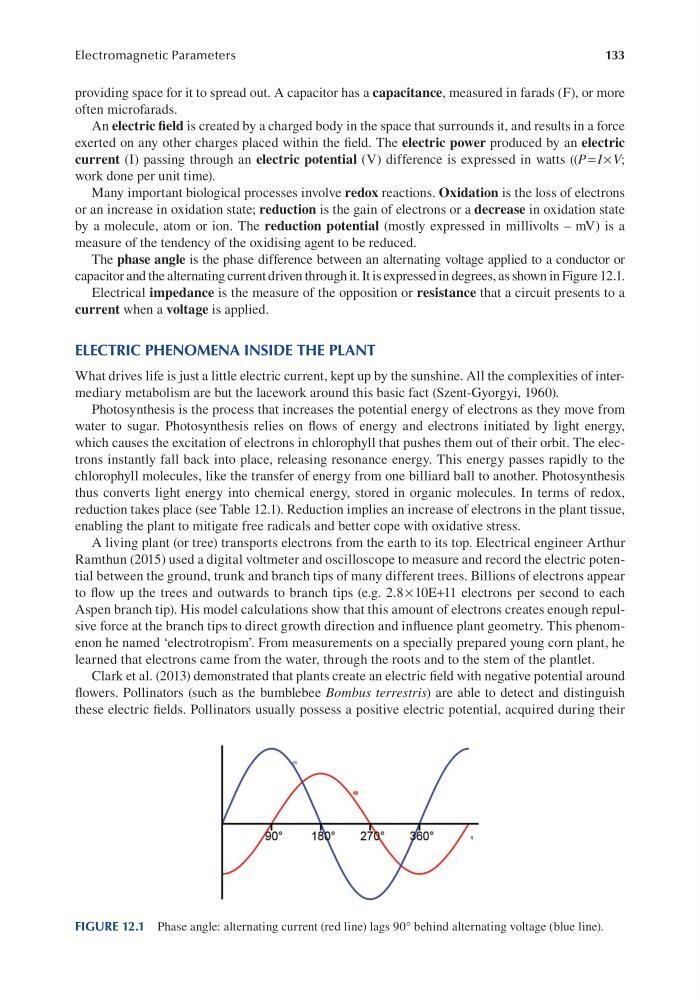
The phase angle is the phase difference between an alternating voltage applied to a conductor or
capacitor and the alternating current driven through it. It is expressed in degrees, as shown in Figure 12.1.
Electrical impedance is the measure of the opposition or resistance that a circuit presents to a
current when a voltage is applied.
ELECTRIC PHENOMENA INSIDE THE PLANT
What drives life is just a little electric current, kept up by the sunshine. All the complexities of intermediary metabolism are but the lacework around this basic fact (Szent-Gyorgyi, 1960).
Photosynthesis is the process that increases the potential energy of electrons as they move from
water to sugar. Photosynthesis relies on fows of energy and electrons initiated by light energy,
which causes the excitation of electrons in chlorophyll that pushes them out of their orbit. The electrons instantly fall back into place, releasing resonance energy. This energy passes rapidly to the
chlorophyll molecules, like the transfer of energy from one billiard ball to another. Photosynthesis
thus converts light energy into chemical energy, stored in organic molecules. In terms of redox,
reduction takes place (see Table 12.1). Reduction implies an increase of electrons in the plant tissue,
enabling the plant to mitigate free radicals and better cope with oxidative stress.
A living plant (or tree) transports electrons from the earth to its top. Electrical engineer Arthur
Ramthun (2015) used a digital voltmeter and oscilloscope to measure and record the electric potential between the ground, trunk and branch tips of many different trees. Billions of electrons appear
to fow up the trees and outwards to branch tips (e.g. 2.8 × 10E+11 electrons per second to each
Aspen branch tip). His model calculations show that this amount of electrons creates enough repulsive force at the branch tips to direct growth direction and infuence plant geometry. This phenomenon he named ‘electrotropism’. From measurements on a specially prepared young corn plant, he
learned that electrons came from the water, through the roots and to the stem of the plantlet.
Clark et al. (2013) demonstrated that plants create an electric feld with negative potential around
fowers. Pollinators (such as the bumblebee Bombus terrestris) are able to detect and distinguish
these electric felds. Pollinators usually possess a positive electric potential, acquired during their
FIGURE 12.1 Phase angle: alternating current (red line) lags 90° behind alternating voltage (blue line).
Electromagnetic Parameters
providing space for it to spread out. A capacitor has a capacitance, measured in farads (F), or more
often microfarads.
An electric feld is created by a charged body in the space that surrounds it, and results in a force
exerted on any other charges placed within the feld. The electric power produced by an electric
current (I) passing through an electric potential (V) difference is expressed in watts ((P = I × V;
work done per unit time).
Many important biological processes involve redox reactions. Oxidation is the loss of electrons
or an increase in oxidation state; reduction is the gain of electrons or a decrease in oxidation state
by a molecule, atom or ion. The reduction potential (mostly expressed in millivolts – mV) is a
measure of the tendency of the oxidising agent to be reduced.
The phase angle is the phase difference between an alternating voltage applied to a conductor or
capacitor and the alternating current driven through it. It is expressed in degrees, as shown in Figure 12.1.
Electrical impedance is the measure of the opposition or resistance that a circuit presents to a
current when a voltage is applied.
ELECTRIC PHENOMENA INSIDE THE PLANT
What drives life is just a little electric current, kept up by the sunshine. All the complexities of intermediary metabolism are but the lacework around this basic fact (Szent-Gyorgyi, 1960).
Photosynthesis is the process that increases the potential energy of electrons as they move from
water to sugar. Photosynthesis relies on fows of energy and electrons initiated by light energy,
which causes the excitation of electrons in chlorophyll that pushes them out of their orbit. The electrons instantly fall back into place, releasing resonance energy. This energy passes rapidly to the
chlorophyll molecules, like the transfer of energy from one billiard ball to another. Photosynthesis
thus converts light energy into chemical energy, stored in organic molecules. In terms of redox,
reduction takes place (see Table 12.1). Reduction implies an increase of electrons in the plant tissue,
enabling the plant to mitigate free radicals and better cope with oxidative stress.
A living plant (or tree) transports electrons from the earth to its top. Electrical engineer Arthur
Ramthun (2015) used a digital voltmeter and oscilloscope to measure and record the electric potential between the ground, trunk and branch tips of many different trees. Billions of electrons appear
to fow up the trees and outwards to branch tips (e.g. 2.8 × 10E+11 electrons per second to each
Aspen branch tip). His model calculations show that this amount of electrons creates enough repulsive force at the branch tips to direct growth direction and infuence plant geometry. This phenomenon he named ‘electrotropism’. From measurements on a specially prepared young corn plant, he
learned that electrons came from the water, through the roots and to the stem of the plantlet.
Clark et al. (2013) demonstrated that plants create an electric feld with negative potential around
fowers. Pollinators (such as the bumblebee Bombus terrestris) are able to detect and distinguish
these electric felds. Pollinators usually possess a positive electric potential, acquired during their
FIGURE 12.1 Phase angle: alternating current (red line) lags 90° behind alternating voltage (blue line).