

4 Cattle Dung Manure Microbiota as a Substitute …
85
release effect for nutrients through the growing season, given the reason for suitability
for environmental and soil conditions because of the gradual release of plant nutrients
(Eghball et al. 2002). It is yet to consider a match between nutrient release from dung
and plant demand for nutrients; mismatch might result in nutrient leaching (main
nitrate in humid areas), toxicity, or nutrient deficiency. Nevertheless, sole compost is
not enough to satisfy the farm production to cover the whole nutrients requirements
in a short-term period. Besides, meeting crop demand for nutrients through organic
matter supply does not guarantee optimum supply of minerals require for crop yield
due to the fact that the decomposition of organic matter is a climate-dependent process
(Wall et al. 2008).
On the other hand, organic matter amendments in soil stimulate the biological
activity, which makes the nutrients cycle less predictable (Tao et al. 2015). Therefore, organic farming practices include rotation of legume crops, green manuring,
returning uncomposted agricultural wastes to soil, and crop residues incorporation
in the fertilization schemes assist to provide, soluble fractions of the essential nutrients (Reckling et al. 2016). Incorporation of green manure crops into soil provides
a considerable amount of soluble nutrients into the soil system. Ewulo et al. (2007)
observed the comparative effect of cow dung manure on soil and leaf nutrient and
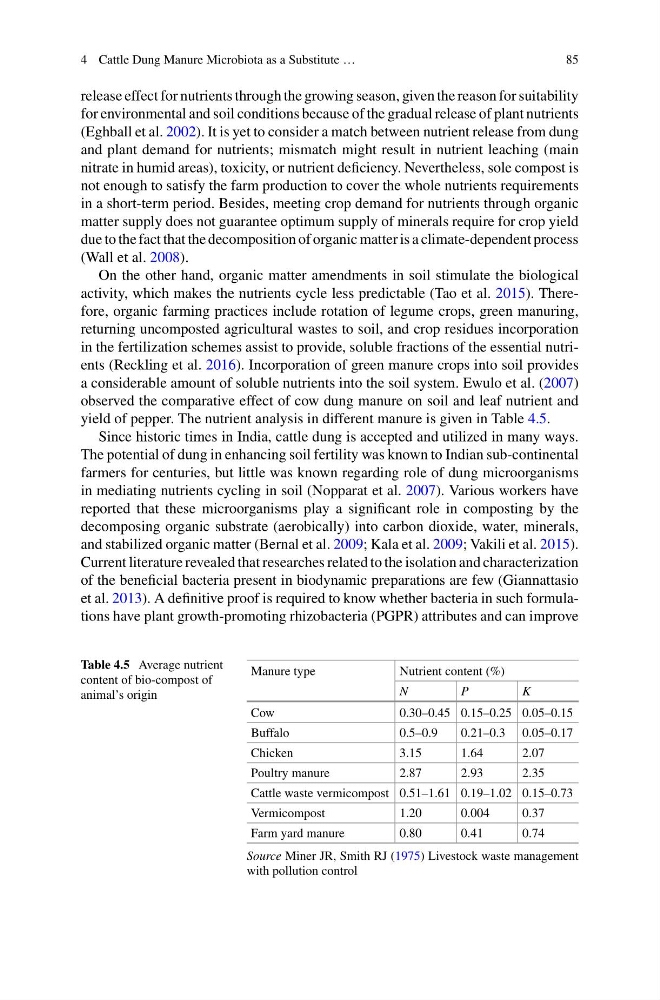
yield of pepper. The nutrient analysis in different manure is given in Table 4.5.
Since historic times in India, cattle dung is accepted and utilized in many ways.
The potential of dung in enhancing soil fertility was known to Indian sub-continental
farmers for centuries, but little was known regarding role of dung microorganisms
in mediating nutrients cycling in soil (Nopparat et al. 2007). Various workers have
reported that these microorganisms play a significant role in composting by the
decomposing organic substrate (aerobically) into carbon dioxide, water, minerals,
and stabilized organic matter (Bernal et al. 2009; Kala et al. 2009; Vakili et al. 2015).
Current literature revealed that researches related to the isolation and characterization
of the beneficial bacteria present in biodynamic preparations are few (Giannattasio
et al. 2013). A definitive proof is required to know whether bacteria in such formulations have plant growth-promoting rhizobacteria (PGPR) attributes and can improve
Table 4.5 Average nutrient
content of bio-compost of
animal’s origin
Manure type
Nutrient content (%)
N
P
K
Cow
0.30–0.45 0.15–0.25 0.05–0.15
Buffalo
0.5–0.9
0.21–0.3 0.05–0.17
Chicken
3.15
1.64
2.07
Poultry manure
2.87
2.93
2.35
Cattle waste vermicompost 0.51–1.61 0.19–1.02 0.15–0.73
Vermicompost
1.20
0.004
0.37
Farm yard manure
0.80
0.41
0.74
Source Miner JR, Smith RJ (1975) Livestock waste management
with pollution control
85
release effect for nutrients through the growing season, given the reason for suitability
for environmental and soil conditions because of the gradual release of plant nutrients
(Eghball et al. 2002). It is yet to consider a match between nutrient release from dung
and plant demand for nutrients; mismatch might result in nutrient leaching (main
nitrate in humid areas), toxicity, or nutrient deficiency. Nevertheless, sole compost is
not enough to satisfy the farm production to cover the whole nutrients requirements
in a short-term period. Besides, meeting crop demand for nutrients through organic
matter supply does not guarantee optimum supply of minerals require for crop yield
due to the fact that the decomposition of organic matter is a climate-dependent process
(Wall et al. 2008).
On the other hand, organic matter amendments in soil stimulate the biological
activity, which makes the nutrients cycle less predictable (Tao et al. 2015). Therefore, organic farming practices include rotation of legume crops, green manuring,
returning uncomposted agricultural wastes to soil, and crop residues incorporation
in the fertilization schemes assist to provide, soluble fractions of the essential nutrients (Reckling et al. 2016). Incorporation of green manure crops into soil provides
a considerable amount of soluble nutrients into the soil system. Ewulo et al. (2007)
observed the comparative effect of cow dung manure on soil and leaf nutrient and
yield of pepper. The nutrient analysis in different manure is given in Table 4.5.
Since historic times in India, cattle dung is accepted and utilized in many ways.
The potential of dung in enhancing soil fertility was known to Indian sub-continental
farmers for centuries, but little was known regarding role of dung microorganisms
in mediating nutrients cycling in soil (Nopparat et al. 2007). Various workers have
reported that these microorganisms play a significant role in composting by the
decomposing organic substrate (aerobically) into carbon dioxide, water, minerals,
and stabilized organic matter (Bernal et al. 2009; Kala et al. 2009; Vakili et al. 2015).
Current literature revealed that researches related to the isolation and characterization
of the beneficial bacteria present in biodynamic preparations are few (Giannattasio
et al. 2013). A definitive proof is required to know whether bacteria in such formulations have plant growth-promoting rhizobacteria (PGPR) attributes and can improve
Table 4.5 Average nutrient
content of bio-compost of
animal’s origin
Manure type
Nutrient content (%)
N
P
K
Cow
0.30–0.45 0.15–0.25 0.05–0.15
Buffalo
0.5–0.9
0.21–0.3 0.05–0.17
Chicken
3.15
1.64
2.07
Poultry manure
2.87
2.93
2.35
Cattle waste vermicompost 0.51–1.61 0.19–1.02 0.15–0.73
Vermicompost
1.20
0.004
0.37
Farm yard manure
0.80
0.41
0.74
Source Miner JR, Smith RJ (1975) Livestock waste management
with pollution control