

4 Cattle Dung Manure Microbiota as a Substitute …
83
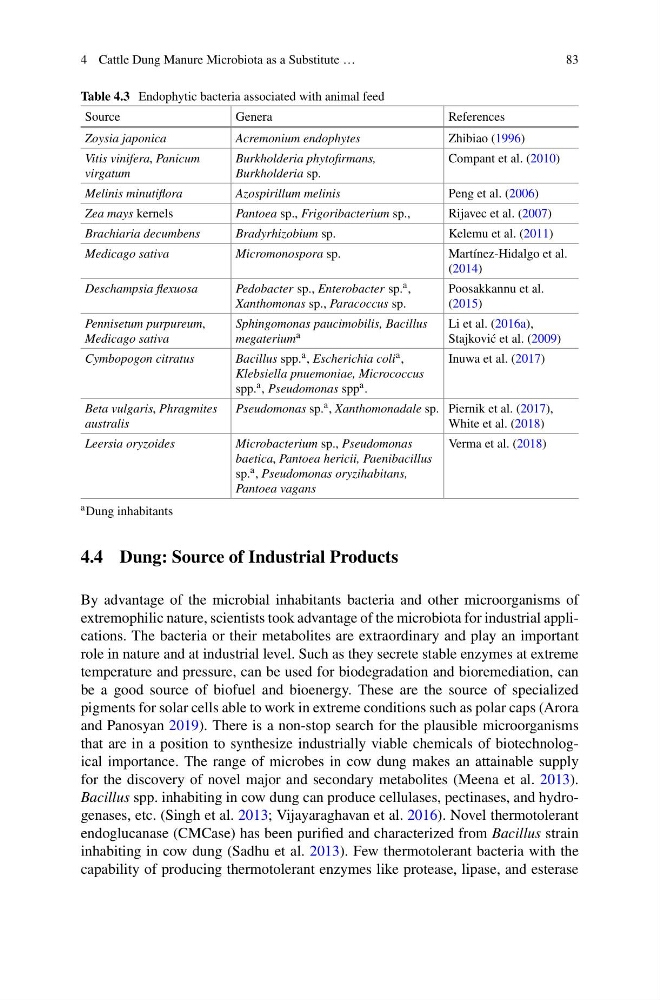
Table 4.3 Endophytic bacteria associated with animal feed
Source
Genera
References
Zoysia japonica
Acremonium endophytes
Zhibiao (1996)
Vitis vinifera, Panicum
virgatum
Burkholderia phytofirmans,
Burkholderia sp.
Compant et al. (2010)
Melinis minutiflora
Azospirillum melinis
Peng et al. (2006)
Zea mays kernels
Pantoea sp., Frigoribacterium sp.,
Rijavec et al. (2007)
Brachiaria decumbens
Bradyrhizobium sp.
Kelemu et al. (2011)
Medicago sativa
Micromonospora sp.
Martínez-Hidalgo et al.
(2014)
Deschampsia flexuosa
Pedobacter sp., Enterobacter sp. a ,
Xanthomonas sp., Paracoccus sp.
Poosakkannu et al.
(2015)
Pennisetum purpureum,
Medicago sativa
Sphingomonas paucimobilis, Bacillus
megaterium a
Li et al. (2016a),
Stajkovi´ c et al. (2009)
Cymbopogon citratus
Bacillus spp. a , Escherichia coli a ,
Klebsiella pnuemoniae, Micrococcus
spp. a , Pseudomonas spp a .
Inuwa et al. (2017)
Beta vulgaris, Phragmites
australis
Pseudomonas sp. a , Xanthomonadale sp. Piernik et al. (2017),
White et al. (2018)
Leersia oryzoides
Microbacterium sp., Pseudomonas
baetica, Pantoea hericii, Paenibacillus
sp. a , Pseudomonas oryzihabitans,
Pantoea vagans
Verma et al. (2018)
a Dung inhabitants
4.4 Dung: Source of Industrial Products
By advantage of the microbial inhabitants bacteria and other microorganisms of
extremophilic nature, scientists took advantage of the microbiota for industrial applications. The bacteria or their metabolites are extraordinary and play an important
role in nature and at industrial level. Such as they secrete stable enzymes at extreme
temperature and pressure, can be used for biodegradation and bioremediation, can
be a good source of biofuel and bioenergy. These are the source of specialized
pigments for solar cells able to work in extreme conditions such as polar caps (Arora
and Panosyan 2019). There is a non-stop search for the plausible microorganisms
that are in a position to synthesize industrially viable chemicals of biotechnological importance. The range of microbes in cow dung makes an attainable supply
for the discovery of novel major and secondary metabolites (Meena et al. 2013).
Bacillus spp. inhabiting in cow dung can produce cellulases, pectinases, and hydrogenases, etc. (Singh et al. 2013; Vijayaraghavan et al. 2016). Novel thermotolerant
endoglucanase (CMCase) has been purified and characterized from Bacillus strain
inhabiting in cow dung (Sadhu et al. 2013). Few thermotolerant bacteria with the
capability of producing thermotolerant enzymes like protease, lipase, and esterase
83
Table 4.3 Endophytic bacteria associated with animal feed
Source
Genera
References
Zoysia japonica
Acremonium endophytes
Zhibiao (1996)
Vitis vinifera, Panicum
virgatum
Burkholderia phytofirmans,
Burkholderia sp.
Compant et al. (2010)
Melinis minutiflora
Azospirillum melinis
Peng et al. (2006)
Zea mays kernels
Pantoea sp., Frigoribacterium sp.,
Rijavec et al. (2007)
Brachiaria decumbens
Bradyrhizobium sp.
Kelemu et al. (2011)
Medicago sativa
Micromonospora sp.
Martínez-Hidalgo et al.
(2014)
Deschampsia flexuosa
Pedobacter sp., Enterobacter sp. a ,
Xanthomonas sp., Paracoccus sp.
Poosakkannu et al.
(2015)
Pennisetum purpureum,
Medicago sativa
Sphingomonas paucimobilis, Bacillus
megaterium a
Li et al. (2016a),
Stajkovi´ c et al. (2009)
Cymbopogon citratus
Bacillus spp. a , Escherichia coli a ,
Klebsiella pnuemoniae, Micrococcus
spp. a , Pseudomonas spp a .
Inuwa et al. (2017)
Beta vulgaris, Phragmites
australis
Pseudomonas sp. a , Xanthomonadale sp. Piernik et al. (2017),
White et al. (2018)
Leersia oryzoides
Microbacterium sp., Pseudomonas
baetica, Pantoea hericii, Paenibacillus
sp. a , Pseudomonas oryzihabitans,
Pantoea vagans
Verma et al. (2018)
a Dung inhabitants
4.4 Dung: Source of Industrial Products
By advantage of the microbial inhabitants bacteria and other microorganisms of
extremophilic nature, scientists took advantage of the microbiota for industrial applications. The bacteria or their metabolites are extraordinary and play an important
role in nature and at industrial level. Such as they secrete stable enzymes at extreme
temperature and pressure, can be used for biodegradation and bioremediation, can
be a good source of biofuel and bioenergy. These are the source of specialized
pigments for solar cells able to work in extreme conditions such as polar caps (Arora
and Panosyan 2019). There is a non-stop search for the plausible microorganisms
that are in a position to synthesize industrially viable chemicals of biotechnological importance. The range of microbes in cow dung makes an attainable supply
for the discovery of novel major and secondary metabolites (Meena et al. 2013).
Bacillus spp. inhabiting in cow dung can produce cellulases, pectinases, and hydrogenases, etc. (Singh et al. 2013; Vijayaraghavan et al. 2016). Novel thermotolerant
endoglucanase (CMCase) has been purified and characterized from Bacillus strain
inhabiting in cow dung (Sadhu et al. 2013). Few thermotolerant bacteria with the
capability of producing thermotolerant enzymes like protease, lipase, and esterase