

92
S. Dhiman et al.
of NPK + cattle manure and NPK + swine manure increased total organic carbon
(TOC), total nitrogen, and crop yield, in comparison to NPK fertilization (Li et al.
2017). Further, the combined application of organic (cattle manure compost) and
inorganic (NPK) fertilization increased soil organic carbon (SOC), total nitrogen and
also improved the bacterial community involved in the breakdown of complex organic
matter and in transferring soil carbon, nitrogen, and phosphorus transformations (Li
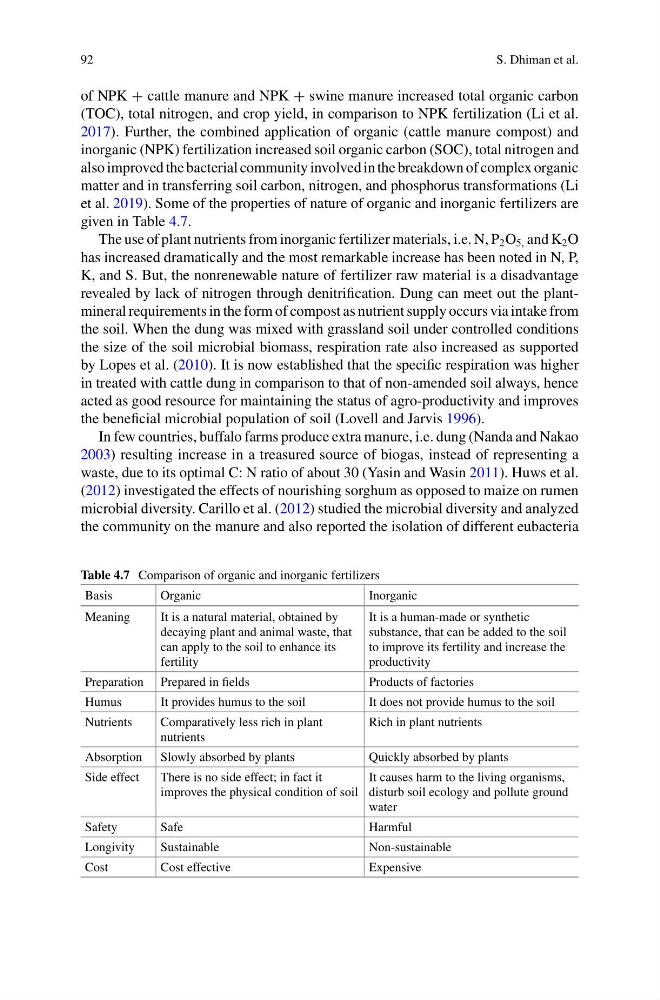
et al. 2019). Some of the properties of nature of organic and inorganic fertilizers are
given in Table 4.7.
The use of plant nutrients from inorganic fertilizer materials, i.e. N, P 2 O 5, and K 2 O
has increased dramatically and the most remarkable increase has been noted in N, P,
K, and S. But, the nonrenewable nature of fertilizer raw material is a disadvantage
revealed by lack of nitrogen through denitrification. Dung can meet out the plantmineral requirements in the form of compost as nutrient supply occurs via intake from
the soil. When the dung was mixed with grassland soil under controlled conditions
the size of the soil microbial biomass, respiration rate also increased as supported
by Lopes et al. (2010). It is now established that the specific respiration was higher
in treated with cattle dung in comparison to that of non-amended soil always, hence
acted as good resource for maintaining the status of agro-productivity and improves
the beneficial microbial population of soil (Lovell and Jarvis 1996).
In few countries, buffalo farms produce extra manure, i.e. dung (Nanda and Nakao
2003) resulting increase in a treasured source of biogas, instead of representing a
waste, due to its optimal C: N ratio of about 30 (Yasin and Wasin 2011). Huws et al.
(2012) investigated the effects of nourishing sorghum as opposed to maize on rumen
microbial diversity. Carillo et al. (2012) studied the microbial diversity and analyzed
the community on the manure and also reported the isolation of different eubacteria
Table 4.7 Comparison of organic and inorganic fertilizers
Basis
Organic
Inorganic
Meaning
It is a natural material, obtained by
decaying plant and animal waste, that
can apply to the soil to enhance its
fertility
It is a human-made or synthetic
substance, that can be added to the soil
to improve its fertility and increase the
productivity
Preparation Prepared in fields
Products of factories
Humus
It provides humus to the soil
It does not provide humus to the soil
Nutrients
Comparatively less rich in plant
nutrients
Rich in plant nutrients
Absorption Slowly absorbed by plants
Quickly absorbed by plants
Side effect
There is no side effect; in fact it
improves the physical condition of soil
It causes harm to the living organisms,
disturb soil ecology and pollute ground
water
Safety
Safe
Harmful
Longivity
Sustainable
Non-sustainable
Cost
Cost effective
Expensive
S. Dhiman et al.
of NPK + cattle manure and NPK + swine manure increased total organic carbon
(TOC), total nitrogen, and crop yield, in comparison to NPK fertilization (Li et al.
2017). Further, the combined application of organic (cattle manure compost) and
inorganic (NPK) fertilization increased soil organic carbon (SOC), total nitrogen and
also improved the bacterial community involved in the breakdown of complex organic
matter and in transferring soil carbon, nitrogen, and phosphorus transformations (Li
et al. 2019). Some of the properties of nature of organic and inorganic fertilizers are
given in Table 4.7.
The use of plant nutrients from inorganic fertilizer materials, i.e. N, P 2 O 5, and K 2 O
has increased dramatically and the most remarkable increase has been noted in N, P,
K, and S. But, the nonrenewable nature of fertilizer raw material is a disadvantage
revealed by lack of nitrogen through denitrification. Dung can meet out the plantmineral requirements in the form of compost as nutrient supply occurs via intake from
the soil. When the dung was mixed with grassland soil under controlled conditions
the size of the soil microbial biomass, respiration rate also increased as supported
by Lopes et al. (2010). It is now established that the specific respiration was higher
in treated with cattle dung in comparison to that of non-amended soil always, hence
acted as good resource for maintaining the status of agro-productivity and improves
the beneficial microbial population of soil (Lovell and Jarvis 1996).
In few countries, buffalo farms produce extra manure, i.e. dung (Nanda and Nakao
2003) resulting increase in a treasured source of biogas, instead of representing a
waste, due to its optimal C: N ratio of about 30 (Yasin and Wasin 2011). Huws et al.
(2012) investigated the effects of nourishing sorghum as opposed to maize on rumen
microbial diversity. Carillo et al. (2012) studied the microbial diversity and analyzed
the community on the manure and also reported the isolation of different eubacteria
Table 4.7 Comparison of organic and inorganic fertilizers
Basis
Organic
Inorganic
Meaning
It is a natural material, obtained by
decaying plant and animal waste, that
can apply to the soil to enhance its
fertility
It is a human-made or synthetic
substance, that can be added to the soil
to improve its fertility and increase the
productivity
Preparation Prepared in fields
Products of factories
Humus
It provides humus to the soil
It does not provide humus to the soil
Nutrients
Comparatively less rich in plant
nutrients
Rich in plant nutrients
Absorption Slowly absorbed by plants
Quickly absorbed by plants
Side effect
There is no side effect; in fact it
improves the physical condition of soil
It causes harm to the living organisms,
disturb soil ecology and pollute ground
water
Safety
Safe
Harmful
Longivity
Sustainable
Non-sustainable
Cost
Cost effective
Expensive