

3.1.1 Conformational
Restriction of the Peptide
N-Terminus
The peptide positions most important for binding are near its
C-terminus. A difficulty is that with a short, 8-residue peptide,
the N-terminus has large fluctuations, detaching and reattaching
on a 10 ns timescale. These fluctuations cannot be adequately
sampled with 100 ns MD runs. We expect they are not too dependent on mutations near the C-terminus and so it is better to
suppress them. Thus, we introduced weak, “flat-bottomed”
restraints at the peptide N-terminus, which only acted if the first
two residues moved more than 1 Å away from their starting position, as measured by their contact distances to the PDZ domain.
3.1.2 Force Field and MD
Simulations
We used the Amber force field, consistent with the highthroughput CPD stage. For PDZ domains, it is important to use
the recent ff14SB release, which gives improved helix backbone
structures. We used the TIP3P water model, which has been extensively tested in combination with the Amber force field. The combination gives excellent agreement with available X-ray structures
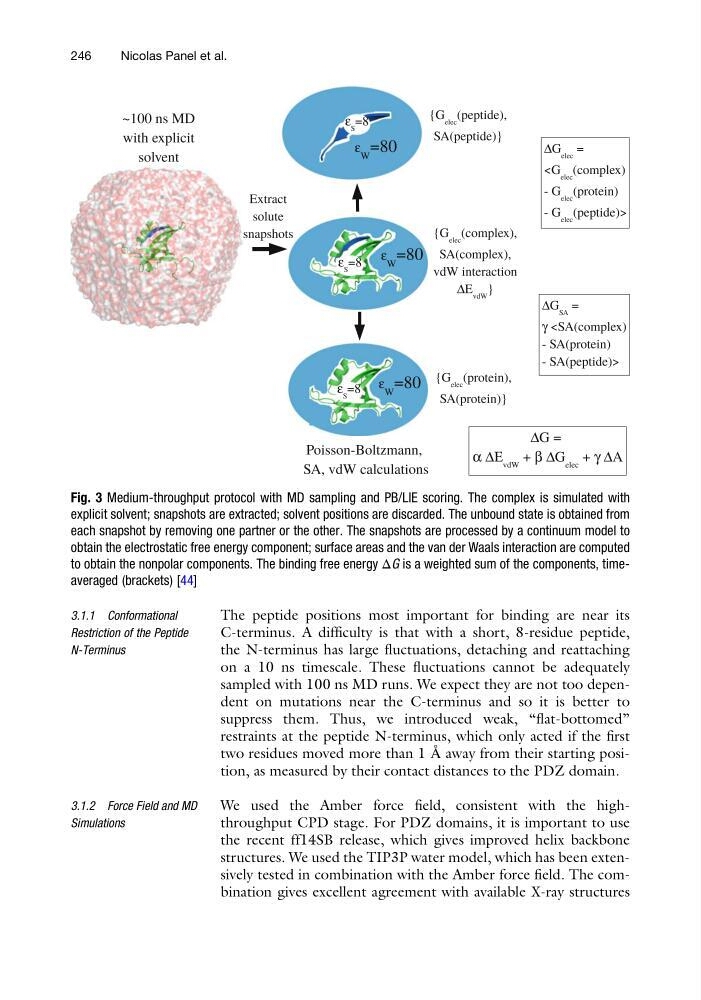
Fig. 3 Medium-throughput protocol with MD sampling and PB/LIE scoring. The complex is simulated with
explicit solvent; snapshots are extracted; solvent positions are discarded. The unbound state is obtained from
each snapshot by removing one partner or the other. The snapshots are processed by a continuum model to
obtain the electrostatic free energy component; surface areas and the van der Waals interaction are computed
to obtain the nonpolar components. The binding free energy ΔG is a weighted sum of the components, timeaveraged (brackets) [44]
246
Nicolas Panel et al.
Restriction of the Peptide
N-Terminus
The peptide positions most important for binding are near its
C-terminus. A difficulty is that with a short, 8-residue peptide,
the N-terminus has large fluctuations, detaching and reattaching
on a 10 ns timescale. These fluctuations cannot be adequately
sampled with 100 ns MD runs. We expect they are not too dependent on mutations near the C-terminus and so it is better to
suppress them. Thus, we introduced weak, “flat-bottomed”
restraints at the peptide N-terminus, which only acted if the first
two residues moved more than 1 Å away from their starting position, as measured by their contact distances to the PDZ domain.
3.1.2 Force Field and MD
Simulations
We used the Amber force field, consistent with the highthroughput CPD stage. For PDZ domains, it is important to use
the recent ff14SB release, which gives improved helix backbone
structures. We used the TIP3P water model, which has been extensively tested in combination with the Amber force field. The combination gives excellent agreement with available X-ray structures
Fig. 3 Medium-throughput protocol with MD sampling and PB/LIE scoring. The complex is simulated with
explicit solvent; snapshots are extracted; solvent positions are discarded. The unbound state is obtained from
each snapshot by removing one partner or the other. The snapshots are processed by a continuum model to
obtain the electrostatic free energy component; surface areas and the van der Waals interaction are computed
to obtain the nonpolar components. The binding free energy ΔG is a weighted sum of the components, timeaveraged (brackets) [44]
246
Nicolas Panel et al.