

experimental conditions. In agreement with the two-state
assumption, the m value and the apparent transition midpoint
should be robust and conserved at all the conditions explored.
Failure to fulfil this observation demands additional care and
can imply the presence of folding intermediates that accumulate at equilibrium.
3.2 Kinetic Studies
Kinetic folding studies are critical to understand the protein
dynamics and the mechanical details of the folding pathway. Furthermore, they are essential to address the structural properties of
folding transition states as well as in defining which amino acids are
important for the folding of a given protein.
In general, any kinetic technique implies the rapid perturbation
of the equilibrium by changing the chemical (mixing techniques) or
physical (relaxation techniques) properties of the solution containing the protein of interest.
In this section we will briefly describe the experiments obtained
on the third PDZ from PSD-95 [4], using the stopped-flow methodology, which represents the most versatile method for these types
of experiments.
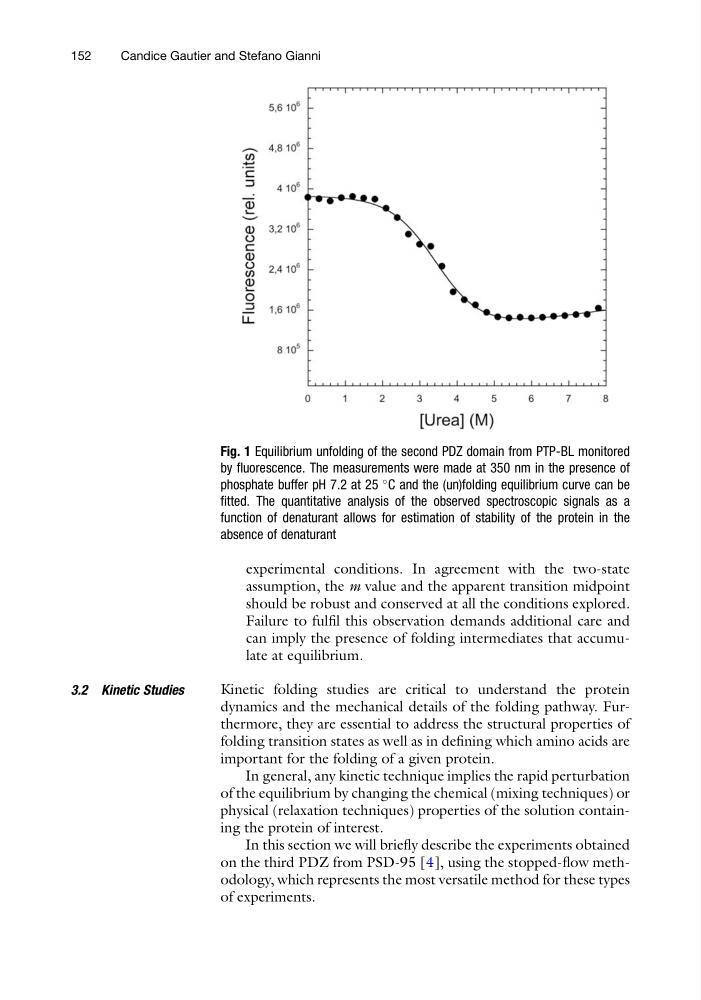
Fig. 1 Equilibrium unfolding of the second PDZ domain from PTP-BL monitored
by fluorescence. The measurements were made at 350 nm in the presence of
phosphate buffer pH 7.2 at 25
C and the (un)folding equilibrium curve can be
fitted. The quantitative analysis of the observed spectroscopic signals as a
function of denaturant allows for estimation of stability of the protein in the
absence of denaturant
152
Candice Gautier and Stefano Gianni
assumption, the m value and the apparent transition midpoint
should be robust and conserved at all the conditions explored.
Failure to fulfil this observation demands additional care and
can imply the presence of folding intermediates that accumulate at equilibrium.
3.2 Kinetic Studies
Kinetic folding studies are critical to understand the protein
dynamics and the mechanical details of the folding pathway. Furthermore, they are essential to address the structural properties of
folding transition states as well as in defining which amino acids are
important for the folding of a given protein.
In general, any kinetic technique implies the rapid perturbation
of the equilibrium by changing the chemical (mixing techniques) or
physical (relaxation techniques) properties of the solution containing the protein of interest.
In this section we will briefly describe the experiments obtained
on the third PDZ from PSD-95 [4], using the stopped-flow methodology, which represents the most versatile method for these types
of experiments.
Fig. 1 Equilibrium unfolding of the second PDZ domain from PTP-BL monitored
by fluorescence. The measurements were made at 350 nm in the presence of
phosphate buffer pH 7.2 at 25
C and the (un)folding equilibrium curve can be
fitted. The quantitative analysis of the observed spectroscopic signals as a
function of denaturant allows for estimation of stability of the protein in the
absence of denaturant
152
Candice Gautier and Stefano Gianni