

1.3.3 Analytical
Ultracentrifugation
During analytical ultracentrifugation experiment, there are no dissociating forces acting on the sample and the concentration is
constant during the all-time. However, it is more sample- and
time-consuming than SEC SLS and will require a specialist help.
An analytical ultracentrifuge allows the monitoring of the sedimentation process of a sample while moving in the centrifugal field
[23]. It will separate PDZ domains according to their sedimentation features which are linked to their size and molecular mass.
Sedimentation velocity experiments are done at high speed to
analyze the movement of the sedimenting species until all sample
collects at the bottom of the cell. Then, the experiments are analyzed using a specific algorithm such as the one used in SEDFIT and
Ultrascan [24, 25] to determine, for each species present, a sedimentation coefficient, a frictional ratio and consequently a molecular mass (Fig. 3). For each species, we will get macromolecular
shape information as well as the oligomeric state. The resolving
power of the experiment will allow to separate contaminants and
aggregates and the different oligomeric states of the PDZ. Nowadays, the detectors are really versatile and can detect sample absorption at any wavelengths between 190 nm and 600 nm, or refractive
index changes allowing measurement of PDZ samples at concentration as low as 10 μg/ml. We will not detail the technique in this
chapter. However, a good starting point for new users is the technical paper of Andrea Balbo and al [26]. The techniques will use
between 100 and 400 μl of sample at a concentration ranging from
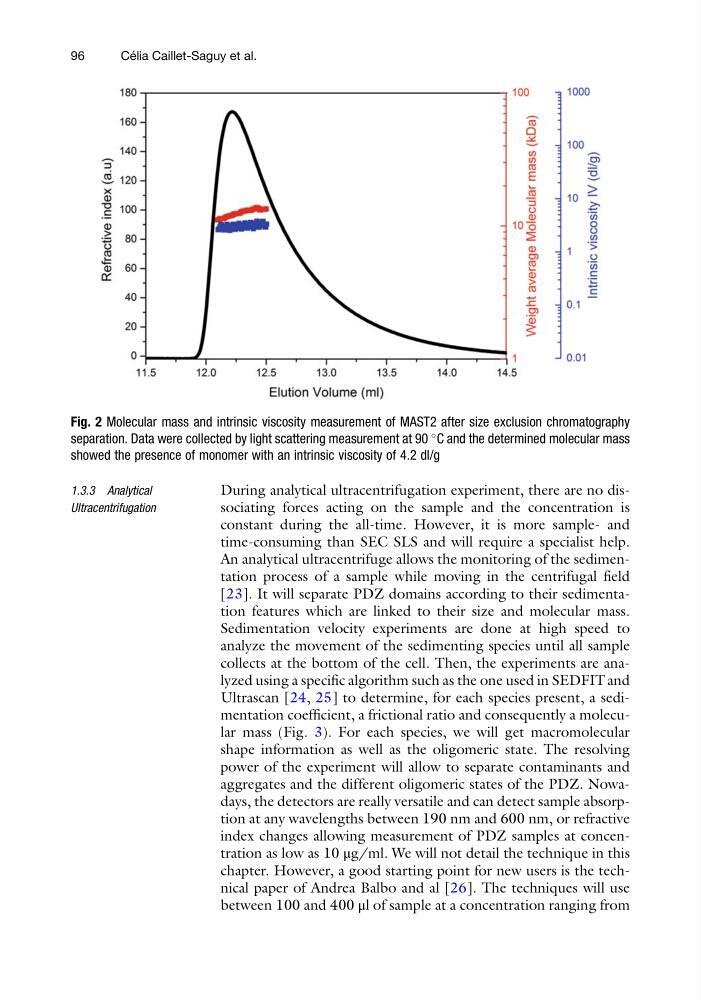
Fig. 2 Molecular mass and intrinsic viscosity measurement of MAST2 after size exclusion chromatography
separation. Data were collected by light scattering measurement at 90
C and the determined molecular mass
showed the presence of monomer with an intrinsic viscosity of 4.2 dl/g
96
Ce ´ lia Caillet-Saguy et al.
Ultracentrifugation
During analytical ultracentrifugation experiment, there are no dissociating forces acting on the sample and the concentration is
constant during the all-time. However, it is more sample- and
time-consuming than SEC SLS and will require a specialist help.
An analytical ultracentrifuge allows the monitoring of the sedimentation process of a sample while moving in the centrifugal field
[23]. It will separate PDZ domains according to their sedimentation features which are linked to their size and molecular mass.
Sedimentation velocity experiments are done at high speed to
analyze the movement of the sedimenting species until all sample
collects at the bottom of the cell. Then, the experiments are analyzed using a specific algorithm such as the one used in SEDFIT and
Ultrascan [24, 25] to determine, for each species present, a sedimentation coefficient, a frictional ratio and consequently a molecular mass (Fig. 3). For each species, we will get macromolecular
shape information as well as the oligomeric state. The resolving
power of the experiment will allow to separate contaminants and
aggregates and the different oligomeric states of the PDZ. Nowadays, the detectors are really versatile and can detect sample absorption at any wavelengths between 190 nm and 600 nm, or refractive
index changes allowing measurement of PDZ samples at concentration as low as 10 μg/ml. We will not detail the technique in this
chapter. However, a good starting point for new users is the technical paper of Andrea Balbo and al [26]. The techniques will use
between 100 and 400 μl of sample at a concentration ranging from
Fig. 2 Molecular mass and intrinsic viscosity measurement of MAST2 after size exclusion chromatography
separation. Data were collected by light scattering measurement at 90
C and the determined molecular mass
showed the presence of monomer with an intrinsic viscosity of 4.2 dl/g
96
Ce ´ lia Caillet-Saguy et al.