

according to their Stokes or hydrodynamic radius [21], with larger
molecular species eluting before smaller ones. Aggregates, contaminants, and potentially different molecular arrangements of
the protein of interest can be readily separated and quantified,
with an online concentration detection (UV or refractive index
(RI)). However, the precise quantification of the molecular mass
of each eluted species requires an online static light scattering (SLS)
detector [22], in combination with the UV or RI detector (Fig. 2).
Several types of SLS systems are available on the market with multiangle detectors or MALS (multiangle light scattering), and low
angle detectors. Their main differences are centered around the
way they extrapolate light scattering intensity at 0
to measure
molecular mass [20]. In the case of PDZ domains, both methods
will give the same result as the domain is small and the instrument
will not detect any angular dependence. However, the protein
sample will be diluted during the SEC experiment by as much as a
ten-fold factor that might alter the equilibrium between oligomeric
species. Furthermore, “inert” may the gel filtration resins be, some
proteins do interact with them, rendering SEC impossible. Finally,
for small domains such as PDZs, the gel filtration column may not
be resolute enough to separate different oligomeric states that
differ by only 10 kDa. In all these cases, the technique of choice
to measure molecular mass will be analytical ultracentrifugation.
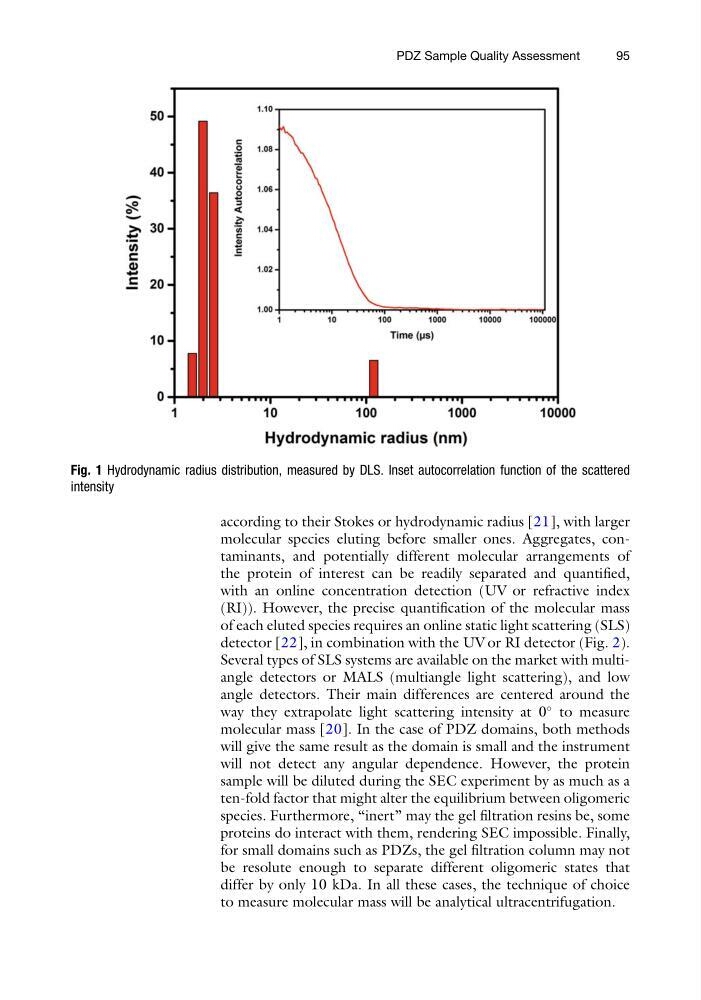
Fig. 1 Hydrodynamic radius distribution, measured by DLS. Inset autocorrelation function of the scattered
intensity
PDZ Sample Quality Assessment
95
molecular species eluting before smaller ones. Aggregates, contaminants, and potentially different molecular arrangements of
the protein of interest can be readily separated and quantified,
with an online concentration detection (UV or refractive index
(RI)). However, the precise quantification of the molecular mass
of each eluted species requires an online static light scattering (SLS)
detector [22], in combination with the UV or RI detector (Fig. 2).
Several types of SLS systems are available on the market with multiangle detectors or MALS (multiangle light scattering), and low
angle detectors. Their main differences are centered around the
way they extrapolate light scattering intensity at 0
to measure
molecular mass [20]. In the case of PDZ domains, both methods
will give the same result as the domain is small and the instrument
will not detect any angular dependence. However, the protein
sample will be diluted during the SEC experiment by as much as a
ten-fold factor that might alter the equilibrium between oligomeric
species. Furthermore, “inert” may the gel filtration resins be, some
proteins do interact with them, rendering SEC impossible. Finally,
for small domains such as PDZs, the gel filtration column may not
be resolute enough to separate different oligomeric states that
differ by only 10 kDa. In all these cases, the technique of choice
to measure molecular mass will be analytical ultracentrifugation.
Fig. 1 Hydrodynamic radius distribution, measured by DLS. Inset autocorrelation function of the scattered
intensity
PDZ Sample Quality Assessment
95