

Processes 2019, 7,97
C. difficile was already vegetative and investigated the effect of taurocholate on C. difficile growth.
Preliminary FBA calculations with the C. difficile metabolic reconstruction showed that taurocholate
uptake increased the growth rate, while taurocholate uptake was not possible with the three commensal
species reconstructions.
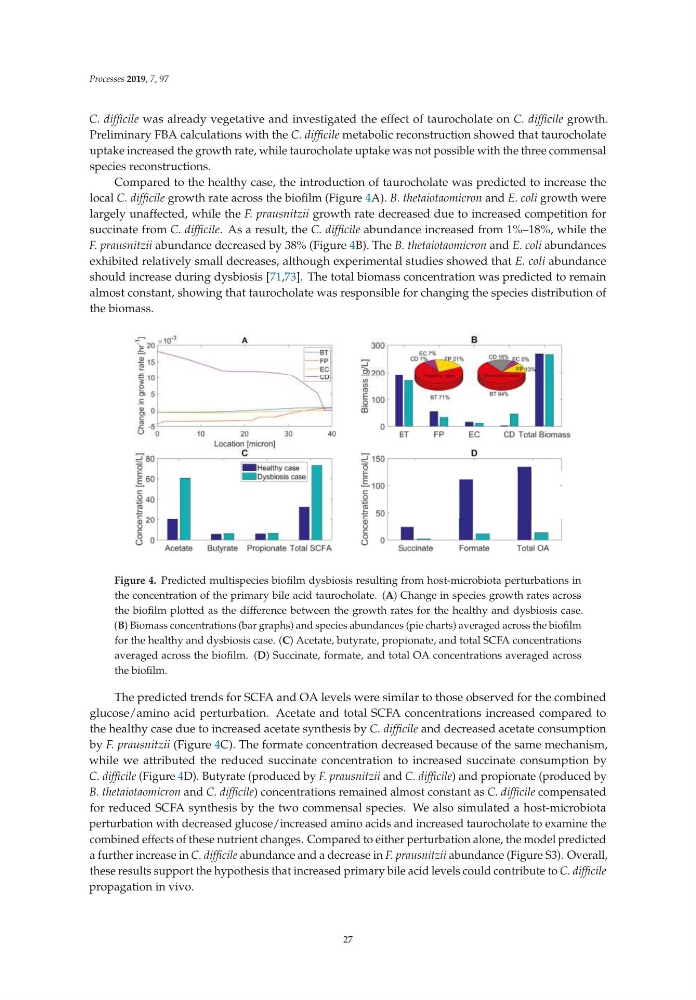
Compared to the healthy case, the introduction of taurocholate was predicted to increase the
local C. difficile growth rate across the biofilm (Figure 4A). B. thetaiotaomicron and E. coli growth were
largely unaffected, while the F. prausnitzii growth rate decreased due to increased competition for
succinate from C. difficile. As a result, the C. difficile abundance increased from 1%–18%, while the
F. prausnitzii abundance decreased by 38% (Figure 4B). The B. thetaiotaomicron and E. coli abundances
exhibited relatively small decreases, although experimental studies showed that E. coli abundance
should increase during dysbiosis [71,73]. The total biomass concentration was predicted to remain
almost constant, showing that taurocholate was responsible for changing the species distribution of
the biomass.
Figure 4. Predicted multispecies biofilm dysbiosis resulting from host-microbiota perturbations in
the concentration of the primary bile acid taurocholate. (A) Change in species growth rates across
the biofilm plotted as the difference between the growth rates for the healthy and dysbiosis case.
(B) Biomass concentrations (bar graphs) and species abundances (pie charts) averaged across the biofilm
for the healthy and dysbiosis case. (C) Acetate, butyrate, propionate, and total SCFA concentrations
averaged across the biofilm. (D) Succinate, formate, and total OA concentrations averaged across
the biofilm.
The predicted trends for SCFA and OA levels were similar to those observed for the combined
glucose/amino acid perturbation. Acetate and total SCFA concentrations increased compared to
the healthy case due to increased acetate synthesis by C. difficile and decreased acetate consumption
by F. prausnitzii (Figure 4C). The formate concentration decreased because of the same mechanism,
while we attributed the reduced succinate concentration to increased succinate consumption by
C. difficile (Figure 4D). Butyrate (produced by F. prausnitzii and C. difficile) and propionate (produced by
B. thetaiotaomicron and C. difficile) concentrations remained almost constant as C. difficile compensated
for reduced SCFA synthesis by the two commensal species. We also simulated a host-microbiota
perturbation with decreased glucose/increased amino acids and increased taurocholate to examine the
combined effects of these nutrient changes. Compared to either perturbation alone, the model predicted
a further increase in C. difficile abundance and a decrease in F. prausnitzii abundance (Figure S3). Overall,
these results support the hypothesis that increased primary bile acid levels could contribute to C. difficile
propagation in vivo.
27
C. difficile was already vegetative and investigated the effect of taurocholate on C. difficile growth.
Preliminary FBA calculations with the C. difficile metabolic reconstruction showed that taurocholate
uptake increased the growth rate, while taurocholate uptake was not possible with the three commensal
species reconstructions.
Compared to the healthy case, the introduction of taurocholate was predicted to increase the
local C. difficile growth rate across the biofilm (Figure 4A). B. thetaiotaomicron and E. coli growth were
largely unaffected, while the F. prausnitzii growth rate decreased due to increased competition for
succinate from C. difficile. As a result, the C. difficile abundance increased from 1%–18%, while the
F. prausnitzii abundance decreased by 38% (Figure 4B). The B. thetaiotaomicron and E. coli abundances
exhibited relatively small decreases, although experimental studies showed that E. coli abundance
should increase during dysbiosis [71,73]. The total biomass concentration was predicted to remain
almost constant, showing that taurocholate was responsible for changing the species distribution of
the biomass.
Figure 4. Predicted multispecies biofilm dysbiosis resulting from host-microbiota perturbations in
the concentration of the primary bile acid taurocholate. (A) Change in species growth rates across
the biofilm plotted as the difference between the growth rates for the healthy and dysbiosis case.
(B) Biomass concentrations (bar graphs) and species abundances (pie charts) averaged across the biofilm
for the healthy and dysbiosis case. (C) Acetate, butyrate, propionate, and total SCFA concentrations
averaged across the biofilm. (D) Succinate, formate, and total OA concentrations averaged across
the biofilm.
The predicted trends for SCFA and OA levels were similar to those observed for the combined
glucose/amino acid perturbation. Acetate and total SCFA concentrations increased compared to
the healthy case due to increased acetate synthesis by C. difficile and decreased acetate consumption
by F. prausnitzii (Figure 4C). The formate concentration decreased because of the same mechanism,
while we attributed the reduced succinate concentration to increased succinate consumption by
C. difficile (Figure 4D). Butyrate (produced by F. prausnitzii and C. difficile) and propionate (produced by
B. thetaiotaomicron and C. difficile) concentrations remained almost constant as C. difficile compensated
for reduced SCFA synthesis by the two commensal species. We also simulated a host-microbiota
perturbation with decreased glucose/increased amino acids and increased taurocholate to examine the
combined effects of these nutrient changes. Compared to either perturbation alone, the model predicted
a further increase in C. difficile abundance and a decrease in F. prausnitzii abundance (Figure S3). Overall,
these results support the hypothesis that increased primary bile acid levels could contribute to C. difficile
propagation in vivo.
27